
Politics
Nigeria: From NNDP To APC
One indisputable fact here is that Nigeria has had some worst experiences in the area of party system.


Nigeria was 56 at the
weekend as a corporate nation. But for the prevailing economic recession which has ostensibly and brutally taken its toll on many a hapless citizen of this beleaguered nation, great pomp and panoply would ordinarily have hallmarked this day, given the psychic income it has offered: Self rule.
Yet not a few Nigerians believe that self rule which the founding fathers strove assiduously to achieve through the party system, even at the risk of their personal freedom has hardly moved the Nigerian nation from where the British colonial interlopers left it.
Indeed, there is hardly anything significant on the credit of our balance sheet as a sovereign nation to warrant any celebration, given its very sorry and tragic socio-economic state which defies every pill aimed at reviving it; a condition worse than the Biblical seven-year lean period of the Egyptians.
Worse still, national unity which the nation’s founding father envisaged at independence has continued to elude us to the extent that everything that the Nigerian nation has tried its hand on since then has failed.
And the fact that the event was marked under the leadership of Muhammadu Buhari’s All Progressives Congress (APC) which change mantra has so far woefully failed to ameliorate the anguish of Nigerians but worsened their misery, not a few Nigerians have been pondering about the future of party politics in Nigeria, and its desirability.
One indisputable fact here is that Nigeria has had some worst experiences in the area of party system.
At the outset, through the first republic, the second republic, the aborted third republic and the present republic, the system has placed premium on trivialities and sectionalism at the expense of issues critical to national unity, cohesion and progress necessary for the much-needed development of the nation. This is moreso as the system has, most of the times, thrown up politicians some of whom are ever so narrow-minded that they fail to see the map whole, upon assumption of leadership, only to pursue their narrow interest.
In an analysis of the role of politicians in the failure of the first attempt by Nigerians at self rule through elected representatives, former Governor of Old Oyo State and an active participant in the First and Second Republic Politics, Chief Bola Ige had, in his Politics and Politicians of Nigeria, written of how the NCNC, AG and NPC dominated the pre and post independence politics of Nigeria thus: “The Three parties gave the public the impression that they were engaged in some game of wit, and that all that one needed to do was to out manouvre the other. The issue of paramountcy of Nigeria’s interest was not even raised, not to talk of its being emphasized. As far as our leaders were concerned, there was an over-personalisation of issues. They made things look like the fight for spoils of office, not service to Nigeria. Even Awo, the most radical and single-minded of them all, saw the pursuit of power for the AG as synonymous with personal ambition, or aspiration as he would call it.”
Corroborating Ige’s views on Awolowo in his The Making of Nigeria and her 4th Republic, Jubril Martins-Kuye wrote of Awo: “The National election should be the ultimate or apex of his involvement, provided that if he does not get what he wants, he should not abandon the base of his aspiration”.
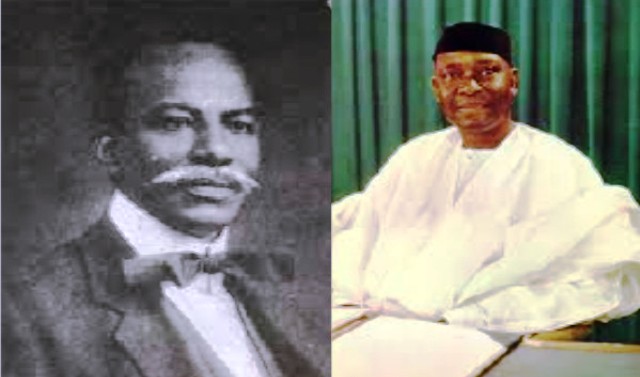
Nonetheless, as we appraise the party system in the 56 years of our tortuous journey to nationhood, it becomes imperative to go back to the colonial era precisely in 1923, when some emerging indigenous agitated elites led by the late foremost nationalist, Herbert HeeLas Macaulay formed the first political party, the Nigeria National Democratic Party ( NNDP) as a response to the need to form an organised pressure group against the colonialists. Peopled by such first set of elite Professionals as Sir Adeyemo Alakija, Mr Eric Moore, Dr C. C. Adeniyi Jones, Mr Ernest Sisei Ikoli, Mr Egerton Shyngle, Mr Winter Shackleford and Mr J. Clinton, the NNDP operated mainly in the Lagos Colony with Macaulay’s Daily News as its mouth piece.
However, in 1934, the ever growing population of Nigerian educated elites which included such nationalists as Dr Nnamdi Azikiwe, Chief Obafemi Awolowo, Chief Hezekiah Oladipo Davies, Oba Samuel Akinsanya among others formed the Nigerian Youth Movement (NYM) as an alternative plafform for political agitation. By 1937, it had become an all embracing political platform for Southern Nigeria. This was vividly seen when Ikoli , an Ijaw and Akinsanya, a Yoruba were vying for the post of NYM’s Secretary –General. While Azikiwe’s West African Pilot employed cheap blackmail in support of Akinsanya, who was dubbed “Ijebu Ike” to spite the Yorubas supporting Ikoli, Awolowo mustered support for Ikoli who eventually won.
Sequel to the crisis that rocked the NYM, the National Council of Nigeria and Cameroons (NCNC) was formed in 1944 with Macaulay and Zik as President and Secretary-General respectively. Its major objective was to create a vanguard for nationalist struggle and to source for funds to dispatch a delegation to England to oppose certain “obnoxious bills”.
The delegation comprising of Zik, Dr Ibikunle Olorunmibe, Prince Adelekan Adedoyin, Zama Bukar Dipcharima, Za’ad Zungur and Mrs Funmilayo Ransome Kuti eventually went to England but returned home without any significant success, freely accusing one another.
Zik who became National President after Macaulay’s death was to later form an alliance with Northern Elements Progressive Union (NEPU) which membership included Aminu Kano, Tanko Yakassai, Danbazau, Bello Ijumu and other followship restricted to Kano and Zaria. But Zik’s preference for Unitary system of government rendered NCNC unpopular in the North and in the West’s hinterland. However, in 1962, the party came up with the political philosophy of pragmatic socialism.
As the search for more vibrant platform for nationalist agitation continued, a group of British-trained Yoruba elites which included Awolowo and some traditional rulers, in 1948 came together and formed Egbe Omo Oduduwa to promote Yoruba irredentism prefratory to entrenching the hitherto unexisting grassroot consciousness amongst the yorubas most of whom were largely Zikists. So by the time the Egbe gave impetus to the formation of the AG in 1951 with Awo’s philosophy as contained in his Path To Nigerian Freedom (1948), Awolowa had already stretched his tentacles to all nook and crannies of the Western Region to the extent that many Zikists and other Yoruba politicians who are had not been convinced Zikists joined the AG which political ideology was democratic socialism. This development was to later force Zik to relocate its political base to the Eastern region, thus lending credence to the accusation that Awo actually introduced ethnicity into Nigerian politics. Nevertheless, AG’s idea of free education at the primary school level, free health for people below 18 years, modernization of agricultural system among others, endeared it to the people.
Moved by the need to create a platform to pursue and protect the interest of the North in an emerging Nigerian scenario, especially in the face of then political aggressiveness of Southern leaders, a group of Northern educated elites which included Sir Ahmadu Bello (who later became premier of the region), Sir Abubakar Tafawa Balewa, Alhaji Muhammadu Ribadu, Alhaji Inuwa Wada and Dr R.A.B. Dikko congregated in 1949 to form the Northern People’s Congress (NPC) which awarded scholarships to many Northern students and invested heavily in agriculture as a way of economically empowering the masses of its people.
Apart from the Aminu Kano radical NEPU formed two years before the NPC, the Joseph Tarka’s United Middle Belt Congress (UMBC) and the Abubakar Imam’s Borno Youth Movement (BYM) were the other political parties in the first Republic. The UMBC was so popular in the area now known
as the Middle Belt that it won 25 parliamentary seats which it later turned to its allies, the AG- a development that irked Bello till his death from assassin’s bullet January 15, 1966.
To avoid a repeat of the First Republic experience in which the NCNC, NPC and AG held sway in their respective strongholds, the military which was planning to return power to civilians in 1978 decided to regulate the emergence of political power by insisting that such new parties must have nationwide spread in terms of membership, leadership and presence of party secretariats.
In strict adherence to the conditionalities set by the Federal Electoral Commission (FEDECO), only five parties were registered in 1978, viz-the National Party of Nigeria (NPN), the Unity Party of Nigeria (UPN), the Nigerian Peoples Party (NPP), the Great Nigerian Peoples Party (GNPP) and the Peoples Redemption Party (PRP). However, in 1982, an additional party, the Nigerian Advance Party (NAP) was registered as the sixth party in a move observers say was intended to challenge the domineering influence of Awo and the UPN in the West.
The NPN, an offshoot of the defunct NPC, was a conservative party with tremendous spread and notable personalities such as Alhaji Shehu Shagari who was later elected President, Chief Adisa Akinloye, the National Chairman, Mallam Adamu Ciroma, Alhaji Uba Ahmed, Alhaji Shettima Ali Monguno, Alhaji Isa Kaita, Chief Richard Akinjide, Senator Olusola Saraki, Senator Victor Akan, Senator Joseph Tarka and many others.
With provision of cheap food and housing for all as its manifesto, it won elections in Sokoto, Niger, Benue, Kwara, Bauchi, Rivers and Cross Rivers.
On its part, the UPN was an AG incarnate. Strictly ideological and well organized by its Chairman and Presidential candidate, Chief Awolowo, it sold four cardinal programmes of free education, free health, rural integration and urban development, winning in Ogun, Oyo, Ondo, Lagos and Bendel States that made up the old Western Region. Its prominent members included Alhaji Lateef Jakande, Chief Adekunle Ajasin, Chief Bola Ige, Chief Udoakaha Jacob Esuene, Senator Abraham Adesanya, Alhaji Mohammed Kura, Senator Jonathan Odebiyi, Prof Ambrose Alli, Chief M.C.K. Ajuluchukwu and many others. It provided stiff opposition to the NPN, controlled federal government.
The NPP, a centrist reincarnation of the defunct NCNC, had its root in the old Eastern Region and won in the old Anambra, Imo and Plateau States led by Dr Nnamdi Azikiwe. It paraded such personalities as Chief Adeniran Ogunsanya (chairman), Chief Sam Mbakwe, Dr Paul Unongo, Chief Solomon Lar, Chief Jim Nwobodo, Chief R.B.K. Okafor among others.
The GNPP led by wealthy business mogul, Alhaji Ibrahim Waziri, its Presidential Candidate, was a breakaway faction of NPP with roots in the old BYM, hence it won in Borno and Gongola States.
The left wing radical PRP led by Mallam Aminu Kano, on its parts, was a derivative of the old NEPU that paraded such big wigs as Alhaji Balarabe Musa, Alhaji Abubakar Rimi, Alhaji Barkin Zuwo, Chief Michael Imoudu, Prof Wole Soyinka, among others.
The NAP led by Dr Tunji Braithwaite was largely peopled by youths and did not win any seat in the 1983 elections despite its avowed commitment to chase “mosquitoes, rats, cockroaches, leeches and other reptiles and insects it believed were retarding the growth of the nation.
The Ibrahim Babangida administration which had since taken over from the civilians had to introduce a novel idea. It rejected the application of 13 political associations seeking to become parties, created two parties-the National Republican Convention (NRC) and the Social Democratic Party (SDP) and asked politicians wishing to contest elections to join either of them.
The NRC which was a “little to the Right” platform for core conservatives and right wing liberals was very popular in South South, South East and core North as it won elections in these areas, Chief Tom Ikimi and Dr Ahmed Kusauotu were, at various times, its chairman while its presidential candidate was Alhaji Bashir Tofa from Kano State.
The SDP which was the “little to the Left” of the Centre party accommodated the membership of the Second Republic welfarist parties – UPN, NPP, PRP and GNPP – and was firmly rooted in the South West, North-East and North Central where it won elections. Its National Chairman were Ambassador Baba Gana Kingibe who was Chief MKO Abiola’s running mate in the 1993 election won by Abiola but later annulled by the military, and Chief Tony Anenih.
When General Sani Abacha took over from General Babagida who had ‘stepped aside’ for Ernest Shonekau’s Interim National Government, he scrapped the two parties and allowed the formation and subsequent registration of parties that were not a threat to his administration.
Consequently, five parties aptly dubbed five fingers of a leprous hand by Chief Bola Ige-the United Nigeria Congress Party (UNCP), the Democratic Party of Nigeria (DPN), the National Centre Party of Nigeria (NCPN), the Congress for National Concensus (CNC) and the Grassroots Democratic Movement (GDM), were registered.
Clearly an inglorus era in party politics in Nigeria, the UNCP led by Alhaji Isah Mohammed, the DPN by Alhaji Saleh Ahmed, the NCPN by Alhaji Magaji Abdullahi, the CNC by Chief Barnabas Gemade and the GDM by Alhaji Gambo Lawan later adopted Abacha as its concensus candidate for the presidential election planned for 1998.
After the death of those parties with General Abacha, the General Abdulsalam Abubakar government set out another guideline for the registration of political parties. Ultimately, three parties, the All Peoples Party (APP), the Alliance for Democracy (AD) and the Peoples Democratic Party (PDP) were registered for the 1999 general elections from among the over 10 political associations that applied for registration. While AD, largely populated by those who fought Abacha under the aegis of the National Democratic Coalition (NADECO), won overwhelmingly in South West, the APP swept the polls in the far North and the Middle Belt States claiming 36 governors and 26 of the 109 Senators and got enmeshed in crisis thereafter.
It is worthy of mention here that both the AD and APP fielded Chief Olu Falae and Alhaji Umaru Shinkafi as Presidential candidate and running mate respectively in a joint ticket which they lost to the Peoples Democratic Party (PDP) candidate at the 1999 polls, Chief Olusegun Obasanjo.
The PDP has its root in the G-34 comprising of top Second Republic politicians in such defunct groups as the ANC, the Peoples Democratic Movement (PDM) Peoples National Front among several other groups. The obviously behemoth party led Chief Solomon Lar dwarfed the other two parties, making impressive showings in the South-South, South East and North Central States and sharing the North-East and the North-West with the APP.
Under its rotation formula, Obasanjo got the Presidential ticket and eventually elected president, while it garnered 21 of the 36 states with majority in the National Assembly. The PDP continued its winning streak, electing Umaru Musa Yar’Adua whose death paved the way Dr Goodluck Jonathan to serve for six years as president before his defeat in the 2015 general elections by the All Progressives Congress (APC).
Presently, the PDP is a weak opposition party to the APC, led Federal Government, having been embroiled in leadership crisis. The APC on its part has been battling rather unsuccessfully to fulfill its campaign promises woven around its change mantra which the electorate believe is a hoax.
It must noted here that despite PDP’s loss in the 2015 polls, the party remains the closest Nigeria has got to in the notion of a strong party in its 83 years experience in party system. And with the APC currently enmeshed in crisis ahead the 2019 elections, the PDP may well rise again from the ashes of defeat and despondency to retrieve its honour and take its pride of place in party politics in Nigeria.
Victor Tew


The Independent National Electoral Commission (INEC) has extended the deadline for political parties to submit the list of candidates for the 2027 governorship and state Houses of Assembly elections from Saturday, August 8, to Tuesday, August 11, 2026.
The commission announced the extension in a statement issued on Saturday and signed by the National Commissioner and Chairman of its Information and Voter Education Committee, Mohammed Haruna.
According to INEC, the decision followed appeals by political parties for additional time to complete the submission process through the dedicated online portal.
“The submission window, which according to the revised Timetable and Schedule of Activities for the General Election was originally scheduled to close on Saturday, 8th August, 2026, has been extended to Tuesday, 11th August, 2026,” the commission said.
In a a related development, INEC announced the suspension of PVC collection in Osun State ahead of the August 15 governorship election.
The commission said voters who applied for replacement of lost, damaged or defaced Permanent Voter Cards would have until midnight on Sunday, August 9, to print downloadable copies of their cards.
The electoral body explained that the deadline was necessary to enable it compile data on downloaded PVCs and produce final statistics on the total number of cards collected ahead of the election.
INEC said PVC collection in Osun commenced at the Registration Area level from July 22 to 28, 2026, but was extended to July 31 following complaints about large crowds and difficulties experienced by voters at collection centres.
The exercise subsequently moved to the local government level and ran from August 1 to 7.
The commission also disclosed that replacement downloadable PVCs had been made available to voters in Odo-Otin and Ife Central Local Government Areas following the theft of cards during attacks on the two collection centres.
It stressed that the stolen cards could not be used to vote.
INEC reassured Osun residents of its preparedness for the August 15 governorship election.
“The commission reiterates that the stolen cards cannot be used to vote.
“INEC reassures the people of Osun State of its readiness to conduct a free, fair, credible and inclusive governorship election on 15th August, 2026,” the statement said.
The commission said the deadline, initially set for Saturday, 8 August, has been extended to Tuesday, 11 August 2026, following appeals from political parties for more time.
INEC also announced that the window for voters who applied to replace lost, damaged or defaced PVCs to download their replacement cards will close at midnight on Sunday, 9 August.
The move is to enable the commission compile final PVC collection figures ahead of the 15 August Osun governorship election.
INEC said replacement downloadable PVCs have also been provided to affected voters in Odo-Otin and Ife Central Local Government Areas after hoodlums carted away cards from two collection centres, stressing that the stolen cards cannot be used to vote.
The commission reaffirmed its readiness to conduct a free, fair, credible and inclusive election in Osun State.
Gov. Kefas made the remarks over the weekend at the Federal Medical Centre (FMC), Jalingo, during the flag-off of the second phase of the Renewed Hope Medical Outreach in Taraba State, organised as part of activities marking Prof. Yilwatda’s 58th birthday.
The governor commended Prof. Yilwatda for choosing to mark his birthday by providing medical care to people in need.
“What Professor Nentawe did is a powerful demonstration of what leadership should be,” Gov. Kefas said.
He assured that his administration would continue to support initiatives that complement government efforts to improve healthcare delivery and the wellbeing of residents.
Speaking at the event, Prof. Yilwatda called on Nigerian leaders to embrace the culture of giving and use their positions to touch the lives of the less privileged.
He said his decision to celebrate his 58th birthday in Taraba State was deliberate and informed by the needs of underserved communities, particularly people who face difficulties accessing healthcare because of distance and financial constraints.
According to him, the intervention followed a needs assessment and was extended across the three senatorial districts of the state.
He said the exercise commenced on August 3 at Takum General Hospital and covered the Federal University Teaching Hospital, Wukari; First Referral Hospital, Sunkani, Ardo-Kola Local Government Area; General Hospital, Bali; General Hospital, Gembu; and FMC Jalingo.
Prof. Yilwatda said the intervention provided medical services to thousands of beneficiaries, including people who required surgical procedures.
He said sustainable national development could only be achieved when strong institutions placed Nigerians at the centre of development.
“Leadership is about service,” he said, urging political and public leaders to make giving back to society an important part of their responsibilities.
He reaffirmed his commitment to serving Nigeria and its people, saying his personal vision was to make every day of his life useful to humanity.
“Every day that I live, the vision is: let it be useful to humanity,” he said.
The Taraba State Commissioner for Health, Dr. Bordiya Buma, commended the initiative, saying it was consistent with the Renewed Hope agenda and efforts to strengthen healthcare delivery in the state.
Dr Buma said the second phase followed the successful completion of the first phase, which was conducted simultaneously in six local government areas, with two LGAs selected from each of the three senatorial districts.
According to him, more than 10,000 patients were attended to during the first phase, including people with medical and surgical conditions.
He disclosed that 327 general surgeries, 71 eye surgeries and 575 dental procedures were carried out during the exercise.
The commissioner expressed appreciation to President Bola Tinubu for the Renewed Hope Medical Outreach and thanked Prof. Yilwatda for supporting the initiative and choosing Taraba State as a beneficiary.
The Minister of Health and Social Welfare, Prof. Muhammad Ali Pate, also commended Prof. Yilwatda for choosing Taraba State to mark his 58th birthday through a medical outreach.
Prof. Pate said making healthcare the centrepiece of the birthday celebration was significant because health affects everyone.
-

 News2 days ago
RSG Targets Nine Million Residents in Mosquito Net Distribution Campaign
-

 Oil & Energy1 day ago
Aiyedatiwa Signs New Electricity Bill
-

 Oil & Energy1 day ago
NLNG Commissions Research And Innovation Centre In RSU
-

 Maritime1 day ago
Marine Minister Commends President Tinubu On NPERA Bill Assent
-

 News2 days ago
KenPoly Holds Eight Convocations, August 29
-

 News2 days ago
RSG Begins Another Phase of Projects Commissioning Today
-

 News2 days ago
RMAFC Completes Revenue Sharing Review, Proposes New Pay
-

 Maritime1 day ago
NAGAFF Petitions IGP Over Alleged Maritime Police Harassment