
News
N’Delta Leaders Reject FG’s $10bn Dev Package …As Talks Begin,’Morrow

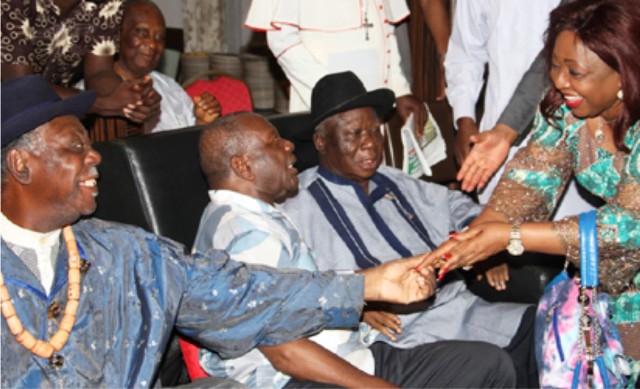
Ahead of their meeting with President Muhammadu Buhari, tomorrow, strong indications emerged, yesterday, that elders, leaders and stakeholders of the Niger Delta Region have rejected the Federal Government’s move to launch a $10 billion (N4 trillion) infrastructural rebirth investment programme in the area.
The multi-trillion naira programme is part of the Short and Medium Term Priorities to Grow Nigeria’s Oil and Gas Industry (2015 to 2019), tagged the ‘7 BigWins’, a new initiative of the Ministry of Petroleum Resources.
Dismissing the proposal as a blackmail since there is no money to fund it, the Niger-Delta leaders said it is imperative to tell President Buhari that they are rejecting the move because it is private sector-driven with the aim of dragging the government into it.
. “At the end of the day, other Nigerians will say why complain when you have $10 billion and the money is not there in the first place. If the companies have such money, they should pay the money owed the Niger Delta Development Commission, NDDC, rather than blackmail the region with such money,” they said.
These are part of the issues that would be raised with President Buhari tomorrow. These were also some of the resolutions at the end of a meeting held at the residence of the convener, Chief Edwin Clark at his 43, Haile Selassie Street, Asokoro, Abuja in the wee hours of Saturday.
Clark, a former Federal Commissioner for Information and South-South leader, will lead about 46 traditional rulers, elders and leaders drawn from the academia, civil society, freedom fighters and ethnic nationalities of the six South-South states to meet President Buhari tomorrow.
The leaders said it would be blackmail for the people of the Niger Delta as they were not consulted before the decision was taken and announced, adding that the people should have been carried along and their inputs obtained because they know the problems of the region.
Canvassing a bottom-up approach instead of a top-bottom strategy, the leaders noted that the people of the region are suffering from oil exploitation, while mining is going on in the North without anyone harassing the people.
The elders also urged President Buhari to jettison moves to change the Maritime University, Okerenkoko, Gbaramatu, Delta State to a polytechnic, against the backdrop that the government did not consult with the people of the region.
The region is also seeking for a special Marshal Plan for the Niger Delta, review of the amnesty programme and the need to have a ministerial department that will always be a platform for discussion by the people of the region.
The elders and leaders at the meeting will engage the President on the need for justice, equity, fairness, confidence-building and consultations with Niger-Delta people prior to taking decisions on their problems.
Other issues to be raised at the parley include the need for restructuring the country and the zone; implementation of the 2014 National Conference report, the Petroleum Industry Bill, PIB, appointments of board of the Nigerian National Petroleum Corporation, NNPC where membership must reflect oil producing areas, and the need to perfect the protocol of memorandum of understanding, MOU on the ceding of Bakassi, because if not addressed, the people of the area stand the risk of not having a country.
The problem in Gbaramatu with military allegedly harassing the people would also be presented before the President. After tomorrow’s meeting, the elders and leaders will ask for an executive session with the President where meaningful discussions would take place.
Clark In his remark at the meeting, noted that the issue of not having representatives to negotiate with government for Niger Delta people was gone, saying the people are ready for negotiation.
He said if there were issues, the meeting will not be the last, adding that the people are one family, though they are from different communities. The elder statesman, who stressed the need for unity of purpose, said the people were not fighting the President but wanted government to carry them along. His words: “We are going to ask for justice, fairness and equity. We are going to tell him that he should dialogue with the people of the Niger Delta and that the use of force is not and cannot be a solution to the Niger Delta crisis.
“He is our President. We will pledge our loyalty to him. We will congratulate him on his election because this is the first time we are seeing him as a people since he won. We are not going to submit any long list of demands to him, but we will let him know the need for him to carry the people of Niger Delta along in his government.
They should take us as a people who are part of Nigeria. We are not separating from Nigeria. “It is obvious that the country requires true federalism to move forward. We will tell him that and that is the same thing other parts of the country are asking for. If there is true federalism, we will not have a case of states not being able to pay salaries or maintain themselves. Those (states) that cannot stand on their own will join others. “Of course, we are going to talk to him about the need to develop Niger Delta.
The problem is not lack of ideas on what should be done, Report on Niger Delta in 2009 and others are there; the problem is lack of political will to develop the region.” Before the Saturday meeting, Niger Delta leaders and stakeholders, to enable them speak with one voice, came up with a position against those who they accused of using divide and rule tactics against the region. They decided to fuse all the separate groups into one umbrella body, Pan-Niger Delta Forum, PNDF.
The groups included the Pan-Niger Delta States Consultative Forum, led by Clark, the Niger Delta Dialogue and Contact Group, NDDCG, led by King Alfred Diete-Spiff, and a new group that was facilitated by the Minister of Transportation, Mr. Rotimi Amaechi. Other groups that collapsed into the PNDF were the Traditional Rulers of Oil Mineral Producing Communities of Nigeria, TROMPCON, Host Communities of Nigeria Producing Oil and Gas, HOSTCOM, Initiative for Peace, Governance and Development, South-South Consolidated Forum among others.
“The insincerity on the part of the Federal Government is capable of escalating the already volatile situation in the Niger Delta despite the efforts of leaders and stakeholders of the region.
“The insincerity of the federal government is further buttressed by the much publicized $10bn intervention fund for the Niger Delta. The way and manner government publicized this intervention fund would seem as if the fund would be released instantly to start the development process, whereas it is a 10-year initiative with no guaranteed source of funding. All the identified sources of funding are vague and unpredictable without stakeholders’ input.
Therefore, the IYC regards this effort more as a propaganda strategy by the Federal Government rather than a genuine effort towards the development of the Niger Delta region.” It’s ridiculous, insulting – Gbenekema Chief Gbenekama, the Ibe Benemowei of Gbaramatu kingdom, who spoke on phone to Vanguard from Abuja, said: “It has come to our knowledge that on October 27, 2016, the Federal Government launched a book entitled ‘7 Big Wins to grow the oil sector,’ as presented by the Minister of State for Petroleum, Dr Ibe Kachikwu. “Among these ‘7 big wins’ is the issue of Niger Delta and Security.
Under Niger Delta and Security, we discovered that one item is the Okerenkoko Maritime University. In presenting the decision of the Federal Government, Dr Ibe Kachikwu stated that the Ministry of Petroleum has taken over the issue of Okerenkoko Maritime University and that the government had decided to reduce the Okerenkoko Maritime University, which was a degree awarding university to a polytechnic that will award OND and HND. “This presentation was sanctioned by the President of the Federal Republic of Nigeria, Muhammadu Buhari. As critical stakeholders and immediate host to the Maritime University, Okerenkoko, we find this presentation and plan annoying, disturbing, disgraceful, insulting and dehumanizing.
“The issue of the Okerenkoko Maritime University was supposed to be a pre-Niger Delta, Federal Government parley agenda, which was part of the low-hanging fruits that the Federal Government was supposed to deal with to build trust before the Niger Delta leaders and Federal Government discussions and signpost that government will be serious with the discussions, but to our surprise, without consultations, the government has gone ahead to take a decision reducing the university to a Petroleum Ministry- run polytechnic that would award OND and HND certificates.
“Whatever would have gone wrong with the maritime university that made the Federal Government to reduce the status to a polytechnic is what any serious minded Niger Deltan and Gbaramatu man in particular cannot understand. For avoidance of doubt, we reject this plan of the Federal Government.
“We are not good enough to be educated, our areas is not good enough to be developed, both infrastructural and human capital development, which is the reason the federal, through its militarization policy of the Niger Delta has rendered all our primary and secondary schools ineffective. The height of it is to cancel the Maritime University which the immediate past administration sited at Okerenkoko with take-off campus at Kurutie in Gbaramatu kingdom,” he said. Militants continue bombing despite Buhari’s meeting with N-Delta leaders Meanwhile, the Niger Delta Greenland Justice Mandate, NDGJM, a militant group in Delta State, went ahead with destruction of oil facilities in Niger Delta region, weekend, despite the meeting tomorrow, between President Buhari and Niger Delta monarchs, leaders and stakeholders in Abuja.
The group, in a statement by self-styled General Aldo Agbalaja, yesterday, said: “At about 23:30 hours of Saturday, October 29, in furtherance of the Operation Hammurabi Code, our Akuma Strike Team struck and brought down the 32-inch Effurun-Otor delivery line.”


The Rivers State chapter of the All Progressives Congress Christian Leaders Forum has expressed strong confidence in the capacity of All Progressives Congress (All Progressives Congress) candidates in the state to deliver effective governance if elected into office in the coming elections.
The State Coordinator of the forum, Archbishop Lucky Aroh, made this known during a breakfast and thanksgiving meeting held in Port Harcourt, where leaders gathered to pray for the stability of the party and the safety of its candidates ahead of the 2027 general elections.According to him, the meeting was convened to seek divine intervention for peace, unity, and security among APC candidates across Rivers State.
“Today we are praying for APC stability in Rivers State and the security of our candidates that have been elected to contest the 2027 elections. It is a breakfast meeting,” Aroh said.
He further expressed optimism that the party’s candidates would not disappoint the people if entrusted with leadership responsibilities.
“They will not fail when elected into office. We are here as fathers of the land to let them know, and I must tell you the truth that these are the authentic people that will do well in Rivers State,” he added.
Speaking earlier, the National Chairman of the forum, Professor Olanrewaju Abraham, commended the Rivers State chapter for organizing the programme, noting that the national body of the forum believes strongly in the power of prayer.
He stated that political leadership provides an opportunity to influence society positively, including advancing moral and spiritual values, while expressing confidence that APC candidates at all levels would emerge victorious in the upcoming elections.
Also speaking, the Rivers State Women Leader of the APC, Hon. Darling Amadi, praised the forum for its commitment to prayers for peace, stability, and the protection of party candidates.
Represented by the Deputy Women Leader of the party in the state, she described the initiative as commendable and urged other political and support groups within the party to emulate the gesture in promoting unity and stability.
By: John Bibor, Menebe Emmanuel & Fortune Paibi
Prominent businessman and philanthropist, Elder Anthony Osagwe-Ogo, was celebrated in grand style as he marked his 70th birthday anniversary, with distinguished Nigerians, business leaders, and golf enthusiasts gathering to honour his remarkable contributions to society.
The colourful celebration took place at the Port Harcourt Golf Club, where friends, associates, and well-wishers converged to pay tribute to the revered elder statesman.
Chairman of the occasion, High Chief (Dr.) Ikenna Okafor, described the celebrant as a detribalised Nigerian whose generosity, humility, and commitment to humanity have earned him admiration across different communities and backgrounds.
According to Dr. Okafor, Pa Osagwe-Ogo’s impact on society and the development of his community remains unparalleled. He noted that members of the golfing community are proud to be associated with a father figure who consistently promotes the welfare and well-being of those around him.
He further stated that the history and growth of the Port Harcourt Golf Club cannot be told without acknowledging the significant role played by the celebrant, whose wisdom, encouragement, and leadership have helped sustain the club over the years.
“We are here to celebrate a man who has impacted humanity positively, a peace-loving individual and an epitome of hope for the younger generation. We pray to emulate his virtues. Today, we celebrate a bridge-builder, a trailblazer, and an iconic leader whose life continues to inspire many,” Dr. Okafor said.
He expressed delight at the large turnout of guests from various walks of life, describing it as a testament to the respect and affection Pa Osagwe-Ogo commands within and beyond Rivers State.
In his response, the celebrant, Pa Anthony Osagwe-Ogo, expressed profound gratitude to God for preserving his life and granting him the privilege of attaining the milestone age of 70.
He also thanked members of the Port Harcourt Golf Club, family members, friends, and associates for identifying with him during the celebration and for their unwavering support over the years.
The event featured the cutting of the birthday cake, presentation of awards to deserving members of the club, goodwill messages, and moments of celebration among guests.
The ceremony was attended by notable personalities from the business community, the golfing fraternity, and other sectors, all of whom joined in celebrating the life and legacy of the respected elder statesman.
Rivers State Governor, Sir Siminalayi Fubara, and the Permanent Secretary of the Rivers State Ministry of Information and Communications, Dr. Honour Kuru Sirawoo, have been honoured with awards of recognition in connection with the 2026 Democracy Day celebrations held in Port Harcourt.
The awards, which formed part of activities marking Nigeria’s Democracy Day on June 12, were formally presented on Tuesday at the Ministry of Information and Communications in Port Harcourt.
Presenting the awards was Hon. Abdul Hameed Oladipupo Alli, popularly known as “Mr. Nigeria,” Publisher of Asiwaju Trumpet Magazine and Achievers World International Magazine.
Governor Fubara was recognised for his efforts in sustaining peace, stability, and a conducive political atmospherJohn Bibor / Menebe Emmanuel / Fortune Paibie in Rivers State. The organisers noted that his administration has fostered harmony and strengthened civic participation across the state.
Dr. Sirawoo, on the other hand, was honoured for his exemplary administrative leadership and significant contributions to effective information management within the Ministry of Information and Communications.
Representing Dr. Sirawoo at the presentation ceremony, Dr. Christian Davies received the award on his behalf and expressed gratitude for the recognition. He described the honour as a reflection of Dr. Sirawoo’s unwavering commitment to professionalism, excellence, and dedicated public service.
Dr. Davies assured the organisers that the award would be formally conveyed to the Permanent Secretary.
The event also featured the presentation of commemorative publications highlighting major governance and civic milestones in Rivers State, including Easter celebrations, Workers’ Day activities, the Governor’s third anniversary in office, and Democracy Day programmes.
Organisers of the awards commended the Rivers State administration for what they described as sustained peace, political stability, and improved civic engagement, noting that these achievements have contributed significantly to the state’s continued development.
By: Jessica Sambol
-

 Niger Delta21 hours ago
Warri Airport Manager Disputes Air Peace Bird Strike Claim
-

 News24 hours ago
Nigeria Won’t Surrender Any Territory To Criminals -Tinubu
-

 News24 hours ago
FG Begins Trial Of Over 600 Terrorism Suspects
-

 Rivers21 hours ago
79th IAUE Inaugural Lecture: Prof Anero Advoctes Tuition-Free Education For Children
-

 Politics20 hours ago
Parties’ Deregistration: How Justice Lifu Overruled Appeal Court Justices
-

 Politics20 hours ago
ADC: Okonkwo Rejects Amaechi As Presidential Running Mate, Withdraws Support
-
Politics21 hours ago
2027: Rivers PFN To Mobilise 600,000 Votes
-

 Politics20 hours ago
2027: Tinubu’s Projects Give APC Edge In South East – Yilwatda