
News
Navy Arrests Avengers Strike Force Leader In Delta

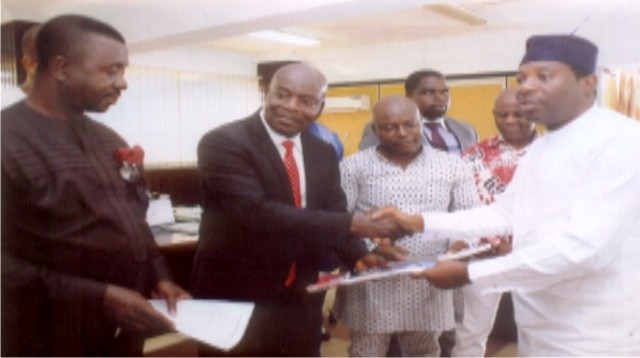
A suspected serial pipeline vandal and strike force leader of the Niger Delta Avengers, has been arrested by the Nigerian Navy around Sapele Council Area of Delta State.
The suspect, Abraham Suru, also known as Gabon, from Ondo State, was arrested weeks after he had been declared wanted by the Nigerian military for being responsible incessant attacks on oil and gas facilities within Warri North and South-West Council areas of the state.
Parading the suspect before newsmen at the Warri Navy Base, yesterday, the Commander, Nigerian Navy Ship Delta, Commodore Joseph Dzunve said the suspect was arrested Tuesday 20 September, 2016 around Sapele where he had been hiding.
Commodore Dzunve noted that Gabon’s arrest was part of intense efforts by the Navy through the Operation Delta Safe to flush out militants and other criminal elements from the region.
The Naval Chief said, “As part of the ongoing efforts by the Federal Government to stop crude oil theft and illegal bunkering activities in the nation’s maritime domain, the Nigerian Navy Ship Delta, being part of the Operation Delta Safe, has arrested a notorious gang leader who has been in this business since 2011.
“He (Abraham Suru aka Gabon) is involved in pipeline vandalism, sea robbery, attacks shipping, illegal bunkering and currently a suspected member of the Niger Delta Avengers.”
He added, “The Nigerian Navy remains committed in apprehending those behind all forms of criminal activities in the Nigerian Maritime Domain. Let me assure the general public that the Navy component of ODS is resolute in curbing criminal activities in the nation maritime environment.”
Answering questions from newsmen, Dzunve explained that the arrested Gabon was the ring leader of one of the cell groups within the Niger Delta Avengers whose team members include one General Felix that had earlier been arrested by his operatives.
The arrested Suru confessed to allegations of being a militant and blowing up oil facilities in the region, including one at Dibi community in Warri North.
He said although he was not a member of the Niger Delta Avengers, he was recruited in 2011 into the criminal act by Genera Kaphapolo, a former militant leader who died recently in a ghastly motor accident; and has since then carried out series of attacks.
Gabon said, “General Kaphapolo told me that their youths are not being recognised by oil companies in the area; and that is why we were attacking facilities.
“But after General Kaphapolo died in motor accident, I was contacted by one General Tony Felix to join their team because they know I am capable of blowing up oil facilities. I am not a member of Niger Delta Avengers.”



The National Drug Law Enforcement Agency (NDLEA) has cautioned parents to closely monitor their children’s craving for cookies and gummies, warning that some of the products may contain illicit substances being smuggled into the country.
In a statement posted yesterday, NDLEA’s Director of Media and Advocacy, Femi Babafemi, said recent seizures by the agency’s officers had revealed attempts by criminal elements to introduce prohibited substances under the guise of everyday snacks.
“As parents, if your kids and young ones always crave for cookies and gummies, you may have to pay a little more attention. There may be more to it than ordinary cookies and gummies,” Babafemi wrote, sharing images of seized packages.
The photos showed colourful pouches of “Cookies Delta 8 Gummies” in flavours such as Hawaiian Rain Pineapple Guava and Thai Mango, labelled as vegan and hemp-derived, alongside the actual gummy products.
The warning comes amid a major interception by the Nigeria Customs Service at the Tin Can Island Port in Lagos.
Officers seized two 40-foot containers containing large quantities of cannabis-infused products concealed among legitimate imports such as used vehicles, generators, batteries and fabrics.
The consignment included thousands of Delta-8 cannabis pre-roll cookies, packs of cannabis-infused gummies and other cannabis-infused cookies, with a combined estimated street value of about ?373.8m.
The items were subsequently handed over to the NDLEA.
NDLEA officials described the products, which originated from the United States and were packaged to resemble ordinary vegan snacks with appealing flavours, as an emerging public health threat.
They noted that the attractive packaging could appeal especially to children, students and young people, raising the risk of accidental consumption of concentrated cannabis.
The Rivers State Waste Management Agency (RIWAMA) has announced plans to partner with the Police Community Relations Committee (PCRC) to strengthen efforts at combating illegal waste dumping and improving environmental sanitation across the state.
The partnership was unveiled during a meeting between officials of RIWAMA and the leadership of the Rivers State chapter of the PCRC in Port Harcourt, recently, where both organisations pledged to work together to restore the Garden City status of the state capital.
In his speech, the Supervisor of Market and Community Sanitation in RIWAMA, Mr. Omereji Ukoha, said the collaboration was in line with the vision of the agency’s Managing Director, Dr. Ibimina Wokoma, and the Board Chairman, Dr. Samuel Nwanosike, to promote a cleaner and healthier environment.
Ukoha described the PCRC as a strategic grassroots partner capable of mobilising communities and driving behavioural change through sustained public enlightenment on proper waste disposal.
He expressed concern over the increasing rate of indiscriminate refuse dumping in parts of Port Harcourt, particularly in New GRA, where blocked drainage channels and illegal shanties have continued to contribute to flooding and environmental degradation.
According to him, the agency is determined to intensify enforcement against environmental offenders, warning that unregistered cart pushers and residents who patronise them would be prosecuted in accordance with the provisions of the RIWAMA Act, 2014.
The RIWAMA official urged residents to embrace proper waste disposal practices and patronise only government-approved waste operators in order to safeguard public health and protect the environment.
Responding, the Chairman of the Police Community Relations Committee in Rivers State, Dr. Voke Emore, commended RIWAMA for seeking collaboration with the committee in addressing environmental challenges confronting the state.
Emore said the PCRC would deploy its community-based structures across the state to support public sensitisation and encourage residents to comply with environmental sanitation regulations.
He also called on local government councils to play more active roles in waste management, noting that they collect sanitation levies and should complement the efforts of the state government in maintaining a clean environment.
The PCRC chairman described indiscriminate refuse disposal as a serious environmental and public health concern, stressing that sustained collaboration among government agencies, community leaders and residents remained critical to achieving lasting sanitation goals.
Both organisations expressed optimism that the partnership would promote cleaner communities, reduce environmental hazards and strengthen public participation in efforts to ensure a healthier and more sustainable environment for the people of Rivers State.
King Onunwor

The Rivers State Police Command has arrested five suspected members of a kidnapping syndicate allegedly terrorising communities in Oyigbo Local Government Area of the State.
The State Police Command disclosed this in a statement by its Public Relations Officer, ASP Blessing Agabe, in Port Harcourt, recently.
The suspects were arrested during a coordinated operation at Oyigbo, following directives by the Commissioner of Police, Rivers State Command, CP Olugbenga Adewole Adepoju.
Those arrested were Ezekiel Emmanuel, 44, from Benue State; Chukwuma Mbanefor, 51, from Anambra State; Nicholas Diala, 65, from Imo State; Ndubuisi Uwakwe, 49, from Abia State; and Ifeanyi Nwakwo, 51, from Imo State.
The Command said the arrest represented another significant operational success in its ongoing efforts to dismantle criminal networks operating in the State.
According to the Police, preliminary investigation indicated that the suspects were allegedly involved in kidnapping operations within Rivers State.
The suspects, during interrogation, allegedly confessed to their involvement in kidnapping and further admitted participating in several operations carried out in Kom-Kom, Railway, Obeama and Afam communities.
The Command said investigation was ongoing, with efforts intensified to identify and apprehend other members of the suspected syndicate who may be connected with the criminal activities.
The Police boss said the operation reflected the implementation of operational directives and the intelligence-driven policing strategy of the Inspector-General of Police, IGP Olatunji Rilwan Disu, psc, NPM.
Adepoju reaffirmed the Command’s determination to sustain aggressive intelligence-led operations against kidnapping, cultism, armed robbery and other violent crimes across Rivers State.
He warned kidnappers and other criminal elements operating in the State that there would be no safe haven for them, stressing that the Command would relentlessly pursue, arrest and ensure that those found culpable were brought to justice.
The Commissioner further assured residents of the Command’s commitment to protecting lives and property, urging members of the public to remain vigilant and cooperate with security agencies in the fight against crime.
He appealed to residents to provide the Police with credible and timely information capable of assisting security operatives in preventing criminal activities and apprehending suspected criminals.
The Command urged members of the public who may have useful information on the activities of the suspected kidnapping syndicate or other criminal elements to contact the Police through its emergency lines, assuring that such information would assist ongoing investigations.
King Onunwor
-
Business15 hours ago
PTDF Committed To Tinubu’s Development Plan – CEO
-

 City Crime10 hours ago
Tinubu Appoints Ex-Tide Staff Registrar Of Chartered Chemists
-
Education16 hours ago
Environmental Education Remains Critical Tool To Address Environmental Challenges Says Experts
-
Oil & Energy15 hours ago
Civil Society Demands Accountability over N60Billion AKS Oil Producing Communities
-
News15 hours ago
Court Hears ATROMPCON Leadership Suit Today
-
 News14 hours ago
Police Nab Kidnap Syndicate, Arrest Five In Rivers
-

 Sports14 hours ago
Rivers-born Chess Player Clinches Third Position At World Amateur Rapid Chess Championship
-
Business15 hours ago
NMDPRA, NUPRC To Strengthen Domestic Crude Supply Chain ………, Says Nigeria’s Refining Capacity Hits 1.25 Million bpd