
Connect with us

Business

Nigeria To Undergo EITI Oil, Gas, Mining Validation – NEITI

Published

on

The Nigerian Extractive Industries Transparency Initiative (NEITI) says Nigeria will undergo a validation test of the Extractive Industries Transparency Initiative (EITI) on oil, gas and mining sectors.
The Executive Secretary of NEITI, Mrs Zainab Ahmed, announced this at a pre-validation workshop for stakeholders in the extractive industries in Abuja on Monday.
The Tide source reports that the validation, which will take place in January 2016, is designed to find out the level of implementation of EITI standards in Nigeria.
The EITI is a global standard to promote open and accountable management of natural resources.
The EITI exercise is conducted from time to time by the global body for quality assurance mechanism.
It is targeted at ascertaining the level of compliance of member countries to EITI principles of transparency and accountability in the extractive industries.
It would be recalled that Nigeria signed up to implement EITI standards in the extractive sector in 2003, but actually began implementation in 2004 .
Ahmed noted that the pre-validation workshop was to prepare Nigeria for the 20116 EITI validation.
She said that the validation was a quality assurance assessment tool employed by EITI to ensure that implementing countries conformed to standards.
She added that Nigeria had been designated as an EITI compliance country by the global body in 2013.
“In 2012, the EITI approved a new set of standards and part of the requirements of the standard is that countries like Nigeria that are EITI compliant will be going into validation every three years.
She said the period was to make sure that “we are complying to the terms and tenets of the standards”.
The workshop was also to equip NEITI to assess its performance over the years in the implementation of the EITI standards, she added.
She said it was also an avenue to help participants identify areas that NEITI needd to improve in the discharge of its responsibility.
“So this workshop is to make an assessment on what we have done in terms of the standards; what we have not done so well and what we have not done at all.’’
She added that the validation team in 2016 would engage stakeholders in the extractive sectors in question sessions, with a view to check performance and compliance to the standards.
Ahmed noted that the consequence of not passing the validation test would not be in the interest of the nation.
She, however, expressed optimism that Nigeria would do well in the validation, given the laudable performance of NEITI.
Speaking at the workshop, the Deputy Head of EITI Secretariat, Eddie Rich, emphasised the need for member countries to meet the EITI standards.
He said that although the standards were characterised by strict measures, the importance of adhering to them could not be overemphasised.
He noted that the pre-validation workshop would promote dialogue and learning on the further implementation of EITI standards.
Rich said that the seminar would provide opportunity to increase the impact of EITI, by providing ways to strengthen government system in fiscal expenditure and revenue collection in the extractive sector..
Reports says that that the two day workshop will have resource persons making presentations.
The topics include analysis of recent oil, gas and mining reports, revenue collection in the oil, gas and mining sector.
Participants at the events were drawn from Nigerian National Petroleum Corporation (NNPC), Federal Inland Revenue Services (FIRS) and civil society groups.
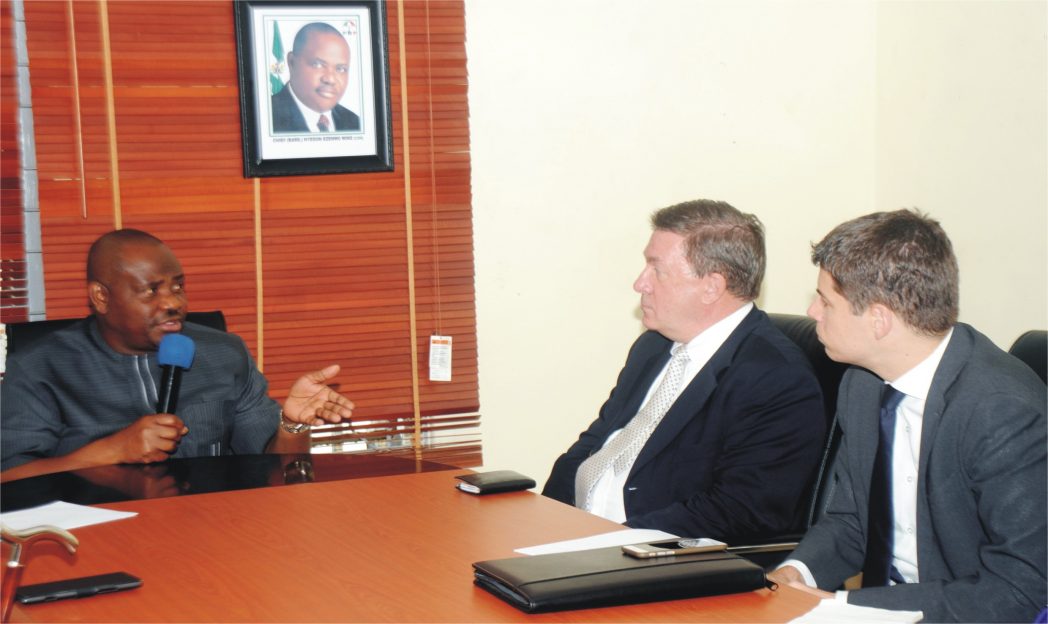
L-R: Rivers Governor-elect, Mr Nyesom Wike; Ambassador of Netherlands, Mr John Groffen And His Secretary, Mr Maurice Paulussen, during their courtesy visit to the Governor-elect on investment opportunities and business partnership with Rivers State, in Port Harcourt, recently.                    Photo: NAN

L-R: Rivers Governor-elect, Mr Nyesom Wike; Ambassador of Netherlands, Mr John Groffen And His Secretary, Mr Maurice Paulussen, during their courtesy visit to the Governor-elect on investment opportunities and business partnership with Rivers State, in Port Harcourt, recently. Photo: NAN


Continue Reading

Business

IPMAN Raises Concern Over Delay In Chinese Refinery Deal …Predicts Lower Fuel Prices Through Competition

Published

on

The Eastern Zone of the Independent Petroleum Marketers Association of Nigeria (IPMAN) has called on the Nigerian National Petroleum Company Limited (NNPCL) to fast-track the conclusion of the proposed Technical Equity Partnership with two Chinese firms.
IPMAN made the appeal amid growing concerns over the delay in finalising the agreement initiated through the signing of a Memorandum of Understanding (MoU) on April 30, 2026, between NNPCL and Sanjiang Chemical Company Limited as well as Xinganchen (Fuzhou) Industrial Park Operation and Management Company Limited.
It said the proposed arrangement was designed to revive and expand operations at the Warri and Port Harcourt refineries, noting that successful implementation would strengthen the downstream petroleum sector and restore confidence in Nigeria’s oil and gas industry.
The former Unit Chairman and current Zonal Secretary of IPMAN, Eastern Zone (System 2E), Comrade Inimgba Emmanuel Okubowei, made the call in a statement issued by the union after the Good Governance Summit organised by the Working People United (WOPU) in Abuja, and obtained by TheTide in Port Harcourt, at the weekend.
Okubowei expressed concern over the continued hardship faced by Nigerians due to the high cost of Premium Motor Spirit (PMS), stressing that households and businesses were increasingly burdened by rising energy costs.
Okubowei stated that fuel prices would naturally decline once the Chinese partners commence full operations at the refineries, explaining that increased refining capacity and a more competitive market environment would positively influence pump prices.
The unionist further noted that the partnership would attract fresh investment, improve domestic refining output, increase petroleum product availability and create a more stable operational environment for industry stakeholders.
He maintained that healthy competition remains one of the most effective mechanisms for achieving fair pricing in the downstream petroleum industry and protecting consumers from avoidable price pressures.
The IPMAN official further argued that the entry of additional technically competent operators into the refining space would discourage monopolistic tendencies, improve operational efficiency and guarantee a more stable supply of petroleum products across the country.
He, therefore, appealed to the Group Chief Executive Officer of NNPCL, Engr. Bashir Bayo Ojulari, and the management of the company to accelerate all outstanding processes required for the successful execution of the Technical Equity Partnership.
Okubowei also called on the NNPCL leadership to publicly explain the reasons behind the prolonged delay and provide Nigerians with a definite timeline for the commencement of the project.
He emphasised that transparency, accountability and timely communication would strengthen public confidence in the initiative, adding that prompt execution of the agreement would enhance Nigeria’s energy security, create employment opportunities, stimulate economic growth and provide lasting relief to millions of Nigerians through more affordable petroleum products.
King Onunwor
Continue Reading

Business

Gas Economy: Decade of Gas, Pi-CNG/ EV Deepen Media Engagement

Published

on

Poised to achieving an in-depth understanding of the Nigeria’s gas economy by it’s populace, the Decade of Gas Secretariat, in collaboration with the Presidential Initiative on Compressed Natural Gas and Electric Vehicles (Pi-CNG & EV), has deepened media capacity engagement across the country.
The media session, third in its series, and held at the Hotel President, Port Harcourt, recently, brought together 30 journalists from the television, radio, print, and digital media platforms to deepen their understanding of Nigeria’s gas development agenda and further enhance their reportage on the role of gas in driving economic growth, energy security, industrialization, job creation, and improved living standards.
Speaking during the session, the representative,  Decade of Gas Secretariat,Taofeek Balogun , noted that the port Harcourt engagement followed two earlier sessions held in Lagos and Abuja, a move that began in 2025.
According to him, Nigeria’s gas sector continues to record significant progress, with year-to-date gas production reaching 7.85 billion standard cubic feet per day (bcfd).
Domestic gas utilization has surpassed the 2 bcfd mark, while gas exports have risen to their highest level in five years, reflecting growing demand across power generation, industries, transportation, exports, and household consumption.
Balogun emphasised the successful completion of the Obiafu-Obrikom-Oben (OB3) River Niger Crossing by NGIC/NNPCL, describing it as a critical infrastructure milestone that would improve gas transportation across the country, support industrial growth, attract investment, strengthen energy security, and contribute to economic development.
As part of efforts to expand domestic gas utilization, he reiterated the Federal Government’s commitment to increasing access to clean cooking solutions. The government’s target is to distribute cooking gas cylinders to five million households by 2030.
Following the successful rollout of the programme across the six geopolitical zones by the Minister of State for Petroleum Resources (Gas), Hon. Ekperikpe Ekpo, implementation would now move to the state level, beginning with Bayelsa State in July 2026.
Under the initiative, Balogun said, 27,000 households in Bayelsa are expected to receive cooking gas cylinders within the year as part of the 1(one) million homes per year target.
Also speaking, the Chief Operating Officer of Pi-CNG & EV, Tosin Coker, highlighted ongoing efforts to expand the adoption of Compressed Natural Gas (CNG) and electric mobility solutions as cleaner and more affordable transportation alternatives for Nigerians.
He disclosed that the Federal Government is promoting the adoption of CNG across Ministries, Departments and Agencies (MDAs) through the conversion of existing vehicle fleets and the procurement of CNG-powered vehicles as part of broader efforts to reduce transportation costs and improve energy efficiency.
Coker said “more than 100,000 vehicles have now been converted to CNG nationwide under the initiative, reflecting growing acceptance of alternative fuel solutions and supporting the country’s transition towards cleaner and more sustainable transportation”.
Participants commended the initiative for strengthening media capacity and improving public understanding of developments within Nigeria’s energy sector.
The Decade of Gas Secretariat and Pi-CNG & EV further reaffirmed their commitment to sustained stakeholder engagement and public awareness as Nigeria continues its journey towards a gas-powered economy.
Continue Reading

Business

Group Seeks Media Partnership To Enhance Business Growth

Published

on

The Chief Executive Officer of Kefa Communication, Mr. Obihele Victor Amos, has called for stronger collaboration between business organisations and media institutions to enhance business growth, economic expansion and wider public engagement across communities.
Amos made the call during a press briefing in Port Harcourt at the weekend.
He emphasised that strategic media partnership remains critical to improving visibility for businesses and attracting investment opportunities.
According to him, the media occupies a central position in shaping public perception and creating awareness that can support enterprise development and economic sustainability.
He also noted that, many emerging businesses continue to face growth limitations due to insufficient publicity and inadequate access to effective communication channels.
“Stronger engagement with the media would help bridge information gaps and create better connections between businesses and potential customers”, he said.
The CEO further stated that responsible and developmental journalism could play a significant role in promoting innovation and encouraging healthy competition within the business environment.
He stressed that beyond informing the public, the media serves as a platform for influencing policies and encouraging stakeholder participation in economic development.
Amos further disclosed the group is committed to building relationships with media organisations through continuous engagement and collaborative initiatives.
He said such partnerships would create opportunities for entrepreneurs and support efforts aimed at expanding market access.
The business leader also urged media practitioners to sustain professionalism and continue highlighting stories that promote enterprise and national development.
He expressed confidence that improved synergy between the media and the business community would contribute to employment generation and economic resilience.
Some participants at the briefing described the initiative as a welcome development capable of strengthening public understanding of business opportunities.
There were also calls for sustained cooperation among stakeholders to drive inclusive business growth and long-term development.
King Onunwor
Continue Reading

Trending










