
Connect with us

Ict/Telecom

Telecoms Providers, Subscribers Lament Challenges

Published

on

The concluding part of the story published Friday,
August 1, 2014.

Daniel also said the
company had reduced its Turn-Around Time, a period during which customers’ complaints are addressed, to less than one hour, as part of efforts to satisfy customers.
On differences in the cost of recharge cards in Gombe, he said the company had set up a committee to ensure uniform prices.
He said the company was using the media to sensitise the public to the services which Globacom offered as well as other issues that would improve its service delivery.
Miss Paula Paul, New Dawn Manager of MTN Trade Partner in Gombe, said the company had bought 3G network facility to increase the strength of its services, especially for those browsing on the network.
However, The Tide source revealed that as part of solutions to the various problems observed, operators like MTN, GLO and Etisalat have installed the 3G system.
GLO has also opened smaller offices in the headquarters of local government areas across the country to get their services closer to subscribers at the grass-roots level.
Subscribers, on their part, called on the Nigeria Communications Commission (NCC), as a regulatory body, to try and curtail the excesses of operators found to be short-changing subscribers.
The Director of Public Affairs, NCC, Mr Tony Ojobo, informed that subscribers had legal rights to call the hot line of the commission to report any ill treatment by the network providers across the country.
He said subscribers would have to ensure that the network provider actually short-changed by reporting first to the providers before calling on the NCC for intervention.
Ojobo also said that vandalism of facilities of network providers had been a big challenge to the sector and that there was a bill before the National Assembly to address the problem.
He also advised telephone users to get certified mobile phones whenever they purchase a new phone.
According to the NCC spokesman, epileptic services on the network are due partly to the fact that some mobile phones which the subscribers use do not have the capacity of receiving calls at a close range.
On telemarketing, Ojobo said, “it is global practice, hence, it is impossible to ban it in the country.’’
He said the commission tried to regulate the timing of such messages so as not to inconvenience subscribers, adding that the time was now restricted to between 8 a.m. and 8 p.m.
He urged subscribers who were still being inundated with such unsolicited text messages at odd hours to sue the telecoms operators involved for invasion of their privacy.
According to him, the NCC is watching the operators and anyone that flouts the regulation on telemarketing would be punished.
He said that apart from issues bordering on unsolicited SMS, consumers could also ‘take the telecoms firms to task’ on account of the poor services being rendered to them.
“I think time has come for people to assert their rights. It is only in the telecoms industry that the people want the regulator to do everything for them.
“People should also take up the responsibility at some point to demand their rights from their service providers. That is the point we have made; people can take the service providers to court.
“It is not everything that the regulator should handle. In order climes, people have gone to court for even lesser matters. “We need to be able to put our laws to test. It is a contract! Every network has a contractual obligation in its drive to provide services for members of the public,’’ Ojobo said.
The Corporate Service Executive of MTN Nigeria, Mr Wale Goodluck, said that the issue regarding capacity to accommodate subscribers was essentially in the hands of the operators.
Goodluck said that it behoved operators to have a good understanding of the demands of customers and to put in place the capacity to meet them.
“The good news is that operators have the resources to install the required capacity but the reality is that it is extremely difficult to put infrastructure on ground in our environment.
“The same infrastructure challenges that have bedevilled the power industry also affect the telecommunications industry,” he said.
Goodluck stressed that telecoms infrastructure could not exist in a vacuum as there ought to be a parallel growth in other sectors for full realisation of the benefits of the increased rollout.
The Chairman, Association of Licensed Telecommunications Operators of Nigeria, Mr Gbenga Adebayo, said that the challenges in the sector remained enormous and had been hampering capacity rollout.
Adebayo cited the insecurity of telecoms infrastructure, a phenomenon which, he said, manifested prominently in the 2012 terror attacks on telecoms facilities in some parts of the country.
He said that the operators faced other challenges such as multiple taxation, difficulty in obtaining the Right of Way (RoW), as well as different levies imposed by some states and local governments.
Adebayo said that some of these issues hampered efforts to erect base stations that would boost the quality of services offered by service providers.
It would be recalled that no fewer than 30 base stations were bombed while several others were damaged in the 2012 terror attacks on telecoms installations, and some of the facilities have yet to be rebuilt due to lack of access to the sites.
Recent reports revealed that telecoms firms recorded a minimum of 70 cases of vandalism of its infrastructure monthly in different parts of the country.
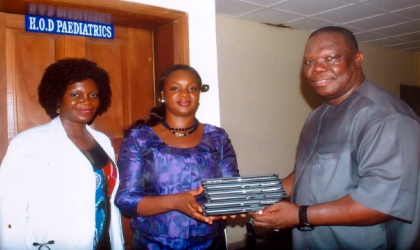
Special Adviser to the Rivers State Governor on ICT, Engr. Goodlife Nmekini (right), presenting  Ipad to Head of Department, Paediatrics, Braitwait Memorial Specialist Hospital, Port Harcourt, Dr. Ajibola Alabi (middle),  during Governor Chibuike Ameachi’s inspection of  installed ICT facility by the State ICT Department at the hospital recently. With them is Dr. Josephine Aiya.


Special Adviser to the Rivers State Governor on ICT, Engr. Goodlife Nmekini (right), presenting Ipad to Head of Department, Paediatrics, Braitwait Memorial Specialist Hospital, Port Harcourt, Dr. Ajibola Alabi (middle), during Governor Chibuike Ameachi’s inspection of installed ICT facility by the State ICT Department at the hospital recently. With them is Dr. Josephine Aiya.

Continue Reading

Ict/Telecom

Konga Launches Tech Sales Drive In Nigeria

Published

on

As demand for connected tools continues to rise among consumers and businesses, Konga has launched a month-long technology sales campaign aimed at boosting access to digital devices and services in Nigeria.
The e-commerce platform said its “Konga Tech Month” campaign, which runs from 1 to 31 May 2026, will offer discounts of up to 50 per cent on a range of products, including smartphones, laptops, televisions, refrigerators and accessories.
The company, in a statement said the campaign was designed to address increasing demand for genuine and reliable technology products in Nigeria’s expanding digital economy, where more individuals and businesses are relying on digital tools for communication, education and productivity.
Konga said it partnered with global technology brands including Samsung, LG, ASUS, HP and Starlink for the campaign.
A key feature of the initiative is the participation of Starlink, which Konga said has designated the retailer as an authorised support centre in Nigeria. The arrangement allows customers to access in-person assistance at selected Konga retail outlets for product purchases, installation guidance and troubleshooting support.
The company said customers would also have access to special discounts on Starlink kits during parts of the campaign.
Konga added that shoppers purchasing products from the official Samsung and LG stores on its platform will benefit from free delivery, while its same-day delivery service, KongaNow, will enable faster fulfilment of urgent orders.
The company encouraged customers to use its mobile application to access app-exclusive offers, flash sales notifications and selected free shipping deals.
Konga said the campaign aligns with broader efforts to improve digital adoption in Nigeria by making technology products more affordable and accessible, adding that direct partnerships with original equipment manufacturers would help ensure customers receive authentic products while improving consumer confidence in online technology purchases.
The company described the campaign as part of its strategy to strengthen its position in Nigeria’s e-commerce and technology retail market through pricing incentives, logistics improvements and partnerships with global brands.
Continue Reading

Ict/Telecom

Telcos Explain Service Disruptions ……As Nigerians Consume 4m Terabytes Data

Published

on

Telecom operators have explained the constant disruption to telephone services in the country, blaming it on persistent fibre disruption and vandalism.
This is coming as Nigerians further prioritise data usage in the first quarter of 2026, with statistics showing that the citizens increased their consumption to four million terabytes within the period.
Chairman, Association of Licensed Telecom Operators of Nigeria (ALTON), Gbenga Adebayo, while speaking at the on a television programme, at the weekend, painted a grim picture of an industry under siege.
Adebayo revealed that the persistent issues of dropped calls and slow Internet are not due to neglect by operators but are the direct result of an “industrial nightmare” of sabotage, vandalism, and criminality.
He described telecom operators as the ‘infrastructure of infrastructures” that supports every other sector, from banking to security regretting however, that this critical backbone is cracking under the weight of constant attacks.
In a startling revelation, Adebayo exposed the disparity between the safety of international infrastructure and the vulnerability of domestic networks.
He noted that the undersea fibre optic cables in the Atlantic have suffered barely one outage in two years.
In stark contrast, the terrestrial fibre optic cable running from Lagos to Kano is cut an average of 40 times every single day.
“If you have fibre cut as many as 40 times a day across the national network, there is no way that that will not impact the quality of service,” Adebayo stated flatly.
He explained that these cuts, often caused by reckless excavation or road construction, bleed the industry dry financially and force congestion onto remaining network routes.
Recall that the Executive Vice Chairman of the Nigerian Communications Commission (NCC), Dr Aminu Maida, said operators suffered 1,883 fibre cuts in the first three months of the year.
Beyond fibre cuts, the ALTON chairman highlighted the rampant theft of diesel, batteries, and generators at cell sites. He cited a bizarre situation in a Lekki community — one of Nigeria’s wealthiest corridors — where residents lacked public electricity for four months but demanded flawless service.
Operators, he revealed, are often forced to pay local community groups just to transport diesel to sites under the cover of darkness.
Perhaps the most alarming revelation was the security situation facing technical staff.
Adebayo disclosed that there are vast territories in Nigeria where engineers cannot respond to faults after 6:00 p.m. due to the threat of attacks by armed vandals and non-state actors.
Despite the doom, Adebayo noted a silver lining. He said the recent 50 per cent tariff adjustment approved by the government has restored investor confidence. He confirmed that capital is finally flowing back into the sector after years of stagnation.
Adebayo who warned that money alone would not fix the problem, issued a passionate call to the government, demanding that vandalism of telecom infrastructure be treated with the same severity as crude oil theft.
In a related development, March subscription statistics from the Nigerian Communications Commission showed that Nigerians consumed more than four billion gigabytes of data in 90 days in the first quarter of 2026.
Specifically, from January to March, Nigeria recorded 4.06 million terabytes of data, the highest level since the NCC began tracking the data. The development further confirmed data as the new ‘oil’ as more Nigerians do stuff online.
Continue Reading

Ict/Telecom

Platform Petroleum Unveils ICT Hub For Niger Delta Youths

Published

on

In a move to  boost the digital education and technological empowerment in Rivers State, the Platform Petroleum Limited has inaugurated the O.B. Lulu-Briggs ICT Centre for Digital Innovations in Obonoma, Akuku-Toru Local Government Area .
The state-of-the-art facility, commissioned recently,  represents a significant intervention aimed at bridging the digital divide and expanding access to information and communication technology across riverine communities in the Niger Delta.
Commissioning the centre, former Catholic Archbishop of Abuja, John Onaiyekan, commended the initiative, describing it as a timely investment in human capital development and a catalyst for educational advancement in underserved areas.
The ICT centre equipped with over 280 interconnected computer systems, positioned it as a major hub for computer-based testing (CBT), digital training, and innovation-driven learning.
It is expected to serve residents of Akuku-Toru, Asari-Toru, and Degema local government areas, thereby reducing the need for students and job seekers to travel  to urban centres for examinations and digital services.
Chairman of Platform Petroleum Limited, Dumo Lulu-Briggs, said the project was conceived in response to the increasing demand for digital literacy in a rapidly evolving global economy.
He emphasised that the centre goes beyond infrastructure, serving as a gateway to global opportunities for young people in the region, particularly in an era shaped by artificial intelligence, automation, and technological innovation.
According to Lulu-Briggs, equipping youths with relevant digital skills remains critical to enhancing their competitiveness and enabling them to participate meaningfully in the global knowledge economy.
The facility, named after his father, Olu Benson Lulu-Briggs, forms part of the company’s corporate social responsibility initiatives targeted at promoting education, enterprise, and socio-economic development in host communities.
Beyond its CBT capabilities, the centre also features dedicated spaces for training, collaboration, and enterprise development, alongside residential and support facilities designed to enhance learning outcomes.
In his remarks, Lulu-Briggs urged host communities to take ownership of the facility by ensuring its protection and proper use, stressing that its long-term value depends on collective responsibility and commitment.
The O.B. Lulu-Briggs ICT Centre is widely regarded as a strategic investment that will not only improve access to digital education but also strengthen Rivers State’s emergence as a growing hub for technology and innovation in Nigeria.
Stakeholders at the inauguration described the project as a transformative intervention capable of narrowing the digital gap, stimulating innovation, and creating sustainable opportunities for thousands of young people across the region.
Dignitaries at the event included Vice Chairman Ojunekwu Augustine Avuru and Managing Director/CEO John Anim, as well as traditional rulers, religious leaders, community stakeholders, and youth representatives.
King Onunwor
Continue Reading

Trending







