
Business
FG Renews Commitment To Automobile, Manufacturing

The Federal Government has renewed its commitment to creating policies that would enhance the development of the automobile and manufacturing sectors.
The Minister of Industry, Olusegun Aganga, said this in Lagos yesterday at a business roundtable organised by the Sam Ohuabunwa Foundation for Economic Empowerment.
Aganga, represented by Director-General, Standard Organisation of Nigeria (SON), Dr Joseph Odumodu, said the automobile industry had boomed in the last six months than the past 30 years.
He attributed the growth to the alignment of the private sector and stakeholders in the industry to government policies for the sector.
“The automobile sector has grown in the last six months than the past 30 years.
“The reason is not far from the cooperation of the private sector and stakeholders with the National Industrial Revolution Plan (NIRP).
“A major challenge, however, is that the value chain on raw materials have not been properly linked because major manufacturers still import batteries, lubricants and so on.
“Presently we are meeting with stakeholders like INNOSON, discussing the way forward for the sector,” he said.
Aganga also urged small and medium business owners to plan their businesses on a long term budget cycles rather than a short time.
“By 2050, it is estimated that Nigeria’s population will be one of the largest in the world, competing with China.
“This is a factor that SMEs and local manufacturers can leverage on, on a long term basis,” he said.
He also urged private sector practitioners to establish more training centres for varieties of professionals to cover the human skills gap to boost the manufacturing sector.
He said that the federal government’s collaboration with the United Nations International dcevelopment Organisation (UNIDO) to boost skill gaps and train professionals to compete with foreign counterparts was still in place.
Also speaking at the event, the Minister of Finance, Dr Ngozi Okonjo-Iweala, said there were so many beneficial government policies that Nigerian entrepreneurs had yet to access.
Okonjo-Iweala, represented by a director in the ministry, Mr Gabriel Ajudua, said the N100 billion textile industry intervention fund had lacked investors coming forward for investment loans.
She also said that the federal government was working on the partnership with private sector to provide 750,000 jobs through the agriculture and manufacturing sector.
The Proprietor of the foundation, Sam Ohuabunwa had earlier said the event was a platform for government officials to feed entrepreneurs of opportunities available through government policies.
The theme of the forum is “Optimising Opportunities in the Federal and State Budgets”.
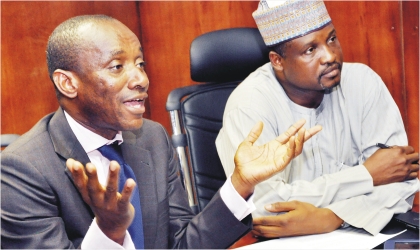
Chairman, Nigerian Electricity Regulatory Commission (NERC), Dr Sam Amadi (left), briefing newsmen on electricity fixed charge in Abuja last Wednesday. With him is Commissioner, Government and Customer Affairs, Dr Abba Ibrahim.



Business
Jonathan, Diri, Others Laud Firm’s Milestone in Bayelsa …Says Project Will Drive Industrialisation, Create Jobs



-

 News3 days ago
RSG Targets Nine Million Residents in Mosquito Net Distribution Campaign
-

 Oil & Energy3 days ago
Aiyedatiwa Signs New Electricity Bill
-

 Oil & Energy3 days ago
NLNG Commissions Research And Innovation Centre In RSU
-

 Maritime3 days ago
Marine Minister Commends President Tinubu On NPERA Bill Assent
-

 News3 days ago
KenPoly Holds Eight Convocations, August 29
-

 News3 days ago
RMAFC Completes Revenue Sharing Review, Proposes New Pay
-

 News3 days ago
RSG Begins Another Phase of Projects Commissioning Today
-

 Maritime3 days ago
NAGAFF Petitions IGP Over Alleged Maritime Police Harassment