
Nation
THE STATES

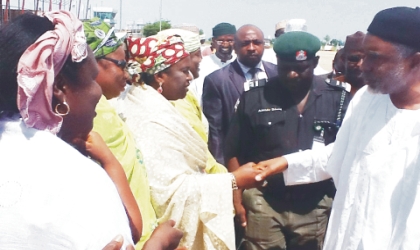
Adamawa State Governor, Murtala Nyako being received by some commissioners and special advisers at Yola International Airport, recently. Photo:NAN
Benue
Governor Gabriel Suswam of Benue State has urged the Federal Government to intervene in the Fulani/Tiv land skirmishes, to put an end to it.
Suswam who made the call at the Town Hall Meeting in Makurdi to mark the end of the Good Governance tour in the state said that the greatest problem besetting the rural farmers in the state was the intermittent land feud they had with some invading herdsmen.
The governor advised the Federal Government to take the issue of the Fulani/Tiv crises more seriously, to enhance the growth of the peasant farmers in the state.
Responding to questions from participants at the meeting, Suswam said Benue was a rural state and his administration was committed to the construction of rural roads.
He dismissed insinuations that teachers in the state were being owed, adding that a staff audit of the teachers had commenced, to avoid payment to ghost teachers.
Borno
Governor Kashim Shettima of Borno State has expressed reservation with the quality of work in some sections of the proposed campus of the state university in Maiduguri.
Shettima made the observation when he paid an unscheduled visit to the campus located at the site of the defunct Borno Informatics Institute on Jos Road, Maiduguri.
He expressed concern about the quality of work at the administrative building and described it as ‘deficient.’
He advised the contractor handling the project to rectify the problem, noting that the supervising engineers from the Ministry of Works was responsible for the defects.
The governor warned that government would henceforth hold site engineers responsible for poorly executed projects.
“The site engineers posted from the Ministry of Works have the right to reject poorly executed projects from the onset.
FCT
The Head of the Civil Service of the Federation (HOSCF), Alhaji Isah Sali said on Thursday in Abuja that the introduction of Performance Management System (PMS) would enhance the productivity of civil servants.
Sali made the statement at a sensitisation workshop to PMS, organised by the office of the HOCSF for officers on the Directorate Cadre of the service.
Sali said PMS had been recognised as the backbone for transforming the civil service into an institution of excellence and quality service delivery and the vehicle to drive the transformation agenda of the present administration.
The HOSCF was represented on the occasion by Mr Charles Bonat, the Permanent Secretary, Establishment and Records in the Office of the Head of Civil Service of the Federation.
Jigawa
Governor Sule Lamido of Jigawa has said that President Goodluck Jonathan’s planned visit to the state would boost commercial activity in the state.
our correspondent reports that the President, billed to visit Jigawa State between November 5 and November 6, is expected to lay the foundation stone of the proposed Jigawa State University of Agriculture and Dutse International Airport.
Jonathan is also scheduled to inaugurate other development projects executed by the Lamido-led administration.
Lamido told newsmen, shortly after inspecting some of the projects in Dutse, that the visit will enable the people of the state to meet with the president, adding that the visit would attract positive developments to the state.
Kaduna
The Legal Aid Council of Nigeria has offered legal services to 719 persons in Kaduna State, the coordinator, Mrs Biba Ohwoavwovhua, has said.
Ohwoavwohua stated this on Thursday in Kaduna during the council’s nationwide annual awareness campaign.
She told newsmen that the council had provided legal services to persons who lacked the means to hire lawyers, adding that it was involved in civil and criminal cases, including cases of persons accused of capital offences.
“We assist them in making sure that they are not convicted before being heard. As far as legal aid is concerned, we are there to show concern, represent and to make sure we diligently defend whoever is accused,’’ she said.
Ohwoavwohua identified distance and inadequate funding as some of the challenges facing the organisation, noting that it was always difficult to offer necessary and timely assistance to people outside the state capital such as Kafanchan, Zaria and Birnin Gwari.
Kano
The Federal Road Safety Commission (FRSC) in Kano State on Wednesday said that no fatal accident was recorded during the Eid-el kabir in the state
The Sector Commander, Shehu Zaki, told newsmen that the commission’s public enlightenment and the deployment of its officers to the highways contributed to the success recorded.
Zaki, however, said that the commission recorded minor accidents, which did not cause much damage to vehicles and the passengers.
He cautioned motorists to keep the good behaviour, noting that the commission was disturbed at the rate of over-loading and over-speeding on some routes.
Kebbi
The National Environmental Standards and Regulations Enforcement Agency (NESREA) in Kebbi State will collaborate with faith based organisation to combat environmental degradation in the state.
The state Coordinator of the agency, Dr Kasim Ahmed, made this known in an interview with newsmen in Birnin Kebbi on Wednesday
Ahmed said that NESREA and Nasirullah Faith Society of Nigeria (NASFAT) would campaign against human activities which contributed to 60 per cent degradation of major cities and towns in the state.
He said the agency decided on the collaboration because NASFAT wide spread in the state and across the nation.
He said that the NASFAT interaction and sessions with Muslim faithful influenced their choice as well as their social and cultural orientation, adding that the two organisations would jointly campaign against unhealthy disposal of waste materials such as cans and polythene bags.
Kwaraa
The Kwara State Government treated 8, 979 people with eye disorders between January and July, Dr Afolabi Ezekiel, the Programme Manager of Kwara Eye Care Scheme, said.
Ezekiel told newsmen in Ilorin on Tuesday that the people were treated of eye afflictions, including cataract and glaucoma.
“The state government is committed to the treatment of eye disorders in the state,” it said, and advised people above 40 years to go for regular eye tests to prevent blindness, stressing that 80 per cent of eye disorders which led to blindness were avoidable and treatable.
The ophthalmologist advised the people against the use of urine and other local medications for the treatment of eye diseases.
Lagos
President, Advisory Committee of the International Table Tennis Federation (ITTF), has urged budding talents in the country to show commitment to sport.
Oludotun-Segun told newsmen on Thursday in Lagos that his committee was evolving an arrangement to enable sportsmen and women to develop themselves educationally, just as they built their sports careers.
“Education is very important; it is also good to develop one”s talent, especially when it is discovered at the early stages. The idea is that no one should suffer any serious disadvantage,’’ he said.
According to him, poor educational background has a way of affecting an athlete’s career because such a person would not be able to interact freely with his or her contemporaries.
Ogun
Ogun State Police Command says it has arrested a 62-year old man for allegedly defiling his 10-year old step-daughter in Abeokuta.
Police Public Relations Officer (PPRO) in Ogun State, Muyiwa Adejobi, told newsmen in Abeokuta that the suspect had earlier evaded arrest.
He said that the suspect committed the alleged offence on October 27 around Ayetoro area of Abeokuta, adding that the combined efforts of police and public-spirited individuals led to the arrest.
The ASP said that the suspect had been taken to the state Criminal Investigation Department of the Anti-Human Trafficking for further interrogations.
The PPRO said that information available to police was that the suspect had always slept with the victim before she finally broke her silence to relatives.
Oyo
The Catfish Farmers Association of Nigeria (CAFAN) has appealed to the Federal Government to protect local fish farmers against dumping of foreign fishes in Nigerian market.
The President of the association, Chief Tayo Akingbolagun made the appeal during the opening of the Oyo State CAFAN 2012 Catfish Fair in Ibadan.
He said that the protection became necessary to enable the farmers attain the target of one million tonnes of fish production in the next five years.
According to him, the target is set under the Federal Government’s Aqua-culture Value Chain Development programme, saying that dumping of foreign fish in Nigeria was one of the greatest challenges facing the local fishing industry.
“Government should address this challenge as stakeholders embark on strategies for effective take off of fisheries development under the Agricultural Transformation Agenda,’’ he said.
Plateauu
Information Minister, Labaran Maku has said that Nigeria was not ripe for state police.
Some governors have continued to clamour for state police, using the argument that the step would empower them, as chief executives of their states, to effectively secure their domains.
But Maku, who led the national good governance tour team, currently in Plateau State, to a visit to the Police Staff College, in the outskirts of Jos, said that the nation lacked adequate facilities to handle that.
He said that the nation’s police force was doing well in spite of the enormous challenges, stressing that advocates of state police had never looked at the area of training.
“Training is very key to success, unfortunately those asking for state police have not looked at that area.’’



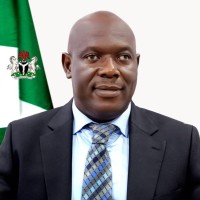
The Hydrocarbon Pollution Remediation Project (HYPREP) has commemorated the 15th anniversary of the release of the United Nations Environment Programme (UNEP) Environmental Assessment Report on Ogoniland, reaffirming its commitment to restoring the environment and improving the livelihoods of affected communities.
In a statement signed by the Project Coordinator, Prof Nenibarini Zabbey, to commemorate the anniversary, HYPREP described the anniversary as a significant milestone in Nigeria’s environmental restoration efforts, noting that the project has made remarkable progress in implementing the recommendations of the landmark UNEP report released on August 4, 2011.
The UNEP report had revealed extensive oil pollution across Ogoniland, severe environmental degradation, and serious public health risks resulting from decades of petroleum operations. It also recommended an initial $1 billion fund to commence the cleanup of the affected communities.
According to HYPREP, the Federal Government formally launched the Ogoni clean-up in 2016, while the Project Coordination Office was established in 2017 to drive the implementation of UNEP’s recommendations.
Zabbey said the current administration has continued to prioritise the project under the Renewed Hope Agenda.
Providing an update on the cleanup, the Project Coordinator disclosed that 30 of the 65 contaminated sites identified by UNEP have been fully remediated, while work is ongoing at several medium- and high-risk locations. It also stated that more than 1.5 million mangrove seedlings have been planted as part of what it described as the world’s largest restoration of oil-degraded mangroves, with over 1,000 hectares of shoreline already rehabilitated.
Zabbey further revealed that 49 Ogoni communities have been connected to potable water schemes through multiple water projects and booster stations aimed at providing safe drinking water across the region.
In the health sector, he said the 100-bed Ogoni Specialist Hospital in Kpite and the 43-bed Cottage Hospital in Buan are nearing completion, adding that several existing health facilities have been upgraded with modern medical equipment, while five ambulances have been donated to improve emergency healthcare services. The Project Coordinator also disclosed that a three-year human health biomonitoring study is being conducted in collaboration with the World Health Organization’s International Agency for Research on Cancer (IARC).
On economic empowerment, Zabbey stated that the Project has created more than 8,000 direct jobs and trained thousands of Ogoni youths and women in various vocational and technical skills, including software development, cybersecurity, aviation, commercial diving, seafaring, mechatronics, and creative arts. The project also reported awarding scholarships to more than 1,000 students, providing grants to small businesses, and supporting persons living with special needs through skills acquisition programmes.
The statement further highlighted ongoing legacy projects, including the Ogoni Power Project and the Centre of Excellence for Environmental Restoration, which it said is about 96 per cent complete. HYPREP also welcomed the recent designation of the Ogoni Wetland as a Ramsar Site of International Importance and pledged to continue promoting biodiversity conservation and sustainable management of the ecosystem.
Marking the anniversary, Zabbey said the progress achieved over the past 15 years demonstrates the collective commitment of government, development partners, stakeholders, and local communities to restoring Ogoniland. He called for renewed collaboration to sustain the cleanup effort, promote environmental sustainability, and support the long-term development of the region. 3
-

 News2 days ago
RSG Targets Nine Million Residents in Mosquito Net Distribution Campaign
-

 Oil & Energy2 days ago
Aiyedatiwa Signs New Electricity Bill
-

 Oil & Energy2 days ago
NLNG Commissions Research And Innovation Centre In RSU
-

 Maritime2 days ago
Marine Minister Commends President Tinubu On NPERA Bill Assent
-

 News2 days ago
KenPoly Holds Eight Convocations, August 29
-

 News2 days ago
RSG Begins Another Phase of Projects Commissioning Today
-

 News2 days ago
RMAFC Completes Revenue Sharing Review, Proposes New Pay
-

 Maritime2 days ago
NAGAFF Petitions IGP Over Alleged Maritime Police Harassment