
Nation
THE STATES

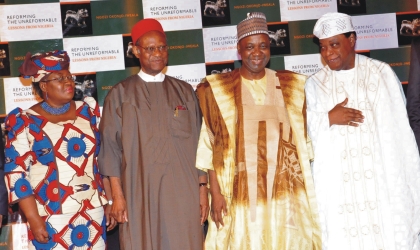
R-L: Minister of Finance and author of the book, Dr Ngozi Okonjo-Iweala; former Commonwealth Secretary General and Chairman of the occasion, Chief Emeka Anyaoku, representative of the President of Nigeria, Vice President Namadi Sambo and the Chief Launcher, Ide Ahaba, Chief Sonny Odogwu, at a book presentation entitled `Reforming The Unreformable, Lesson From Nigeria' by Dr Iweala in Abuja,recently. Photo: NAN.
Benue
Benue State Commissioner for Education, Dr Elizabeth Ugo, has advised secondary schools principals in the state to desist from admitting students into JSSIII, SSII and SSIII classes.
Ugo gave this advice in Makurdi at a meeting between the ministry and stakeholders in the education sector.
The commissioner who emphasised that the stoppage of the practice had become necessary to check and to eliminate all forms of examination malpractice., lamented that Benue was always on top of the chart of states that indulged in examination malpractice, adding that the development was tarnishing the image of the state.
Ekiti
The Chairman, Ekiti Christian Pilgrims Welfare Board, Chief Aaron Komolafe, has urged contingent to the 2012 Jerusalem pilgrimage to see the exercise as a serious spiritual one and not as a jamboree.
He gave the charge in Ado-Ekiti at a one-day orientation programme organised for the intending pilgrims.
Komolafe, who noted that the programme was aimed at sensitising intending pilgrims on what would be required of them before and during the pilgrimage, advised them to allow the impact of pilgrimage to reflect on them, their families, Ekiti and the country at large.
He warned them to be moderately dressed and to exhibit characters that would show them as people from the land of honour, adding that they should be good ambassadors of the state.
FCT
The Minister of State for Education, Chief Nyesom Wike has urged the Universal Basic Education Commission to improve its monitoring and evaluation of basic education projects.
Wike, who made the call while monitoring the Federal Government Special Girl-Child School project in Lafia, Nasarawa State, said that the practice would ensure that the projects achieved their desired results.
He expressed disappointment over the poor supervision of construction work in the school and regretted that the quality of job carried out by the contractor under the supervision of UBEC consultant was below the specification of the Federal Government.
“I wonder why UBEC consultant would write the UBEC management claiming that the school has been fully completed and initiating the takeover process for the school.
Gombe
All Farmers Association of Nigeria (AFAN), Gombe State Chapter, says over 1,600 farm lands were affected by flood in the state.
The Secretary of the association, Alhaji Gambo Sarkin-Noma disclosed this in an interview with newsmen in Gombe.
He said that members of the association accompanied the committee set up by the Federal Government to inspect some of the affected areas that were seriously flooded, noting that plans were under way to drill boreholes in those areas for irrigation purposes.
According to him, almost every part of the state was affected but he identified the areas worst hit to include Dadin-Kowa in Yamaltu/Deba Local Government area which is close to the upper Benue river basin.
Jigawa
The Chairman, Jahun Local Government of Jigawa State, Alhaji Idris IIIiyasu has warned traders against indiscriminate dumping of wastes.
Illiyasu gave the warning while inspecting shopping malls, canteens and restaurants in Jahun town.
He decried the practice of indiscriminate dumping of waste by the traders, saying that the filthy environment exposed the residents to health risks.
“Poor waste disposal is posing serious environmental challenges,” he said, adding that the council would not condone acts capable of destroying the environment.
Kaduna
The Kaduna State Government said it spent more than N85 million on the payment of fees for its students that sat for the rescheduled 2011/2012 NECO examinations.
The state Commissioner for Education, Alhaji Muhammed Usman, said this in an interview with newsmen in Kaduna.
Usman said the amount was used to pay the fees for all candidates in public and private schools in the state.
The examinations were rescheduled following the June 17 bomb attack on Churches in Zaria and Kaduna, and the reprisals that followed which led to the imposition of a curfew in the state.
Kano
Livestock traders in Kano State said that they recorded low patronage during the Eid-el-Kabir celebration.
Muslims worldwide celebrated Eid-el Kabir last Friday to mark the end of the 2012 Hajj operation.
“We have no choice but to return our unsold animals home due to low sales recorded this year,” some of the traders said.
Malam Habu Mu’azu, a trader from Rimin-Gado Local Government area of Kano, said he recorded a loss due to poor patronage.
“This year has been a horrible one in terms of sales. I brought 30 rams but I only sold eight during the two weeks of my stay in the city.”
Kebbi
The Kebbi State Government has released N156 million for the payment of tuition and registration fees for indigent students on scholarship in tertiary institutions.
The executive secretary of the state scholarship board, Alhaji Murtala Yauri told newsmen in Birnin Kebbi has that the payment to each institution would be immediate.
He said personal details of beneficiaries would be scrutinised to avoid irregularities, adding that students who had earlier paid their tuition or registration fees would be refunded “after showing evidence of such payment”.
He said N1.2 billion had been spent in the past two years for the payment of tuition and registration fees for students within and outside the country, pointing out that the government recently released N67 million for the sponsorship of 32 indigent students to study Medicine and Pharmacy in Sudanese Universities.
Kwara
The Kwara State Government has expressed its readiness to promote the cultivation of ‘Moringa’ plant tree because of its medicinal and economic potential.
Governor Abdulfatah Ahmed stated this in Ilorin in a message to the conference of the ‘Moringa’ Development Association.
He said that the government would encourage youths undergoing training at the Youth Farm Centre, Malete, in Moro Local Government Area to go into large-scale ‘Moringa’ farming with a view to boosting the state’s economy.
Lagos
Community Conservation and Development Initiatives (CCDI), an NGO, has urged local governments to establish local emergency management committees in their communities.
CCDI’s Director of Programmes, Mrs Kofo Adeleke, said in a statement in Lagos that such committees would be needed in disaster risk reduction and management.
Adeleke said that it was imperative for councils in the country’s six geopolitical zones to have structures on ground for reducing flood-related emergencies.
“Local councils in different parts of Nigeria need to be prompted to have these committees in place, as recently directed by the National Emergency Management Agency (NEMA),” she said.
Nasarawa
The Nasarawa State Commissioner for Women Affairs and Social Development,Hajia Hadiza Alakayi, has urged parents to give priority to girl-child education to develop the state.
The Commissioner made the call at Obi during her familiarisation tour of Obi Local Government Area (LGA) of the state.
According to her, educating a female child is like educating the entire society; this is because women are vital instruments for development in every society.
She urged parents who considered the education of a girl-child as less important to reverse such notion and act wisely as that would enable them to overcome future challenges.
Ogun
The Ogun State Chief Judge, Justice Tokunbo Olopade, has set free 13 inmates in Ijebu-Ode and Sagamu prisons.
The inmates were released during the visit of the chief judge to the two prisons.
Nine inmates including four women regained their freedom in Ijebu Ode while an additional four in Sagamu prison had their sentences quashed.
The offences committed by the former inmates ranged from wandering, stealing, inability to repay loans as well as fighting.
Speaking during the visit, Olopade decried the attitude of the police in duplicating case files of the inmates, which she said, was making efforts at releasing those unjustly detained difficult.
Yobe
The Yobe State Livestock Development Programme said it had targeted 2,000 youths and women for training on commercial livestock farming and fattening before the end of the year.
The Programme Manager, Dr Mustapha Gaidam, who disclosed this in an interview with newsmen in Damaturu said that the training would equip youths and women with techniques on commercial livestock farming as a means of employment and wealth creation.



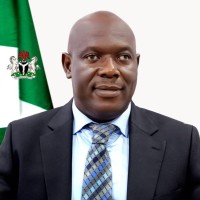
The Hydrocarbon Pollution Remediation Project (HYPREP) has commemorated the 15th anniversary of the release of the United Nations Environment Programme (UNEP) Environmental Assessment Report on Ogoniland, reaffirming its commitment to restoring the environment and improving the livelihoods of affected communities.
In a statement signed by the Project Coordinator, Prof Nenibarini Zabbey, to commemorate the anniversary, HYPREP described the anniversary as a significant milestone in Nigeria’s environmental restoration efforts, noting that the project has made remarkable progress in implementing the recommendations of the landmark UNEP report released on August 4, 2011.
The UNEP report had revealed extensive oil pollution across Ogoniland, severe environmental degradation, and serious public health risks resulting from decades of petroleum operations. It also recommended an initial $1 billion fund to commence the cleanup of the affected communities.
According to HYPREP, the Federal Government formally launched the Ogoni clean-up in 2016, while the Project Coordination Office was established in 2017 to drive the implementation of UNEP’s recommendations.
Zabbey said the current administration has continued to prioritise the project under the Renewed Hope Agenda.
Providing an update on the cleanup, the Project Coordinator disclosed that 30 of the 65 contaminated sites identified by UNEP have been fully remediated, while work is ongoing at several medium- and high-risk locations. It also stated that more than 1.5 million mangrove seedlings have been planted as part of what it described as the world’s largest restoration of oil-degraded mangroves, with over 1,000 hectares of shoreline already rehabilitated.
Zabbey further revealed that 49 Ogoni communities have been connected to potable water schemes through multiple water projects and booster stations aimed at providing safe drinking water across the region.
In the health sector, he said the 100-bed Ogoni Specialist Hospital in Kpite and the 43-bed Cottage Hospital in Buan are nearing completion, adding that several existing health facilities have been upgraded with modern medical equipment, while five ambulances have been donated to improve emergency healthcare services. The Project Coordinator also disclosed that a three-year human health biomonitoring study is being conducted in collaboration with the World Health Organization’s International Agency for Research on Cancer (IARC).
On economic empowerment, Zabbey stated that the Project has created more than 8,000 direct jobs and trained thousands of Ogoni youths and women in various vocational and technical skills, including software development, cybersecurity, aviation, commercial diving, seafaring, mechatronics, and creative arts. The project also reported awarding scholarships to more than 1,000 students, providing grants to small businesses, and supporting persons living with special needs through skills acquisition programmes.
The statement further highlighted ongoing legacy projects, including the Ogoni Power Project and the Centre of Excellence for Environmental Restoration, which it said is about 96 per cent complete. HYPREP also welcomed the recent designation of the Ogoni Wetland as a Ramsar Site of International Importance and pledged to continue promoting biodiversity conservation and sustainable management of the ecosystem.
Marking the anniversary, Zabbey said the progress achieved over the past 15 years demonstrates the collective commitment of government, development partners, stakeholders, and local communities to restoring Ogoniland. He called for renewed collaboration to sustain the cleanup effort, promote environmental sustainability, and support the long-term development of the region. 3
-

 News2 days ago
RSG Targets Nine Million Residents in Mosquito Net Distribution Campaign
-

 Oil & Energy2 days ago
Aiyedatiwa Signs New Electricity Bill
-

 Maritime2 days ago
Marine Minister Commends President Tinubu On NPERA Bill Assent
-

 Oil & Energy2 days ago
NLNG Commissions Research And Innovation Centre In RSU
-

 News2 days ago
KenPoly Holds Eight Convocations, August 29
-

 News2 days ago
RMAFC Completes Revenue Sharing Review, Proposes New Pay
-

 News2 days ago
RSG Begins Another Phase of Projects Commissioning Today
-

 Maritime2 days ago
NAGAFF Petitions IGP Over Alleged Maritime Police Harassment