
Nation
THE STATES

Adamawa
Members of People’s Democratic Party (PDP) in the Adamawa House of Assembly have assured Governor Murtala Nyako of their block votes ahead of the party’s primaries for the state governorship election in 2012.
The development was sequel to a motion moved by Alhaji Umaru Ahmadu, the Majority Leader of the House and member representing Madagali Constituency.
The motion was seconded by Mrs Wilbina Jackson (PDP-Guyuk).
Moving the motion, Ahmadu said all the 20 PDP members in the Assembly had mandated him as their leader to present their position and resolved to give Nyako full support at the party’s governorship primaries and main election.
He said the governor had delivered in all sectors of the economy in his first tenure and deserved to continue in office for a second term.
The lawmakers passed the motion at their session presided over by Speaker Ibrahim Sadiq,
Nyako and a former lecturer, Dr Umar Ardo, have been cleared by PDP for its primaries scheduled for October 24.
Benue
Prof. Chukwudi Obinne of the University of Agriculture, Makurdi, has stressed the need for adequate sensitisation of farmers on various aspects of agriculture to ensure food security in the the world.
Obinne, who made the call in an interview with newsmen in Makurdi, said that farmers in developing countries did not receive the relevant training in farming.
The professor also said that if farmers were encouraged to venture into mechanised farming through necessary incentives, the level of food production would drastically improve.
He said that adult farmers got weaker because of the manual labour associated with agriculture and because they had little understanding of new technologies available to them to improve production.
FCT
The Senate Committee Chairman on Science and Technology, Sen. Robert Boroffice, has assured the Ministry of Science and Technology of the Senate’s cooperation to boost its programmes.
Boroffice gave the assurance on Monday, in Abuja, in an interview with newsmen at the opening of a workshop on the International Space Weather Initiative.
He said that the committee, which was made up of committed members, would do its best to address the challenges facing the sector.
“Working with the Ministry of Science and Technology, we are sure that we would be able to ensure that adequate funding is provided for the sector. ’’
He said that the committee would equally collaborate with the Executive arm of government to develop the sector.
Jigawa
The United Nations Development Programme (UNDP) has indicated interest to partner with Jigawa government on job creation.
The UNDP Resident Representative, Mr Douda Toure, gave the indication when he paid a visit to Gov. Sule Lamido in Dutse on Monday.
Toure said the organisation would collaborate with the state government on job creation for the youth and women.
He said that UNDP was also willing to cooperate with the government in other areas to enhance development in the state.
In his response, Lamido said the state government would partner with UNDP and other interested organisations in its drive to boost development in the state.
Kaduna
The Kaduna State Chapter of the NLC and the Trade Union Congress (TUC) in Kaduna have suspended their planned strike over the non-implementation of the N18,000 minimum wage in the state.
Addressing newsmen, the Chairman of the NLC in the state, Mr Adamu Ango, said the strike was suspended because of the agreement between labour and the government over the new table which covered grade levels nine to 17 that were excluded from the previous chart.
Ango said the two unions had agreed and adopted the new table after studying it and decided on the suspension of the proposed strike.
Kano
The Parent-Teacher Association of Gwammaja Model Primary School in Dala Local Government Area of Kano State has donated 50 chairs and two sets of computer to the school.
Presenting the items, the Chairman of the association, Alhaji Isa Salihu, said similar donations of books and other teaching materials had been made to the school in the past.
He advised the Education Department of the local government to deploy additional teaching staff and strive to provide a conducive atmosphere for learning in the school.
Receiving the chairs and computers on behalf of the school, the Chairman of the State Universal Basic Education Board, Alhaji Yakubu Adamu, reiterated the commitment of the state government to raise educational standards.
Kogi
The Chief Judge of Kogi, Justice Nasir Ajanah, has decried the poor performance of lower courts in the determination of cases brought before them.
Speaking at a special court session to herald the commencement of the 2011/2012 Legal Year in Lokoja, he said that courts in the state received 29,096 cases in the out-going year, out of which 15,150 were disposed of.
The remaining 13,919 cases, he added, were allowed to spill over to the new legal year, noting that a great percentage of the carry-over were from the lower courts.
Ajanah said that of the 1,845 cases pending in the state High Courts in the out-going year, 1,210 were fully determined, leaving 635, while the 38 magistrates’ courts received 3,768 cases, and disposed of 1,920.
Lagos
The Lagos State House of Assembly (LSHA) has passed a resolution to organise a public hearing on the planned removal of fuel subsidy by the Federal Government
To this end, the House has raised a seven-man committee to organise the hearing, scheduled for October 27.
In a motion moved on the floor of the House by Mr Sanai Agunbiade (ACN-Ikorodu I), the lawmakers expressed concern over moves to remove fuel subsidy in 2012.
The committee chaired by Agunbiade, includes Mr Rotimi Olowo (Somolu I), Mr Yishawu Gbolahan (Eti-Osa), Mr Hodewu Avoseh (Badagry II) and Mr Hakeem Masha (Lagos Island).
Others are Mr Sultan Adeniji-Adele (Amuwo-Odofin) and Mr Abiodun Tobun (Epe II).
Niger
Governor. Babangida Aliyu of Niger State has said the State Government had so far spent about three billion naira on Millennium Development Goals MDGs projects between 2008 and 2009.
Aliyu made the remark while receiving an award of‘“The International Millennium Development Ambassador” by Global Educator for All Initiative at Government House, Minna, saying the money was expended on quick-win projects and conditional cash transfer.
He cited some constraints militating against the country in meeting its MDGs’ targets by 2015, expressing the hope that the country could meet the target five years after the deadline.
Ogun
Small-scale farmers under the aegis of Association of Small-scale Agro-Producers in Nigeria (ASSAPIN), Ogun State Chapter has decried poor funding of agriculture by the three-tiers of government in the country.
They, however, urged governments at all levels to increase budgetary allocation to agriculture to avert food crisis in the country.
The farmers were gathered in Ijebu-Ode, Ogun yesterday to examine the theme for the 2011 World Food Day: “Food Crisis: From Crisis to Stability”.
They said that there was an urgent need for government at all levels to invest more in agriculture to avert looming food crisis.
Mrs Ireti Disu, the Assistant Director of Justice, Development and Peace Commission (JDPC), Ijebu-Ode Catholic Diocese, said that the poor funding of agriculture had resulted in increased prices of food.
Plateau
A Federal High Court sitting in Jos yesterday discharged and acquitted six suspects accused of participating in the January 20 crisis in the Plateau capital.
The suspects are Alhassan Mohammed, Abubakar Samaila, Abubakar Shuaibu, Buhari Dahiru, Ibrahim Musa and Nasiru Idris.
They were charged with terrorism after allegedly participating in the crisis in which many lives were lost and property worth millions of naira destroyed.
A federal Prosecution Counsel, Mr Gbenga Walington, had earlier told the court, presided over by Justice Ambrose Allagoah, that he could not press charges against the accused.
He said that he was in a “precarious situation,’’ having failed to trace the military officers who arrested the suspects on the day the violence erupted.
Yobe
More than 8,000 youths in Yobe are beneficiaries of the World Bank credit facility under FADAMA III programme, Governor Ibrahim Gaidam has said.
The governor made this known when participants of the National Defence Course 20 visited him at the Government House, Damaturu.
He said that the programme, geared toward dry season farming, had been part of the measures taken by his administration to improve the economic status of people at the grass roots.
He pointed out that the scheme, designed to to encourage self-reliance, was also a source of revenue for the state government.
Gaidam said the government was also developing a Gum Arabic plantation to check desert encroachment and that there were youth empowerment farms in the 17 local government areas of the state.
On measures to boost the state’s internal revenue, he said government had constructed a 3-Star Hotel in Damaturu apart from organising local festivals.



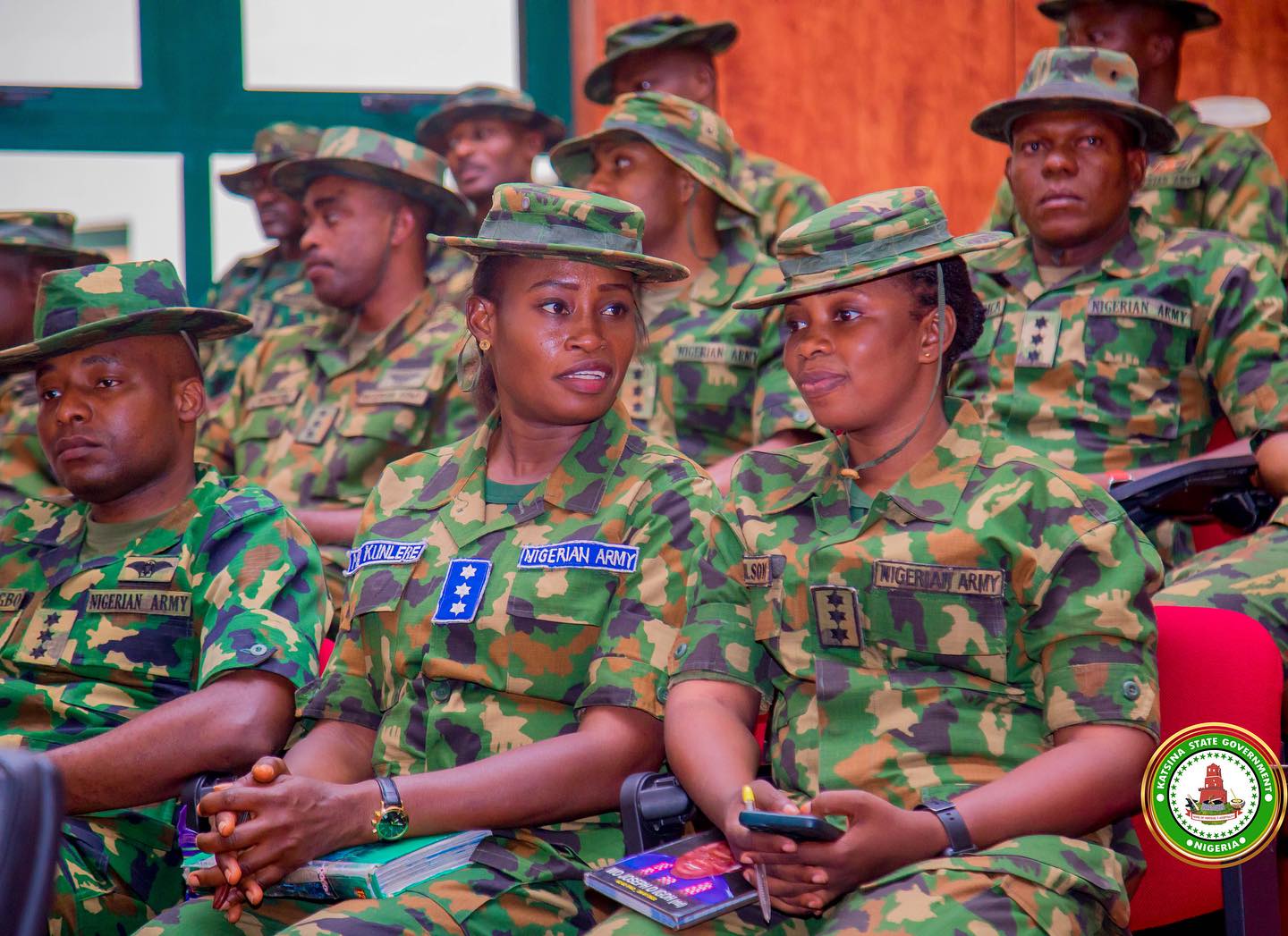
The Nigerian Army has passed out 384 female soldiers of the 90 Regular Recruit Intake (90 RRI) following the successful completion of Exercise SHINING STAR 2026 in Giri, Abuja.
In a post shared on the Nigerian Army’s X handle, yesterday, the Assistant Director, Army Public Relations, Nigerian Army Women Command, Giri, Abuja, Major Nsima Essien, said the passing-out ceremony was held on Wednesday, 28 October 2026, at the Nigerian Army School of Public Relations and Information (NASPRI), Giri, with the Chief of Army Staff (COAS), Lieutenant General W. Shaibu, represented by Major General Umar Gital Yusuf, as the Guest of Honour.
In his address, the Army Chief commended the female personnel for their dedication, resilience, discipline and commitment throughout the training exercise.
He described the successful completion of the exercise as an important milestone in their military careers and reaffirmed the Nigerian Army’s commitment to developing a professional, disciplined and combat-ready force.
He urged the newly trained soldiers to uphold the values of teamwork, courage, loyalty and professionalism, while applying the knowledge and skills acquired during the exercise to their military duties.
Shaibu emphasised the importance of continuous training, physical fitness and operational preparedness in addressing contemporary security challenges before declaring the exercise closed.
Earlier, the Acting Commander of the Nigerian Army Women Command (NAWC), Colonel S. M. Ahmed, welcomed the special guest and other dignitaries to the ceremony.
Ahmed highlighted the significance of Exercise SHINING STAR 2026 in enhancing the physical fitness, military competence, discipline and operational readiness of the female personnel.
He also acknowledged the contributions of the authorities, instructors and other personnel whose efforts ensured the successful conduct of the exercise.
Highlights of the ceremony included obstacle-crossing demonstrations and weapons-handling exercises, during which the female soldiers demonstrated their ability to strip and assemble AK-47 rifles while blindfolded.
The demonstrations showcased the personnel’s physical endurance, confidence, weapons-handling skills and proficiency in basic military tasks.
“A total of 384 female personnel of the 90 RRI participated in the exercise, alongside 14 male personnel from the Headquarters, Directorate of Army Physical Training (HQ DAPT), and 70 male personnel from the 167 Special Forces Battalion, “ Ahmed said.
The ceremony attracted senior military officers from various units and formations, representatives of paramilitary agencies and other invited guests.
Eight male and female personnel who distinguished themselves during the exercise received awards presented by the Acting Commander of NAWC.
The event also featured a vote of thanks delivered by one of the beneficiaries, the presentation of souvenirs and a group photograph to commemorate the successful completion of the exercise.
The exercise forms part of the Nigerian Army’s efforts to strengthen personnel development, improve military competence and enhance operational readiness in response to the country’s evolving security challenges.
As the world marked the 2026 International Day of the Girl Child on Sunday, October 11, 2026, a non-governmental organisation, Stand Up for Women Society (SWS) has intensified its campaign against child marriage, urging schoolgirls to prioritise education, protect their rights and develop skills for a better future.
The organisation joined the global observance of the day under the theme, “International Day of the Girl Child: End Child Marriage and Invest in Girls’ Rights,” with a sensitisation programme at Government Girls Secondary School, Oromenike, D-Line, Port Harcourt, Rivers State.
Led by its Vice Chairperson, Daba Benebo, the group engaged the students in discussions on the dangers of early marriage, teenage pregnancy, sexual abuse and other challenges that threaten the education, safety and development of the girl child.
Speaking during the programme, Benebo urged the students to reject early marriage and remain focused on their studies, stressing that education would empower them to make informed decisions about their lives and future.
She cautioned the girls against allowing anyone to deprive them of their right to education and dignity, advising them to report cases of harassment, abuse and other violations of their rights to the appropriate authorities.
Benebo assured the students that SWS remained available to support them whenever they encountered violations of their rights.
She also encouraged them to maintain discipline and responsible conduct while avoiding behaviours that could expose them to negative influences and jeopardise their future.
Beyond formal education, the SWS vice chairperson urged the students to acquire vocational skills that could provide additional opportunities for economic independence and help them navigate future challenges.
The sensitisation programme, enlivened by singing, dancing and to share their views and experiences on issues affecting the girl child interactive sessions, provided an opportunity for the students to share their views and experiences on issues affecting the girl child.
One of the major issues raised during the discussion was the appropriate age for marriage. While some participants maintained that 18 years was the constitutionally approved age, the discussion highlighted the need to consider not only age but also the maturity, preparedness and responsibilities associated with marriage.
The speaker stressed that marriage required adequate mental and emotional preparation, as well as the capacity to shoulder its responsibilities.
She therefore advised the students to concentrate on acquiring a sound education before considering marriage, noting that education would equip them with the knowledge and skills needed to make responsible decisions and manage family life.
The issue of teenage pregnancy also featured prominently during the question-and-answer session.
In addressing the subject, the speaker explained that pregnancy could occur even at the age of 12, using the example to underscore the vulnerability of young girls to the consequences of early sexual activity.
She advised the students to avoid sexual intercourse and prioritise their education, personal safety and future aspirations.
The discussion also examined the difficulties some girls encounter when living with hostile spouses, relatives or guardians.
Benebo encouraged the students to cultivate patience, humility and diligence, noting that these qualities could help them navigate difficult situations and build a brighter future.
However, she warned that patience and humility should never be interpreted as an obligation to endure violence, abuse or degrading treatment.
She urged girls experiencing hostile or abusive living conditions to seek help from their parents, trusted adults or appropriate support services rather than remain in environments that could expose them to physical or emotional trauma.
“When such happens, please return to your parents and engage in petty trade or learn a skill to support your education rather than stay in a hostile environment,” Benebo stressed.
The programme also underscored the importance of protecting girls from early marriage and other harmful practices that can disrupt their education, compromise their well-being and limit their opportunities in life.
It also reinforced the need for families, schools, communities and relevant organisations to work together to ensure that girls have access to education, vocational training, protection and the support they need to realise their potential.
For SWS, the message was clear: empowering the girl child begins with protecting her rights, investing in her education and equipping her with the confidence and skills to make informed choices about her future.
Stories by Kevin Nengia
The Egberipapa Foundation has unveiled a mass transit scheme aimed at easing transportation difficulties and improving connectivity among communities in the three Kalabari local government areas of Asari-Toru, Degema and Akuku-Toru in Rivers State.
The initiative, established by former Caretaker Committee Chairman of Akuku-Toru Local Government Council, High Chief Sobomabo Jackrich, popularly known as Egberipapa, is designed to make transportation more accessible and affordable for residents across the Kalabari area.
The scheme was launched on Monday, October 12, 2026, and is expected to address longstanding transportation challenges confronting residents, particularly those in riverine and hard-to-reach communities.
Communities expected to benefit from the initiative include Krakrama, Minama, Angulama, Sangama, Omekwe-Tariama and Omekwe-Ama.
The project is expected to ease movement within and beyond the Central Group area, while providing residents with a more convenient means of transportation for their daily activities.
For decades, transportation difficulties have posed significant challenges to several Kalabari communities, making movement between settlements both cumbersome and expensive. These challenges have also affected commercial activities, social interactions and access to essential services.
The introduction of the mass transit scheme is therefore expected to provide relief to residents, strengthen inter-community connections and stimulate economic activities across the benefiting communities.
Beyond improving mobility, the initiative could contribute to community development by facilitating the movement of people and goods, supporting local businesses and enhancing social and economic interactions within the Kalabari area.
As the scheme gets underway, attention will be focused on its implementation, accessibility and sustainability, as well as its capacity to deliver lasting transportation benefits to the target communities.
The initiative represents a potentially significant step towards addressing transportation challenges and promoting grassroots development across the Kalabari Kingdom.
-
News4 days ago
Parents Protest Scholarship Scheme Suspension At PAMO Varsity
-
 News4 days ago
US Hails Nigerian Military For Rescuing 125 Kidnap Victims
-
News24 hours ago
Bayelsa Boat Mishap: Tinubu Donates N250m As Death Toll Hits 29
-
News24 hours ago
Odu Pays Tribute To Late Chinwah, Describes Him As Courageous, Selfless Academic
-
Business4 days ago
Reps Raise Alarm Over N2trn Agricultural Loan Diversion
-

 Featured4 days ago
Presidents Xi, Trump, Putin Commit To Global Stability, Denuclearisation
-
Politics4 days ago
ADC Faults INEC’s Alleged Limited Capacity To Upload Election Result On IREV
-
Politics4 days ago
Tinubu Expands 2027 Campaign Tour To 19 States