
Politics
CPC Boss Makes Case For State Police

The National Chairman of the Congress for Progressive Change (CPC), Prince Tony Momoh, has said that the party’s manifesto has provision for the establishment of a state police.
Momoh who made the statement in an interview with newsmen in Abuja said, “ our party has provided in its manifesto for the restructuring of the country and one of the areas is diversifying the police force so that we would have state police and even community policing,’’ he said.
According to him, the party believes that the central force alone cannot secure Nigeria.
The CPC National Chairman noted that the police had been the formal body in charge of policing.
He said, “individuals too have to be involved because the law itself provides for citizens to be part and parcel of securing the environment against armed robbery, kidnapping among others.
“In a situation where a state governor who is the state’s chief security officer cannot have command over the police in an emergency, he can be likened to a toothless bulldog,’’ he said.
This, he said, was so because in the constitution, the Commissioner of Police could only take order from the Inspector General of Police who is under the Presidency.
Momoh maintained that unless the Nigerian Police was decentralised, there would not be free flow of law enforcement processes.
He said: “ after the post-election violence, one person decided to put the entire North under siege as a Commander in Chief.
“But I believe in a situation where a state governor can have the right to declare a curfew in his/her state if there is security challenges. I believe that would be a welcome development. ’’
An official of the CPC, who did not want his name published, said that the security challenges in the country were not about constitutional amendment.
According to him, the insecurity was about injustice and the only way forward was for “our leaders to be forthright’’.
“Let us have a free and fair society because there can never be security where there is no justice,’’ he stressed.



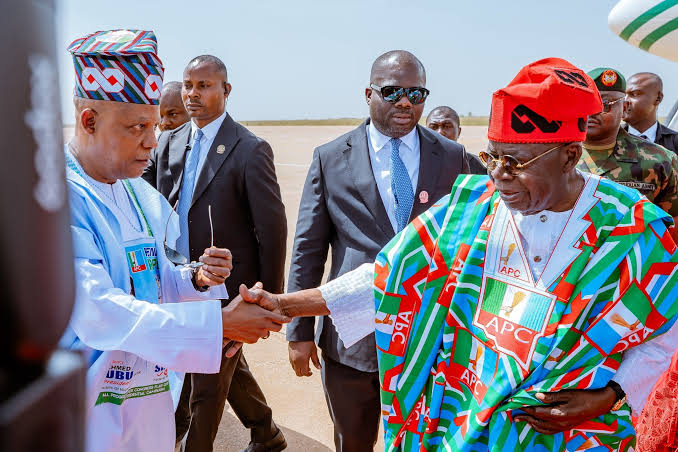
The campaign rally, held at the Kaduna Township Stadium, attracted Vice-President Kashim Shettima, APC governors, party leaders, federal and state lawmakers, political stakeholders and supporters from across the country.
The flag-off marks the beginning of the APC’s drive to secure a second presidential term for President Tinubu, with the party expected to promote its achievements, defend its economic reforms and outline its policy priorities under the proposed Renewed Hope 2.0 agenda.
Kaduna’s selection for the campaign launch underscores the strategic importance of the North-West, a region with a substantial voting population and considerable influence on presidential election outcomes.
The APC faces a significant challenge in Kaduna, where the Peoples Democratic Party’s presidential candidate, Alhaji Atiku Abubakar, defeated President Tinubu in the 2023 election. The rally therefore provides the ruling party an opportunity to strengthen its grassroots structures and regain electoral support in the state.
Addressing supporters, Vice-President Shettima appealed to Northern voters, highlighting President Tinubu’s political relationships with prominent Northern leaders, including Alhaji Abubakar, Mallam Nuhu Ribadu and the late President Muhammadu Buhari.
The Vice-President’s appeal reflects the APC’s determination to consolidate its support in the North as the party intensifies preparations for the presidential contest.
The Renewed Hope 2.0 agenda is expected to feature prominently in the campaign, providing a platform for President Tinubu to explain his administration’s economic policies and outline plans for another term.
However, the President’s record on economic reforms, rising living costs, petrol prices, employment, infrastructure and insecurity is expected to attract considerable scrutiny during the electioneering period.
-

 Education2 days ago
FCE Yola Graduates 3,555 Teachers , Seeks Upgrade to University
-

 Sports2 days ago
Nigerian Trio Target Titles At PFL Africa Finals
-

 Niger Delta2 days ago
Diri Restates Stance On Lagos-Calabar Coastal Highway
-

 Niger Delta2 days ago
C’River, NUJ Pay Tribute To Late Guardian Editor
-

 News2 days ago
NDLEA Recovers Tons Of Illicit Drug Consignments In Nine States
-

 Opinion2 days ago
Checking Voter Apathy In Nigeria’s Electoral Process
-

 Politics2 days ago
2027: DICKSON’S EX-ALLY VOWS TO WORK AGAINST NDC INTEREST IN BAYELSA
-

 Politics2 days ago
2027: GROUP PLEDGES 40,000 SUPPORTERS FOR COALITION CANDIDATES IN RIVERS