
Politics
National Assembly And Sustainable Democracy

Conventionally, the business of modern government is conducted around three arms, namely the legislature, the executive and the judiciary. This division is inspired by the time honoured doctrine of Separation of Powers, first articulated by the ancient Greek philosopher, Aristotle but made popular by the French political thinker, Baron de Monlesquieu. Writing as early as 384-322 B.C, Aristotle remarked that:
There are three elements in each constitution in respect of which every serious law giver must look for what is advantageous to it. The three are, first, the deliberative, which discusses everything of common importance; second, the officials and third, the judicial element.
This idea was what was later elaborated by Montesquieu into what we generally refer to as the doctrine of separation of powers. Writing in 1748 in De L’Epirit des Loise, Montesqueu posited that: When the legislative and Executive powers are united in the same person or in the same body of magistrates, there is no liberty. There is no liberty, if the judicial powers is not separated from the legislative and executive powers. Were it joined with the legislative powers, the life and liberty of the subjects would be. exposed to arbitrary control, for the judge would be the legislator. Were it joined with the executive power, the judge might behave with violence and oppression. There would be an end of everything were the same man or the same body to exercise these three powers.
In its basic formulation, the doctrine of separation of powers demands that the three primary functions of government namely: law making, implementation and adjudicating or interpreting -the law be entrusted into the hands of three of an over concentration of governmental powers in the hands of a few.
In line with the necessity for separation of powers, sections 4,5 and 6 of the constitution of the Federal Republic of Nigeria (CFRN) 1999 clearly stipulate the powers of the three organs of government. In what follows, we reflect on the powers of the legislature.
The legislature in Nigeria is essentially bicameral and is variously referred to as the National Assembly or Parliament. Bicameralism suggests that the National Assembly is made up of two legislative chambers an upper chamber known as the Senate and a lower chamber known as the House of Representatives. It has a total membership of 469,360 from the lower chamber and 109 from the upper chamber.
The powers of the National Assembly are stipulated in Section 4 (1-(9) of the constitution. Section 4 (2) for instance states that ‘the National Assembly shall have powers to make laws for the people, order and good government of the federation or any part thereof with respect to any matter’. Mamora (2009) categorizes the powers of the legislature into three, namely ‘expressed’, ‘implied’ and ‘assumed’ powers. Expressed powers refer to those powers of the legislature that are clearly spell out in the constitution such as lawmaking, authorisation of expenditure of public funds, creation of states etc. Implied powers refer to those powers which may not be expressly stated in the constitution but which by extension of the constitution; the legislature may, by necessary implication legislate on. These include power of arrest (section 89), power to create new ministries etc. Finally, assumed powers may be exercised by the legislature in response to a constitutional or administrative lacuna. For instance, following the failure of the, late president Yar’ Adua to duly notify the National Assembly of his incapacity arising from ill-health, the National Assembly on the basis of the interview he granted the BBC invoked the doctrine of necessity and passed a resolution’ authorising the then Vice President to assume the position of Acting President.
How well the National Assembly has played the aforementioned roles remain a subject of active popular contestation. For some, the legislature is at best a drain on national resources: given the amount of money it costs the nation to maintain the lawmakers. For instance a popular text message that was circulated in the midst of the brouhuha over the pay of legislators queried:
do you know that it costs taxpayers 290m naira yearly to maintain each member of our National Assembly in a country where nothing works & where 80% of population earn below 300 Naira? A working day earning of a senator is more than a yearly income of a doctor; It’s more than the salary of 42 Army generals or 48 professors or 70 commissioners of police or more than twice the pay of the US president or 9 times the salary of US congressmen …
Others believe that though our democracy is expensive. It is better than the pain that military rule represented. The issue for me is not between democracy and dictatorship. It is about how to sensibly remunerate our lawmakers in a manner that does not amount to a derivation of resources that could be mobililsed for national development. It becomes particularly worrisome against the realisation that in terms of productivity, measured in terms of number of bills passed into laws. The Nigeria’s National Assembly lags behind the American congress, even as its members earn several times over what their American counterparts earn.
The controversy is one which is not about to be resolved and it may not be fruitful to detain ourselves on this any further. Given the specific purview of this presentation, it may be fruitful for us to focus our attention on the role of the National Assembly in sustainable democracy.
Aaron is a lecturer in Uniport
Kikpoye K. Aaron



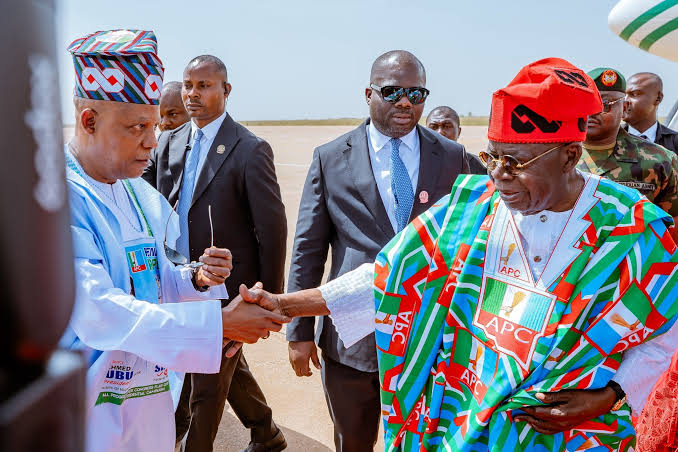
The campaign rally, held at the Kaduna Township Stadium, attracted Vice-President Kashim Shettima, APC governors, party leaders, federal and state lawmakers, political stakeholders and supporters from across the country.
The flag-off marks the beginning of the APC’s drive to secure a second presidential term for President Tinubu, with the party expected to promote its achievements, defend its economic reforms and outline its policy priorities under the proposed Renewed Hope 2.0 agenda.
Kaduna’s selection for the campaign launch underscores the strategic importance of the North-West, a region with a substantial voting population and considerable influence on presidential election outcomes.
The APC faces a significant challenge in Kaduna, where the Peoples Democratic Party’s presidential candidate, Alhaji Atiku Abubakar, defeated President Tinubu in the 2023 election. The rally therefore provides the ruling party an opportunity to strengthen its grassroots structures and regain electoral support in the state.
Addressing supporters, Vice-President Shettima appealed to Northern voters, highlighting President Tinubu’s political relationships with prominent Northern leaders, including Alhaji Abubakar, Mallam Nuhu Ribadu and the late President Muhammadu Buhari.
The Vice-President’s appeal reflects the APC’s determination to consolidate its support in the North as the party intensifies preparations for the presidential contest.
The Renewed Hope 2.0 agenda is expected to feature prominently in the campaign, providing a platform for President Tinubu to explain his administration’s economic policies and outline plans for another term.
However, the President’s record on economic reforms, rising living costs, petrol prices, employment, infrastructure and insecurity is expected to attract considerable scrutiny during the electioneering period.
-

 Education2 days ago
FCE Yola Graduates 3,555 Teachers , Seeks Upgrade to University
-

 Sports2 days ago
Nigerian Trio Target Titles At PFL Africa Finals
-

 Niger Delta2 days ago
Diri Restates Stance On Lagos-Calabar Coastal Highway
-

 Niger Delta2 days ago
C’River, NUJ Pay Tribute To Late Guardian Editor
-

 News2 days ago
NDLEA Recovers Tons Of Illicit Drug Consignments In Nine States
-

 Opinion2 days ago
Checking Voter Apathy In Nigeria’s Electoral Process
-

 Politics2 days ago
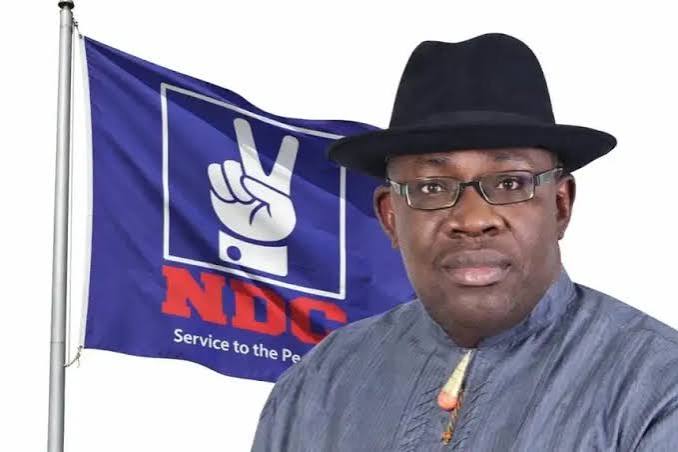
2027: DICKSON’S EX-ALLY VOWS TO WORK AGAINST NDC INTEREST IN BAYELSA
-

 Politics2 days ago
2027: GROUP PLEDGES 40,000 SUPPORTERS FOR COALITION CANDIDATES IN RIVERS