
News
Catholic Bishops Tackle Northern Govs Over Insecurity

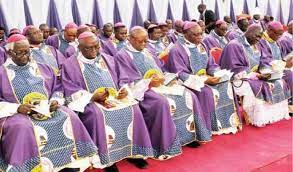
Catholic Bishops of Kaduna Ecclesiastical Province have blamed Nigerian leaders and Northern governors for the rising cases of insecurity in the country and Northern region in particular.
The bishops noted that most policies and programmes of the governors are geared towards one particular religion to allegedly encourage evil perpetrators to hide under them to wreck havoc on innocent people.
The clerics also pointed out that current cases of killing and blood-letting of innocent citizens was akin to civil war of 1967, adding that the country is really at war with enemies that are hiding under religion to perpetrate evils.
In a pastoral statement by jointly signed by Archbishop of Kaduna and Metropolitan, Dr Matthew Man-Oso Ndagoso; and Archbishop of Kaduna Ecclesiastical Province, Dr John Namaza Niyiring, yesterday, pointed out that killings by kidnappers, bandits, as well as terrorist groups have made Nigeria the most terrorised country in the world.
To this end, the clergymen said they have declared a week of prayer and fasting for peace to return to the land, adding that the week of prayer will be formally declared open by the Bishop which will end with a Rosary procession and benediction in Catholic churches.
“The last few years have been the most trying times in the history of our nation. A culture of self-doubt and uncertainty has bred fear, anxiety and deep suspicion among our people. Except for the civil war, our nation has never witnessed the kind of wide spread macabre, evil, wanton destruction and murderous blood-letting. Life has never been so cheap, nor has Nigeria ever been at the stage we are in now. Deaths in the hands of kidnappers, killer herdsmen, bandit, terrorist groups have made Nigeria the most terrorised country in the world.
“We are now one of the most dangerous places to be born into, the least peaceful countries in the world. Everywhere you turn, funerals have become our daily menu. The abductions of school children have presented us with the prospects of a traumatised generation of young students. Even at the best of times, our region has been behind in almost every index of human survival.
“It is important for us all to understand that the northern states have been the most affected in the tragedies, loss of human lives and horror that has engulfed our nation. We all know that the perpetrators these evils are constantly appealing to the religion of Islam to validate their criminality. We, therefore, call on our governors to become more circumspect in the policies that are being enunciated regarding religion.
“Adequate consultations should be undertaken with all religious leaders and the wider society because our plural societies demand nothing less if laws are to be for the good of all. The actions of some of our governors in the past and even present have opened up windows that are being exploited by these men of evil in the name of religion. We are ready to support our governors to see an end to these tragedies. However, our laws must be anchored on the principles of democracy and national cohesion.
“The endless killings in our land have erected one of the most tragic signposts of our lives as a people. The blood of hundreds and thousands of innocent people that have been killed cries out to high heavens. The Christian community along with millions of our brethren have suffered tremendously since we entered this ugly face in the life of our nation.
“Our church leaders have been kidnapped, tortured and in some cases, gruesomely murdered for no reason other than that they bear the cross of Christ. We want to assure you, dear brethren that although these times test our collective will, we shall not surrender to falsehood. Jesus already assured us that the gates of the underworld shall not prevail against his Kingdom (Mt. 16:17.) Our hopes rest firmly on these promises.
“We are writing this Message to appeal to you to be calm, to remain strong because our God is faithful. Recall the saying, ‘Tough times do not last, but tough people do’.
“Brethren, we have declared a week of prayer and fasting for peace in our land from August 15th to 22nd, 2021. The week of prayer will be formally declared open by the Bishop and will encl with a Rosary procession and benediction in our churches,” the statement read.



The State Coordinator of the forum, Archbishop Lucky Aroh, made this known during a breakfast and thanksgiving meeting held in Port Harcourt, where leaders gathered to pray for the stability of the party and the safety of its candidates ahead of the 2027 general elections.According to him, the meeting was convened to seek divine intervention for peace, unity, and security among APC candidates across Rivers State.
“Today we are praying for APC stability in Rivers State and the security of our candidates that have been elected to contest the 2027 elections. It is a breakfast meeting,” Aroh said.
He further expressed optimism that the party’s candidates would not disappoint the people if entrusted with leadership responsibilities.
“They will not fail when elected into office. We are here as fathers of the land to let them know, and I must tell you the truth that these are the authentic people that will do well in Rivers State,” he added.
Speaking earlier, the National Chairman of the forum, Professor Olanrewaju Abraham, commended the Rivers State chapter for organizing the programme, noting that the national body of the forum believes strongly in the power of prayer.
He stated that political leadership provides an opportunity to influence society positively, including advancing moral and spiritual values, while expressing confidence that APC candidates at all levels would emerge victorious in the upcoming elections.
Also speaking, the Rivers State Women Leader of the APC, Hon. Darling Amadi, praised the forum for its commitment to prayers for peace, stability, and the protection of party candidates.
Represented by the Deputy Women Leader of the party in the state, she described the initiative as commendable and urged other political and support groups within the party to emulate the gesture in promoting unity and stability.
By: John Bibor, Menebe Emmanuel & Fortune Paibi
The colourful celebration took place at the Port Harcourt Golf Club, where friends, associates, and well-wishers converged to pay tribute to the revered elder statesman.
Chairman of the occasion, High Chief (Dr.) Ikenna Okafor, described the celebrant as a detribalised Nigerian whose generosity, humility, and commitment to humanity have earned him admiration across different communities and backgrounds.
According to Dr. Okafor, Pa Osagwe-Ogo’s impact on society and the development of his community remains unparalleled. He noted that members of the golfing community are proud to be associated with a father figure who consistently promotes the welfare and well-being of those around him.
He further stated that the history and growth of the Port Harcourt Golf Club cannot be told without acknowledging the significant role played by the celebrant, whose wisdom, encouragement, and leadership have helped sustain the club over the years.
“We are here to celebrate a man who has impacted humanity positively, a peace-loving individual and an epitome of hope for the younger generation. We pray to emulate his virtues. Today, we celebrate a bridge-builder, a trailblazer, and an iconic leader whose life continues to inspire many,” Dr. Okafor said.
He expressed delight at the large turnout of guests from various walks of life, describing it as a testament to the respect and affection Pa Osagwe-Ogo commands within and beyond Rivers State.
In his response, the celebrant, Pa Anthony Osagwe-Ogo, expressed profound gratitude to God for preserving his life and granting him the privilege of attaining the milestone age of 70.
He also thanked members of the Port Harcourt Golf Club, family members, friends, and associates for identifying with him during the celebration and for their unwavering support over the years.
The event featured the cutting of the birthday cake, presentation of awards to deserving members of the club, goodwill messages, and moments of celebration among guests.
The ceremony was attended by notable personalities from the business community, the golfing fraternity, and other sectors, all of whom joined in celebrating the life and legacy of the respected elder statesman.
The awards, which formed part of activities marking Nigeria’s Democracy Day on June 12, were formally presented on Tuesday at the Ministry of Information and Communications in Port Harcourt.
Presenting the awards was Hon. Abdul Hameed Oladipupo Alli, popularly known as “Mr. Nigeria,” Publisher of Asiwaju Trumpet Magazine and Achievers World International Magazine.
Governor Fubara was recognised for his efforts in sustaining peace, stability, and a conducive political atmospherJohn Bibor / Menebe Emmanuel / Fortune Paibie in Rivers State. The organisers noted that his administration has fostered harmony and strengthened civic participation across the state.
Dr. Sirawoo, on the other hand, was honoured for his exemplary administrative leadership and significant contributions to effective information management within the Ministry of Information and Communications.
Representing Dr. Sirawoo at the presentation ceremony, Dr. Christian Davies received the award on his behalf and expressed gratitude for the recognition. He described the honour as a reflection of Dr. Sirawoo’s unwavering commitment to professionalism, excellence, and dedicated public service.
Dr. Davies assured the organisers that the award would be formally conveyed to the Permanent Secretary.
The event also featured the presentation of commemorative publications highlighting major governance and civic milestones in Rivers State, including Easter celebrations, Workers’ Day activities, the Governor’s third anniversary in office, and Democracy Day programmes.
Organisers of the awards commended the Rivers State administration for what they described as sustained peace, political stability, and improved civic engagement, noting that these achievements have contributed significantly to the state’s continued development.
By: Jessica Sambol