
Niger Delta
NGO, Govt, Others Brainstorm On Causes, Effects Of Oil Spill

With the rising cases of oil spills and its attendant consequences to lives of the people of the Niger Delta region and its environment, an NGO, the Stakeholders Alliance for Corporate Accountability (SACA) has said it would in no distant time facilitate the sending of petitions by children of the region to the British, Dutch and other Embassies in Nigeria for their swift reactions.
The Executive Director of SACA,Mr Kingsley Ozegbe, disclosed this yesterday at a two-day programme, tagged: ‘Child Safeguarding Policy Development Forum’ organised by the NGO in partnership with the Bayelsa state Ministries of Education, Environment and Health as well as the Catholic Education Board and the National Association of Proprietors of Private Schools (NAPPS), in Yenagoa, the Bayelsa State capital.
Ozegbe noted that the adverse effect of spillages in the Niger Delta region cannot be overemphasized, reiterating that children are the most affected victims of oil spills.
He identified vandalism as major cause of oil spillages, just as he said equipment failure on the part of oil majors cannot be over ruled, describing poverty as another contributing factor to vandalism and oil-caused environmental hazards.
The Tide reports that the ‘Child Safeguarding Policy Development Forum’ would be rounded off today, just as the Bayelsa State Chairperson of NAPPS, Dr Christiana MacDonald, doubling as chairman of the SACA’s project management committee (PMC), represented by the secretary of NAPPS, Mr Ugosough Richard, thanked the NGO for the partnership, saying it would yield the expected results.
Also speaking, the State Commissioner for Environment, Gbaranbiri Iselema, represented by the Director, Climate Change of the Ministry, Mr Wakedei Ere, promised government continues partnering the NGO, assuring that government was desirous of achieving a hazard-free environment, especially from spills.
High points of the event were seminar topics, entitled ‘Understanding Child safeguarding’, delivered by Mr Okusaga Raphael, Child Safeguarding Officer, St Patrick’s Missionary Society, West Africa and the representatives of the Bayelsa State Ministry of Health, Dr Wilcox Izibeya, Mr Jeremiah Dangana, assistant Director Pollution, Ministry of Environment.
The duo identified child abuse and neglects as key factors which exposed children to environmental pollution caused by oil spills.
Izibeya, who also consults for the NGO, stated that medical investigations carried out by SACA during a recent study of some oil spill affected communities in the state revealed that the rate of ailments had been on the increase since the spill occurred, in comparison to their health status before the spillages.
“Studies on the health statuses of some communities affected by oil spills showed that diseases and rate of illness were on the rise since the occurrence of the spillages, compared to before the spillages”, SACA said.
“Diseases and other abnormalities associated with oil spill, apart from the discovered increase of about 38%, neonatal mortality rate are, chest infections, slurred speech, headaches, cough, watery stool, vomiting, breathlessness, miscarriages, premature labour and allergic reactions”,
“Congenital heart defect, hydrocephalus, Omphalocele, anencephaly, anaemia, cancer and chronic obstructive airways”, SACA added.
By: Ariwera Ibibo-Howells, Yenagoa




The Tide learnt that the election was conducted after 55 years of interregnum over the stool.
Otakeme is the closest neighbouring community to Otabagi, host community of the Oloibiri Oil wells where oil and gas were first struck in commercial quantity in West Africa.
Speaking with Journalists shortly after a close door meeting with community stakeholders midweek, the monarch-elect promised to lead a consultative reign.
He, however, expressed regrets that the community which boasts of an array of intellectuals and major elites across boards had remained without a monarch for so long, and promised to partner indigenes of all walks of life from the community in the discharge of the duties of his royal office.
While pleading with stakeholders and community elites to consolidate on the existing peace in the community, he added that already he has initiated a consultation tour of major cities and towns across the country to meet with indigene of the community in the diaspora.
“It’s sad that our community, Otakeme, has been without a king for 55 years. Otakeme is supposed to be one of the communities in Ogbia that others should emulate in terms of communal living, but regrettably we’ve lost a lot due to disunity which resulted in the absence of a paramount ruler for this long number of years.
“We’ve begun a diaspora consultation with stakeholders to solidify our unity and continue on the path of development. There is a lot to do for our people, and I want to assure everyone from the community that we’ll work together to develop Otakeme community”, he said.
Meanwhile, the monarch-elect has called on youths of the community to maintain peace and tranquility, saying his emergence signals a new era of innovation, peace, development and unity in the ancient community.
By: Ariwera Ibibo-Howells, Yenagoa
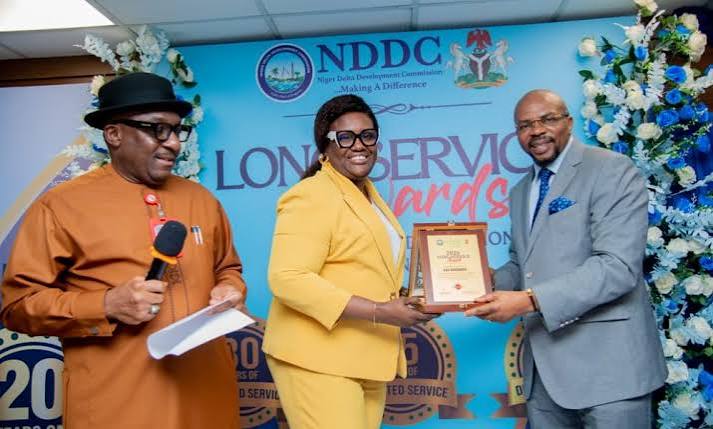
Speaking at the award ceremony held at the Commission’s headquarters in Port Harcourt, the Managing Director, Dr. Samuel Ogbuku, said staff welfare remains a central priority of the Board and Management, describing employees as the institutional memory and driving force of the Commission.
Represented by the Executive Director, Finance and Administration, Alabo Boma Iyaye, Ogbuku congratulated the recipients for their years of meritorious service and commended them for their commitment, which, he said, had contributed significantly to the Commission’s achievements over the years.
He noted that the awards were not only a celebration of longevity in service, but also a recognition of the dedication, professionalism and mentorship demonstrated by the recipients in helping to strengthen the Commission.
“The awardees have devoted decades of their lives to the NDDC, mentoring younger colleagues and playing vital roles in addressing the challenges confronting the Commission.
“Today, we celebrate your dedication, loyalty and commitment to service”, he said.
Ogbuku added: “We are proud of your achievements and grateful for your immense contributions. Each of you has helped shape our processes and our success story. We thank you for investing your talents and time in advancing the sustainable development of the Niger Delta.”
Also speaking, the Director of Administration and Human Resources, Sir Kelechi Nwelue, praised the award recipients for serving the Commission and the Niger Delta with distinction, noting that the recognition reflected years of exemplary service, unwavering commitment and professional excellence.
Responding on behalf of the honourees, the Director of Education, Health and Social Services, Dr. Awele Chukwudifu, expressed appreciation to the Executive Management for the recognition, describing the award as a source of motivation and encouragement.
She said the honour would inspire staff to remain committed to the Commission’s mandate of driving sustainable development across the Niger Delta region while sustaining excellence in service delivery.
###
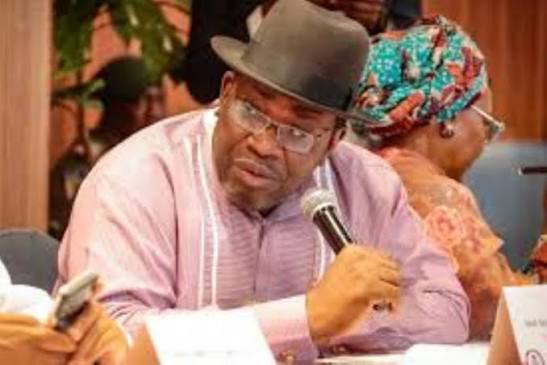
He said no amount of intimidation, political persecution or propaganda would deter him from pursuing what he described as the collective struggle to rescue the nation’s democratic values.
In a lengthy message of appreciation to his supporters, Dickson expressed gratitude to the people of Bayelsa West, Bayelsa State, the Ijaw Nation, and Nigerians at home and abroad for their steadfast support, solidarity and prayers throughout what he called his political journey to strengthen the country’s opposition.
The senator said for the past eight months he had remained away from home while focusing on building the National Democratic Congress (NDC), which he described as “the biggest national opposition party” in Nigeria.
He credited the party’s rapid growth to the commitment of its members, candidates and political partners, particularly the party’s presidential candidate, Peter Obi, and his running mate, Senator Rabiu Musa Kwankwaso.
“I thank God Almighty for His grace and strength. I also thank our party officers at every level and Nigerians across political divides for their confidence, trust and unwavering support”, Dickson said.
He stated that Nigeria’s democracy must be protected, insisting that the survival of a vibrant multi-party system was essential to the country’s future.
According to him, ongoing legal battles and what he termed “contrived anti-democratic shenanigans” would ultimately fail, expressing confidence that the judiciary would uphold the rule of law and resist attempts to undermine democratic institutions.
The former governor also accused unnamed political figures whom he said he had helped to attain positions of authority of turning against him by allegedly weaponising state institutions, removing political opponents from office, victimising innocent citizens and spreading propaganda.
Despite what he described as nearly seven years of sustained persecution against him, his family and supporters, Dickson said the loyalty of his followers had remained unshaken.
He urged Nigerians, particularly young people, to embrace politics driven by ideas, conviction and principles rather than personal gain, appointments or what he called “stomach infrastructure.”
He said the enduring legacy he hoped to leave behind was a generation courageous enough to reject injustice, defend truth and demand accountability from leaders.
Dickson announced plans to return to Bayelsa in the coming weeks alongside the National Chairman of the NDC, Senator Moses Cleopas, to personally appreciate party members and supporters across the state.
He called on citizens to reject violence and intimidation, urging them instead to participate actively in peaceful democratic processes and protect the sanctity of their votes.
The senator warned that politicians who relied on intimidation, abuse of state institutions and violence would ultimately be rejected by the electorate.
Reflecting on his political career, Dickson said he had weathered nearly two decades of investigations, allegations, political conspiracies and intimidation, yet continued to emerge stronger.
He argued that despite governing Bayelsa during a period marked by severe economic recession, his administration recorded lasting achievements across critical sectors and laid a solid foundation for the state’s development.
“I have seen it all and survived it all. The God who has stood by me has not abandoned me. He remains on His throne, watching and judging the actions of all men”, he declared.
Dickson concluded by praying for God’s continued blessings upon the NDC, Bayelsa State and Nigeria, while expressing confidence that justice, democracy and the will of the people would ultimately prevail.
-
 Politics2 days ago
Buhari Administration Originated Fake PFIPC, Budget Office Tells Reps
-
 Politics2 days ago
CHRISTIAN FORUM PASSES CONFIDENCE VOTE ON TINUBU, WIKE, OTHERS
-
 Politics2 days ago
Tinubu Felicitates Umahi @63, Says Works Minister Outstanding
-

 Business2 days ago
$50m Steel Pipe Facility: NCDMB Lauds Brentex, Assures Industry Patronage
-
 Politics2 days ago
How I Paved Way For Other Govs To Join APC — Eno
-
 Editorial2 days ago
Improving Surveillance in Rivers’ Boundary Communities
-

 Politics2 days ago
Speak For Yourself, Otti Tells Uzodimma Over Tinubu’s Reelection Bid
-
 Politics2 days ago
Votes Will Count In 2027, INEC Assures Nigerians