
Opinion
Task For Nigerian Economists

Page 6 of The Tide newspaper of Friday, June 18, 2021, had a news headline: “Economist Challenges W’Bank’s Prediction On Nigeria’s Inflation Rate.” The meat of that headline was that a professor of economics queried World Bank’s prediction that Nigeria’s inflation rate is expected to rise to fifth highest in sub-Saharan Africa by the end of 2021. By 3.35pm same Friday, June 18, there was a laughter at a conference hall because a speaker revealed that there were 137 professors in his university.
The embarrassing laughter came about because someone wanted to know the total member of academic staff in that institution. The meat of that laughter was that there was an after-conference gossip that Nigeria has an inflation rate, professor-wise. What is inflation? It is defined as “a continuing increase in prices or the rate at which prices increase”. Inflation can also mean filling something with air. There was a gossip that meat sellers can inflate meant to make it look fatter.
At the international level, there are gossips that Nigeria is noted for inflating values, ranging from contract value to national budgets. There is also the tendency to inflate personal dignity which is why there can be quarrels when someone is not addressed adequately according to his status. Nigerian dignitaries are known to be jittery over any slight on their status. So, we are showered with flatteries.
In the afore-mentioned news on Nigeria’s inflation rate, it was stated that “Nigeria was lagging the rest of sub-Saharan Africa with food inflation,” which means rising prices of food. Reasons given for the nation’s plight included heightened insecurity and stalled reforms, thus increasing poverty. It is interesting to know that there is a Foundation for Economic Research and Training, based in Lagos.
Research and training programmes would mean great opportunity to expand the frontiers of existing knowledge and also train experts to implement the benefits of research findings. Advancement in the academic world is largely determined by effective teaching, diligent research and publications in scholarly journals. For the institution that was said to have been blessed with 137 professors, excluding retired ones, the possibility is that there are great nation-builders quite active there.
From an economic point of view, the task of nation-building hinges on the productive capacity of the citizens of a nation. There is also a professional code which places priority on commitment to service delivery, whereby reward and praise stay behind service ethics. Therefore, for professional economists, more so, for professors of economics, there is a present task of commitment to service to save Nigeria from her current economic plight.
Apart from the inflation rate issue, there is a more serious issue of productivity. No matter how we may wish to hide the truth, it is known across the globe that the Nigerian elite are an unproductive class of people. There was almost a gang-fight in a foreign country not long ago, because a supervisor in a workplace described Nigerian employees as “malingerers and unproductive”. What annoyed the eight Nigerians more was the statement that “you can do that in your country, but not here”. Diplomacy doused the tension.
What factors have been responsible for the low capacity of productivity among Nigerians, particularly in the public sector? Answer to this question came quickly from a clergyman: “easy money; oil money”. The cleric went on to say: “What do you expect in a country where you can sell an allocation paper and become a millionaire without lifting a broom to serve the nation?” Late Professor Tam David-West once talked about oil barons who never knew what a barrel or drop of oil looked like!
There are Nigerians who talk glibly about corruption without having a clear perception of the mechanics and dynamics of that plight. Does influence peddling not undermine the productive capacity of those who watch some clever people make millions of naira without lifting a broom in service of the nation? Or, is it not true that there are godfathers and sponsors whose favoured candidates dislodge diligent applicants willing to serve the nation with their skills and patriotism? Is the nation’s reward system ideal, or capable of promoting productivity?
Economists would educate us on what they call “runaway” or hyper-inflation and say that: “It’s when you have what we call runaway or hyper-inflation that is when you get worried”. Such state of inflation means that prices are increasing every day or every month without control. Is it wrong to say that such is our current experience? But for those whose food, water, fuel and all other necessities of life are provided by tax payers, the issue of inflation would be a mere academic stuff.
In the academic circle, when an issue is described as “academic stuff” it is same as saying that you can speak from two sides of your mouth so long as you have enough “stomach infrastructure”. Therefore, one of the tasks before our economists is to be realistic, rather than speak from the position of a “high horse”. World Bank’s predictions included the warning that “inflation would push seven million more Nigerians into poverty due to falling purchasing power”.
Poor purchasing power also arises from the pathetic exchange rate of the naira which becomes a relevant concern of all patriotic economists. Why has the value of the naira fallen to the current pathetic state? A soldier, not an economist, provided the answer quickly: “We are not productive; naira exchange rate is a clear testimony to that”. There’s need for clergymen, soldiers and economists to talk together.
Dr Amirize is a retired lecturer from the Rivers State University, Port Harcourt.




Quote “Professor Kamene Okonjo
Some women leave behind more t
Yet, to remember Professor Kam
Professor Okonjo was the belov
one of the most dramatic chapt
On December 14, 2012, the then
She leaves behind children, gr
Professor Kamene Okonjo deserv
By: Sylvia ThankGod-Amadi

Quote: An African who invokes
This is the concluding part
… Given the fact that I was
At the end of the visit by the
Back to my apartment, at abo
Under normal circumstances, yo
That all she asks is that Chie
For some reason that I do not
I believe that everyone in hu
Our ancestors have not gone fa
By: Jason Osai
The parties agreed to reconvene after one month to assess implementation. Ultimately, the value of these resolutions will be measured not by announcements but by whether eligible workers receive the money. Transport costs consume a substantial share of many civil servants’ earnings before they can meet household needs. Support for commuting is therefore not a luxury or political favour; it is temporary assistance to help workers remain at their jobs without sinking further into hardship. For lower-paid employees, transport costs can turn modest salaries into a daily exercise in difficult choices and sacrifice.
The agreement also urges State and Local Governments to participate and unions to press for implementation. The federal agreement does not automatically guarantee that every State and Local Government employee will receive the support. State authorities must clarify how it will apply to their workforce, make the necessary arrangements and publish a payment timetable. Rivers State must approach the arrangement with urgency and transparency. The Government should State whether it will implement the intervention and when payments will begin. Any administrative or financial question should be addressed promptly with organised labour, not allowed to become excuses for delay.
The concern is sharpened by the earlier N35,000 monthly wage award introduced by the Federal Government in 2023 after petrol subsidy removal. It was intended as temporary relief pending a new national minimum wage. While several States negotiated and paid wage awards or related sums, implementation nationwide was uneven. Reports in 2024 indicated that many States had failed to pay the federal award, while others provided different amounts. In Rivers, labour and media reports raised concerns about implementation of the N35,000 award for State workers, amid separate announcements and arrangements concerning Local Government employees.
The wage award was meant to ease the immediate effects of subsidy removal, yet workers faced uncertainty over whether the promised relief would reach them. In February 2024, the Rivers State Government announced approval of the N35,000 award for local government workers, but subsequent reports showed that implementation across worker categories remained a concern. The lesson is clear: approval and implementation are not the same. A declaration at a meeting offers little comfort to a worker whose account does not reflect the promised payment. For workers who travel to their offices daily, the implications of delayed support are significant. Transportation expenses compete with food, rent, school fees, healthcare and other essential household needs.
As fares rise, employees may be forced to reduce spending on necessities or borrow to sustain their families. A timely transport intervention would therefore provide practical relief and demonstrate that government understands the economic pressures confronting its workforce. Its temporary nature makes prompt implementation even more important. It is fair to acknowledge that this transport intervention is a new agreement and that its administrative details may require clarification. Rivers State should not be condemned in advance for a failure that has not occurred. Nevertheless, the earlier experience gives workers legitimate grounds to seek assurances before the November commencement date. The State should avoid allowing uncertainty to persist until workers begin asking why the promised assistance has not arrived.
The NLC and unions in Rivers State should engage the State Government immediately and seek a written commitment, an implementation plan and a process for reporting missed payments. If clarification from the Federal Government is needed, the State should seek it without abandoning the goal of providing relief. Labour leaders must also keep members informed about progress and insist that any agreed arrangements are applied fairly and transparently. The Rivers State Government should treat this intervention as an opportunity to rebuild confidence. Timely support would show that workers’ welfare is more than a talking point and that the State recognises the economic realities confronting its employees.
Silence, delay or selective implementation, by contrast, would revive frustration over earlier relief measures and weaken trust between government and labour. Every month lost to administrative delay leaves workers facing the same transport burden without the intended assistance. The State should consult labour, publish arrangements and pay eligible workers on time. Rivers workers should not have to wonder whether federal relief will reach them. The Federal Government has announced the support; now the State must make its position clear. We hope the N70,000 monthly transport intervention will not follow the troubling path of the earlier wage award. Rivers State should learn from that experience and ensure that this time, relief is not merely promised but delivered.
Sylvia ThankGod-Amadi
-
Rivers3 days ago
NUJ Set To Attend UNIPORT’s 217th Inaugural Lecture
-
 News3 days ago
NJC Suspends Three Judges, Sanctions Eight Others
-
Politics3 days ago
Atiku Kicks-Off 2027 Campaign, Promises To Tackle Nigeria’s Challenges
-
 Featured3 days ago
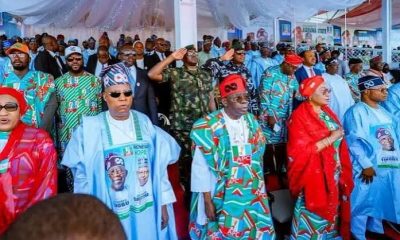
APC Presidential Campaign Storms PH, ‘Morrow
-
News3 days ago
FG Explains Supply Disruption As Power Generation Drops To 3,659MW
-
Metro3 days ago
Port Harcourt Prepares For 10,000 Runners As International Marathon Returns
-
 News3 days ago
Bille Gas Leak: Coalition Tasks FG On Proactive Measures
-

 News3 days ago
IGP Orders Arrest, Prosecution Of Campaign Billboard Vandals