Connect with us

Business

Nigeria’s Recession’ll Not Prolong -Minister

Published

on

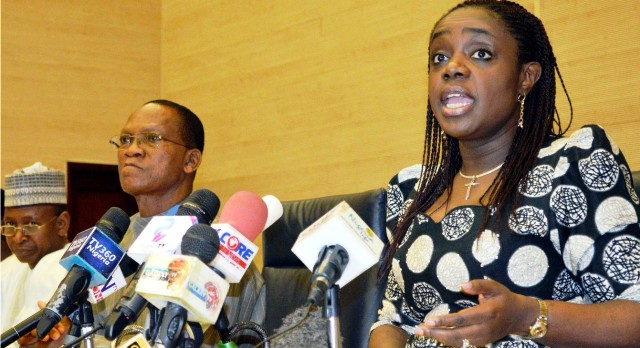
The Minister of Finance, Mrs Kemi Adeousn, has assured Nigerians that the current economic recession the nation is experiencing will not be prolonged.
She gave the assurance on Friday in Abuja while addressing a news conference.
She said that there was a strategic plan by the administration to see that the recession ended soon and also ensure that the economy recovered fully.
“We have a strategic plan that will take us out of the recession we have found ourselves in; we want to make sure the recession is as short as possible because we do not want a prolonged recession.
“From what we are looking at we do not think that it will be a prolonged recession; we think that some of the initiatives that we are working on will now begin to bear fruits.
“We are on course and are confident that the plan we have put together will work and put the economy back on track. “It is a long term plan that would reposition the economy so that we do not go into this boom and burst circles that are driven by the oil price.
“The economy has to be more resilient than that so that we do not find ourselves back where we are.’’
She said that although there was no specific date to end the recession, the fact that there were measures in place was enough indication that the end of the recession had begun and that Nigeria would come out stronger.
Listing some of the measures the administration had taken to address the situation, she said that since the budget was released in May, over N420 billion had been released and cash backed for capital projects.
She said that the largest sector that the money was spent on was Power, Works and Housing.
She also said that a lot had been done in the defence sector to rebuild the capability of the army, especially on efforts in the North East.
“Agriculture has received significant funding because of the time sensitivity of agriculture and because of the fact that food prices were rising, we needed to intervene so that we could get food prices down.
“There is activity resuming on roads, power projects and health projects and we have released money to water resources and solid minerals.’’
Adeosun also said that there was a cash plan to release another N350 billion which would go into the various MDAs.
“The focus is going to be similar, however, there would also be funding of about N60 billion for the Special Intervention Programme and that is very important in putting money into people’s pockets.
“The school feeding programme and the N-Power teachers corps we will cash back today as part of the N350 billion additional release which would take our total capital spending to about N700 billion.’’
She also said that N50 billion was set monthly as budget support plan for some state governments from the Federation Accounts Allocation Committee (FAAC) to support them with additional money to enable them to pay salaries. She said that the loan had been on for three months for the interested states because some states which were buoyant decided not to participate.
On recovery of assets, Adeosun said that the committee was in the process of collating with the non-cash assets like farmlands, vehicles and houses and that a fixed asset register would soon be opened to determine their value.
She said that the jewelries were from different locations and were being brought together to determine the market value and that the next line of action would be decided by the committee. Adeosun explained that the present recruitment by the police and some other government agencies were made possible by the reduction of ghost workers. She added that the savings that were made from the exercise would enable funding for the new recruitment.
“Sometime in January, personnel cost was N165 billion along with pension cost, but so far so good; we have reduced, through the removal of about 40,000 ghost workers, the personnel cost by around N10 billion per month. “Now we have saved about N100 billion this year.’’
She said that though the times were tough, there was hope for Nigerians, adding that issues around infrastructure were the biggest problems of Nigeria which resulted in high cost of living.
“The biggest problem we have is not wages but the cost of living which is too high so it is not how much money you have but it is what it costs you to live. “The problem we have is that many of the things that people are spending money on are the things government should be doing like roads, power and so on.
“So we have to address these things because that is what will really make impact for the average working Nigerian and so when you address the infrastructure you address the cost of living and that is what this government is working on.’’


Continue Reading

Business

IPMAN Raises Concern Over Delay In Chinese Refinery Deal …Predicts Lower Fuel Prices Through Competition

Published

on

The Eastern Zone of the Independent Petroleum Marketers Association of Nigeria (IPMAN) has called on the Nigerian National Petroleum Company Limited (NNPCL) to fast-track the conclusion of the proposed Technical Equity Partnership with two Chinese firms.
IPMAN made the appeal amid growing concerns over the delay in finalising the agreement initiated through the signing of a Memorandum of Understanding (MoU) on April 30, 2026, between NNPCL and Sanjiang Chemical Company Limited as well as Xinganchen (Fuzhou) Industrial Park Operation and Management Company Limited.
It said the proposed arrangement was designed to revive and expand operations at the Warri and Port Harcourt refineries, noting that successful implementation would strengthen the downstream petroleum sector and restore confidence in Nigeria’s oil and gas industry.
The former Unit Chairman and current Zonal Secretary of IPMAN, Eastern Zone (System 2E), Comrade Inimgba Emmanuel Okubowei, made the call in a statement issued by the union after the Good Governance Summit organised by the Working People United (WOPU) in Abuja, and obtained by TheTide in Port Harcourt, at the weekend.
Okubowei expressed concern over the continued hardship faced by Nigerians due to the high cost of Premium Motor Spirit (PMS), stressing that households and businesses were increasingly burdened by rising energy costs.
Okubowei stated that fuel prices would naturally decline once the Chinese partners commence full operations at the refineries, explaining that increased refining capacity and a more competitive market environment would positively influence pump prices.
The unionist further noted that the partnership would attract fresh investment, improve domestic refining output, increase petroleum product availability and create a more stable operational environment for industry stakeholders.
He maintained that healthy competition remains one of the most effective mechanisms for achieving fair pricing in the downstream petroleum industry and protecting consumers from avoidable price pressures.
The IPMAN official further argued that the entry of additional technically competent operators into the refining space would discourage monopolistic tendencies, improve operational efficiency and guarantee a more stable supply of petroleum products across the country.
He, therefore, appealed to the Group Chief Executive Officer of NNPCL, Engr. Bashir Bayo Ojulari, and the management of the company to accelerate all outstanding processes required for the successful execution of the Technical Equity Partnership.
Okubowei also called on the NNPCL leadership to publicly explain the reasons behind the prolonged delay and provide Nigerians with a definite timeline for the commencement of the project.
He emphasised that transparency, accountability and timely communication would strengthen public confidence in the initiative, adding that prompt execution of the agreement would enhance Nigeria’s energy security, create employment opportunities, stimulate economic growth and provide lasting relief to millions of Nigerians through more affordable petroleum products.
King Onunwor
Continue Reading

Business

Gas Economy: Decade of Gas, Pi-CNG/ EV Deepen Media Engagement

Published

on

Poised to achieving an in-depth understanding of the Nigeria’s gas economy by it’s populace, the Decade of Gas Secretariat, in collaboration with the Presidential Initiative on Compressed Natural Gas and Electric Vehicles (Pi-CNG & EV), has deepened media capacity engagement across the country.
The media session, third in its series, and held at the Hotel President, Port Harcourt, recently, brought together 30 journalists from the television, radio, print, and digital media platforms to deepen their understanding of Nigeria’s gas development agenda and further enhance their reportage on the role of gas in driving economic growth, energy security, industrialization, job creation, and improved living standards.
Speaking during the session, the representative,  Decade of Gas Secretariat,Taofeek Balogun , noted that the port Harcourt engagement followed two earlier sessions held in Lagos and Abuja, a move that began in 2025.
According to him, Nigeria’s gas sector continues to record significant progress, with year-to-date gas production reaching 7.85 billion standard cubic feet per day (bcfd).
Domestic gas utilization has surpassed the 2 bcfd mark, while gas exports have risen to their highest level in five years, reflecting growing demand across power generation, industries, transportation, exports, and household consumption.
Balogun emphasised the successful completion of the Obiafu-Obrikom-Oben (OB3) River Niger Crossing by NGIC/NNPCL, describing it as a critical infrastructure milestone that would improve gas transportation across the country, support industrial growth, attract investment, strengthen energy security, and contribute to economic development.
As part of efforts to expand domestic gas utilization, he reiterated the Federal Government’s commitment to increasing access to clean cooking solutions. The government’s target is to distribute cooking gas cylinders to five million households by 2030.
Following the successful rollout of the programme across the six geopolitical zones by the Minister of State for Petroleum Resources (Gas), Hon. Ekperikpe Ekpo, implementation would now move to the state level, beginning with Bayelsa State in July 2026.
Under the initiative, Balogun said, 27,000 households in Bayelsa are expected to receive cooking gas cylinders within the year as part of the 1(one) million homes per year target.
Also speaking, the Chief Operating Officer of Pi-CNG & EV, Tosin Coker, highlighted ongoing efforts to expand the adoption of Compressed Natural Gas (CNG) and electric mobility solutions as cleaner and more affordable transportation alternatives for Nigerians.
He disclosed that the Federal Government is promoting the adoption of CNG across Ministries, Departments and Agencies (MDAs) through the conversion of existing vehicle fleets and the procurement of CNG-powered vehicles as part of broader efforts to reduce transportation costs and improve energy efficiency.
Coker said “more than 100,000 vehicles have now been converted to CNG nationwide under the initiative, reflecting growing acceptance of alternative fuel solutions and supporting the country’s transition towards cleaner and more sustainable transportation”.
Participants commended the initiative for strengthening media capacity and improving public understanding of developments within Nigeria’s energy sector.
The Decade of Gas Secretariat and Pi-CNG & EV further reaffirmed their commitment to sustained stakeholder engagement and public awareness as Nigeria continues its journey towards a gas-powered economy.
Continue Reading

Business

Group Seeks Media Partnership To Enhance Business Growth

Published

on

The Chief Executive Officer of Kefa Communication, Mr. Obihele Victor Amos, has called for stronger collaboration between business organisations and media institutions to enhance business growth, economic expansion and wider public engagement across communities.
Amos made the call during a press briefing in Port Harcourt at the weekend.
He emphasised that strategic media partnership remains critical to improving visibility for businesses and attracting investment opportunities.
According to him, the media occupies a central position in shaping public perception and creating awareness that can support enterprise development and economic sustainability.
He also noted that, many emerging businesses continue to face growth limitations due to insufficient publicity and inadequate access to effective communication channels.
“Stronger engagement with the media would help bridge information gaps and create better connections between businesses and potential customers”, he said.
The CEO further stated that responsible and developmental journalism could play a significant role in promoting innovation and encouraging healthy competition within the business environment.
He stressed that beyond informing the public, the media serves as a platform for influencing policies and encouraging stakeholder participation in economic development.
Amos further disclosed the group is committed to building relationships with media organisations through continuous engagement and collaborative initiatives.
He said such partnerships would create opportunities for entrepreneurs and support efforts aimed at expanding market access.
The business leader also urged media practitioners to sustain professionalism and continue highlighting stories that promote enterprise and national development.
He expressed confidence that improved synergy between the media and the business community would contribute to employment generation and economic resilience.
Some participants at the briefing described the initiative as a welcome development capable of strengthening public understanding of business opportunities.
There were also calls for sustained cooperation among stakeholders to drive inclusive business growth and long-term development.
King Onunwor
Continue Reading

Trending