Connect with us

Environment

Ministry Urges Investment In Bamboo Production

Published

on

The Federal Ministry of
Environment has called on both corporate bodies and individuals to invest in bamboo production.
The Desk Officer for Bamboo and Rattan Production in the ministry, Mr Adebayo Ibrahim, made the call in an interview with newsmen in Abuja.
Ibrahim said the industry had the potential to boost the nation’s economy in the area of non-oil production resources.
According to him, bamboo is a gold mine that can employ many people and also create wealth for many Nigerians.
He said that the United Nations Industrial Development Organisation (UNIDO), in collaboration with the ministry and the International Network for Bamboo and Rattan (IMBAR), had developed a white paper; for investing in a green future bamboo value chain in the country.
Ibrahim said the value chain had envisaged a development from nursing and seed raising, planting and harvesting to processing and marketing.
He said the value chain process, targeted farming communities where the entire production process would be carried out within plantation farms.
He said the document also developed a technical and business skill for private bamboo processors as well as improving capacities in harvesting and post-harvest treatment.
According to him, the document has also developed and improved the marketing skills for the people.
The desk officer, who is also an Assistant Director in the ministry, said that UNIDO had also pledged 150,000 dollars for the provision of expertise and machines for enhancing bamboo production in the country.
Ibrahim said the Federal Government, as part of its counterpart funding, had commenced the reactivation of the National Forest Utilisation Centre in Benin.
He said the centre, owned by the Federal Department of Forestry, had all the infrastructure required for wood processing.
“The Federal Government will renovate the centre, while UNIDO will bring technicians and machines for the processing of bamboo.
“UNIDO will also train artisans and rural farmers on bamboo processing.
“The UNIDO funding pattern in this case is not going to be in cash,’’ he said.
Ibrahim said the ministry had inaugurated a steering committee known as the National Bamboo and Rattan Development Programme (NBARDEP).
He said the committee had already identified stakeholders in the production of bamboo, adding that it was building synergies with relevant agencies of government as well as the private sector.
Ibrahim said the ministry was working hard to ensure that the production of bamboo commenced in a most robust manner, adding that the ministry was in partnership with many relevant agencies.
Reports say that bamboo production is the brainchild of the Federal Ministry of Environment.
The first national stakeholder’s sensitisation workshop on the sustainability and development of bamboo and rattan in Nigeria was held in Benin in 2012.
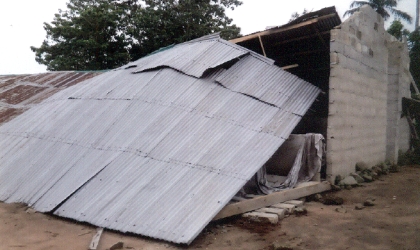
A building devastated by rainstorm in Rivers State, recently.


A building devastated by rainstorm in Rivers State, recently.

Continue Reading

Environment

Why Buildings Keep Collapsing In Nigeria…. NIOB

Published

on

The Nigerian Institute of Building (NIOB) has attributed the recurring building collapse cases across the country to weak construction laws and failure to hold offenders accountable.
President of the institute, Daniel Kolade, made this known in Abuja at the 2026 Builders Day celebration, themed, “Advocacy and Policy Influence: Towards Sustainable Reforms for a Resilient Built Environment”
He expressed worry that, in spite of concerns over building safety, a key regulatory framework meant to strengthen enforcement within the built environment has remained pending before the National Assembly since 2006.
According to him, the delay has created a situation where those responsible for structural failures often escape punishment.
“Because the enforcement arm of the law is still lying with the National Assembly and has not been passed into law since 2006, the room remains for people to go scot-free when these incidents happen,” Kolade said.
According to Kolade, the lack of consequences encourages negligence on construction sites, as many operators believe little or nothing will happen, even if they violate building regulations.
Kolade cited previous building collapse incidents where, years after the tragedies, no individual had been prosecuted or sanctioned.
“As long as people continue to go free when these things happen, you should expect that it may not stop,” he said.
The NIOB president also said that the growing number of unqualified individuals working on construction sites worsened the problem.
He said it has become common for people without the required training or professional certification to assume technical roles in building projects.
“On most construction sites today, everybody claims to be an engineer, even labourers.
“Without the requisite knowledge and understanding, people just assume roles they are not qualified for,” he said.
Kolade noted that professional builders are regulated by the Council of Registered Builders of Nigeria (CORBON), which has the authority to register practitioners and discipline erring members.
He explained that builders found guilty of professional misconduct should face sanctions, including the withdrawal of their practicing licences.
However, he said the absence of a strong enforcement mechanism outside professional bodies makes it difficult to prosecute developers or project promoters who violate construction standards.
“In Nigeria, only one major case in Lagos saw the building promoter go down with the incident.
“In many other cases across the country, those responsible have walked free,” he said.
Kolade stressed that the built environment consists of several specialised professionals, each with defined responsibilities, including builders, architects and engineers.
He said the NIOB remained committed to promoting professionalism, ethical standards and quality assurance within the building industry.
March 13 is observed annually as Builders’ Day to create public awareness about the roles of professional builders and the importance of engaging qualified professionals in construction projects.
Continue Reading

Environment

Lagos Resumes Monthly Environmental Sanitation April 25

Published

on

The Lagos State Government has announced the resumption of the monthly environmental sanitation exercise, nearly a decade after it was suspended in the state.
Residents are expected to clean their surroundings, clear drainage channels in front of their homes, and dispose of waste responsibly as part of efforts to improve environmental hygiene and tackle waste management challenges.
The Commissioner for Environment and Water Resources, Tokunbo Wahab, on Saturday, disclosed the development in a statement, explaining that the exercise would officially restart later in the year.
“I am pleased to inform all Lagosians that the monthly environmental sanitation exercise will resume effective Saturday, 25th April 2026, holding on the last Saturday of every month from 6:30 a.m. to 8:30 a.m.
“During this period, residents are enjoined to clean their surroundings, clear drainage channels in their frontages, and dispose of waste properly as a civic responsibility.”
Wahab urged residents to view the initiative as a shared duty toward building a healthier city, stressing that the government would ensure strict compliance.
“This exercise is a collective responsibility and a vital part of our commitment to a cleaner, healthier, and flood-resilient Lagos. And it shall be backed with the full enforcement weight of the Lagos State Government,” he said.
Explaining the significance of reintroducing the sanitation culture, the commissioner said the state was returning to a practice that once formed part of Lagosians’ lifestyle.
“Let me formally say this and say it boldly. Mr Governor and his deputy are taking a very audacious step. For those who don’t know, prior to 2016, we had a culture that emphasised cleanliness as next to godliness.
“Once every month, we took our time to clean up our surroundings and then maintain them sparkling. However, for some years, we stopped it.”
He said the absence of the exercise had contributed to mounting environmental pressures in the state.
“Now, waste, debt, and environmental challenges have become an existential challenge to us as a state. It’s taken us over a year to debate, talk, and agree that it’s time to reintroduce a monthly environmental sanitation,” Wahab said.
Appealing to residents for cooperation, he urged Lagosians to dedicate a small portion of their time each month to environmental cleanliness.
“It’s a plea that it is time for us to give up just one or two hours a month. In our marketplaces, every Thursday, we observe environmental cleanliness. But this time, we are saying as a state, let us sit back once a month and observe the cleanliness of our environment as we used to before 2016.”
“The monthly sanitation exercise, previously held on the last Saturday of every month between 7 a.m. and 10 a.m., was suspended in November 2016 following a legal pronouncement restricting movement during the exercise.
The suspension later coincided with growing waste management concerns, including clogged drainage channels and indiscriminate refuse disposal across parts of the state.
Continue Reading

Environment

Illegal Buildings On Embassies’ Land Will Be Demolished – Wike

Published

on

The Minister of the Federal Capital Territory, Nyesom Wike, has condemned the construction of buildings on land allocated to foreign embassies in the diplomatic zone of Katampe Extension, Abuja, describing them as illegal structures.
Wike spoke on Friday while addressing journalists during an inspection tour of ongoing infrastructure projects across the FCT.
He said the illegal structures would not be allowed to stand and ordered the demolition of the affected buildings.
During the tour, the minister inspected several roads and infrastructure projects, including the route linking Wuse to the Central Area, a road near the Body of Benchers complex, and the Tungan-Madaki road off the airport corridor.
He expressed confidence that many of the projects would be completed in time for the inauguration marking the third anniversary of President Bola Tinubu’s administration.
On the illegal structures occupying embassy land, Wike said the plots had originally been allocated on March 18, 2008, to various diplomatic missions for residential purposes, but were later seized by an illegal developer who began construction without approval from the Federal Capital Development Authority.
“This land was allocated to various embassies in 2008. Somebody just came here, took the land, and started developing it on their own without approval from the FCDA. We cannot allow this kind of land invasion to continue,” he said.
Wike listed the diplomatic missions affected to include Thailand, Bulgaria, Syria, Somalia, Serbia and Montenegro, Japan, Austria, Switzerland, Senegal, and the Palestine Liberation Organisation. A portion of the land had also been reserved for the Power Holding Company of Nigeria for a 132/133KV power station.
The minister said the FCTA had directed the Department of Development Control to demolish all structures on the land and restore it to its original purpose.
“I have told them to bring down every building standing on this land,” he said, adding that the affected embassies would be formally notified to take possession of their allocated plots.
Wike also disclosed that the suspected developer had been arrested and would soon be prosecuted.
“The man has been arrested and he will be charged in court. The police are carrying out their investigation and he will be charged any moment from now,” he said.
Continue Reading

Trending