Connect with us

Oil & Energy

NNPC Calls For Accelerated Passage Of PIB

Published

on

The Group Managing Di
rector, Nigerian National Petroleum Corporation (NNPC), Mr Andrew Yakubu, has appealed to the National Assembly to accelerate passage of the Petroleum Industry Bill (PIB).
Yakubu made the appeal during the NNPC Day at the ongoing Enugu International Trade Fair.
Represented by Executive Director, Operations, Port Harcourt Refineries, Mr Vitalis Ugochukwu, Yakubu said the PIB when passed into law would facilitate the competitiveness of the NNPC in the global market.
“The PIB is change legislation which promises to offer our corporation all necessary incentives to enable it excel.
“The bill proposes the incorporation of the NNPC as a limited liability company which will be subject to the Companies and Allied Matters Act,” he said.
Yakubu said that it was necessary for the new NNPC to be run as a pure business concern to enable the firm to raise funds from the capital market and pay dividends to its owners.
The bill, he said, would separate the Nigerian Gas Company into two entities, Nigerian Gas Transmission Company and the Nigerian Gas Marketing Company.
“In the same vein, the current PPMC will be split into two entities, namely the National Transportation Logistics Company (NTLC) and the Product Marketing Company (PMC),” he said.
Yakubu said that while the NTLC would be wholly owned by government, the PMC would be wholly owned by the NNPC Ltd.
“At the same time, the NNPC will shed its current regulatory role and focus on the business of exploration, refining and marketing of petroleum products,” he said.
He said that it had become expedient for Nigerians to partake in the actual production of hydro-carbon.
“It is a welcome development because we will have more value for hydro-carbon and understand what other multi-national companies are doing in the crude oil business.”
Yakubu said the PIB bill made provisions for development of gas for the domesticate market through the combination of obligations set by the Petroleum Inspectorate and Favourable Fiscal Provision.
“Gas contributions to the world energy mix are growing faster than can be imagined, and particularly in Nigeria.
“Gas production offers the potential to grow Nigeria’s Gross Domestic Product (GDP),” he said.
Yakubu said that it was the desire of the NNPC to transform into a high performance and join the league of some national oil companies that were classified as International Oil Companies.
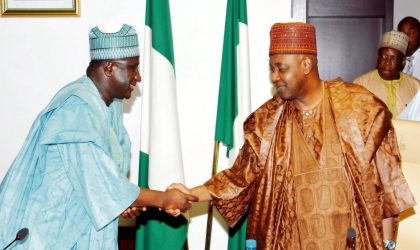
FREDO070414 OIL 18

Continue Reading

Oil & Energy

Resource Wars Are Here and Oil Is the First Casualty

Published

on

In just over a year, the world saw several instances of a choked supply of commodities indispensable for today’s economies and military capabilities.
From China’s restrictions on rare earths and critical minerals supply to the de facto closure of the Strait of Hormuz, policymakers and analysts began to realize that the control of oil, critical minerals, rare earths, and magnets is as important as building and maintaining stockpiles of advanced weapons. It also became clear that without these resources, defense and military capabilities could be weakened. The actual arms race goes hand in hand with the new battle for the resources that underpin economic, manufacturing, and advanced military development.
“Great-power competition has returned to basics: who controls the physical resources that modern economies and militaries run on,” Alice Gower, a partner at London-based political-risk advisory firm Azure Strategy, told the Wall Street Journal.
“Energy, critical minerals and industrial capacity are leverage, not just economic assets,” Gower added.
The war in the Middle East and the blockage at the Strait of Hormuz laid bare the reality of choked energy supply. The world’s most vital oil and LNG chokepoint, through which 20% of daily global trade flowed before the Iran war, has been essentially closed for most tanker traffic for more than three weeks.
The massive supply shock, the worst disruption in the oil market in history, showed that the world is dependent on energy resources, and that geography and actual physical supply matter. With so much oil and gas stranded in the Middle East, oil prices spiked to above $100 per barrel, natural gas prices in Europe doubled, and Asian spot LNG prices hit multi-year highs.
The precarious situation in the Middle East is reverberating across Asia, the region most dependent on oil and LNG supply from the Persian Gulf. Asian refiners pay sky-high premiums for non-Middle Eastern crude, many are considering cutting or have already cut processing rates, and countries have started to enact fuel-preserving measures, from four-day work weeks to bans on fuel exports.
In Europe, the gas refilling season will be the toughest yet, as Asia is outbidding Europe for spot LNG supply after Qatar’s LNG is effectively sidelined and full capacity may not return for up to five years following Iranian missile attacks last week.
Even the ‘energy independent’ United States, the world’s top oil producer, is not independent when it comes to global supply shocks of such magnitude.
The national average price of gasoline is approaching $4 per gallon nationwide, more than $1 a gallon compared to a month ago, before the start of the war.
Oil is a global resource, traded on a global market, and prices reflect fundamentals, although they have been driven by hectic trading activity on geopolitics in recent weeks. But the fundamentals show that there is no resource available to plug the gap that has opened in Middle Eastern supply. Producers are slashing output due to a lack of storage capacity, which further delays a rapid recovery in supply when this mess ends.
All this goes to show that whoever controls the Strait of Hormuz has enormous leverage on inflicting global economic pain.
While the world is focused on the Strait of Hormuz, the race for rare earths and critical minerals continues, with the U.S. and Western countries scrambling to dent China’s dominance.
Since China restricted exports of rare earth elements early in 2025, Western countries have raced to create mine-to-magnet supply chains to reduce dependence on Chinese supply in the key military and automotive industries.
China holds a 59% share of the mining of rare earths, 91% in refining, and a whopping 94% in magnet manufacturing, the International Energy Agency (IEA) estimates.
The U.S. has responded by taking stakes in minerals mining companies, the launch of a U.S. Strategic Critical Minerals Reserve, known as Project Vault, and is leading efforts to break the Chinese stronghold on the pricing of these minerals critical for the defense and auto industries and national security.
Chinese dominance could be eroded, but it would take years.
Still, rising neodymium-praseodymium (NdPr) supply from countries like the U.S. and Australia is set to reduce China’s market share to 69% by 2030 from 90% in 2024, Bloomberg Intelligence (BI) said in new research this month.
“We’re seeing a surge in rare-earth investment as modern technologies demand more critical materials,” said Jack Baxter, Global Metals & Mining Analyst at BI and co-author of the report.
“That said, we anticipate a significant shortfall in supply due to trade uncertainties, with lead times as long as 10 years to get new material out of the ground,” Baxter added.
“This will give pricing power to the few producers that currently are able to supply critical materials outside of China, fracturing the globalized market.”
Amid fractured markets and high geopolitical uncertainty, one thing is certain – the next arms race, alongside the actual arms race, will be for control of key resources such as oil and critical minerals.
By Tsvetana Paraskova
Continue Reading

Oil & Energy

Transcorp Energy, Renewvia Partner On Renewable Energy Gap

Published

on

Transcorp Energy Limited and Renewvia Solar Nigeria Limited have signed a Memorandum of Understanding to jointly develop renewable energy projects across Nigeria.
The move is aimed at addressing the persistent power deficit that has crumble businesses in the nation.
The agreement also outlines a longer-term plan to expand operations across Africa, positioning both firms to tap into growing demand for clean and reliable electricity.
The partnership would target commercial, industrial and residential consumers, as well as underserved communities, through a mix of off-grid and grid-connected energy solutions.
Beyond electricity provision, the collaboration would explore the aggregation and monetisation of Renewable Energy Credits generated from the projects, adding a commercial layer to the clean energy rollout.
The Managing Director and Chief Executive Officer, Transcorp Energy, Chris Ezeafulukwe, said the initiative aligns with the company’s broader strategy to expand access to sustainable power.
He noted that combining grid and decentralised energy systems would enable the company to deliver reliable electricity directly to end-users across different segments of the economy.
Chief Executive Officer of Renewvia, Trey Jarrard, described Nigeria as a critical market for the company’s African ambitions.
According to him, the partnership provides a platform to scale operations rapidly by leveraging established infrastructure and local expertise, while delivering cost-effective and resilient energy solutions.
Both companies said the agreement lays the foundation for a scalable pan-African renewable energy business, capable of supporting diverse markets and accelerating the continent’s transition to cleaner power sources.
The collaboration comes amid increasing pressure on governments and private sector players to deploy sustainable energy solutions to bridge electricity gaps, reduce reliance on fossil fuels, and support economic growth across Africa.
Continue Reading

Oil & Energy

IYC Tasks Niger Delta Governors On  Oil Field Bidding  ….Decries Exclusion of Host Communities

Published

on

The Ijaw Youth Council (IYC) Worldwide has raised concerns over the continued exclusion of host communities from the governance of oil resources, urging Niger Delta governors to take decisive steps by bidding for oil blocs and marginal fields.
The council warned that failure to act would allow external interests to continue dominating the region’s oil assets, despite their location within host communities.
Secretary-General of the council, Maobuye Nangi-Obu, started this at the stakeholders’ meeting organised by the Pipeline Infrastructure Nigeria Limited , with participants drawn from Rivers, Abia and Imo States, in Port Harcourt, recently.
“It is time for state governments in the Niger Delta, especially Rivers State, to form oil companies that can bid for marginal fields within their territories”, he said.
Nangi-Obu expressed concern over the reported listing of about 25 marginal oil fields for allocation, noting that many were located in host communities but allegedly being assigned to non-indigenes.
In his words “They sit in Abuja and decide what happens in our region, yet we are not part of the oil governance of our own resources”.
He explained that marginal fields, though considered uneconomical by major oil firms, remain viable for indigenous operators, adding that their allocation had continued to fuel grievances in the Niger Delta.
The IYC scribe also warned of the implications of directional drilling, describing it as a growing threat to host communities.
“There could be oil wells in your community, and somebody elsewhere could be drilling that oil without your knowledge,” he cautioned.
On environmental concerns, Nangi-Obu condemned the persistent gas flaring in the region, blaming both international and local operators for failing to invest in gas processing infrastructure.
He, however, commended Pipeline Infrastructure Nigeria Limited for its engagement with host communities.
“Pipeline Infrastructure Nigeria Limited is doing the right thing by engaging stakeholders. Not all companies are doing what they are doing,” he stated.
Traditional rulers at the meeting, further acknowledged improvements linked to the company’s activities in their areas.
The Eze Ekpeye-Logbo, King Kevin Anugwo, represented by Dr Patricia Ogbonnaya, noted that “aquatic life that disappeared due to pollution is gradually returning,” attributing the development to improved environmental conditions.
Similarly, Chairman of the K-Dere Council of Chiefs, Chief Batom Mitee, said, “There is now peace in our community,” stressing,  increased oil production must translate into tangible benefits for host communities.
By: King Onunwor
Continue Reading

Trending