
Women
Whither The Family Values?

Children are the future
leaders of any soceity,” therefore, a broken soceity traces its decay to the family.
The family as the strength and pillar of every society is known for good moral which is usually inculcated from one generation to another through the children and even to the children unborn. It is the primary responsibility of every parent to ensure cultural values of societies do not go extinct. The family is highly regarded because character and societal value are molded from infancy. Morals and good values are passed on to the children through their parents and such trait is maintained in building a habitable society.
Today, the rate of moral decadence is so alarming that one begins to wonder where the family is heading for.
In Nigeria, each ethnic group is known for their peculiarities which is not devoid of respect, good ethics, holding of cultural values in high esteem, hospitality, respect for elders, loyalty to authorities, adherence to parents’ training, exemplary living, obedience to parents decissions, adherence to societal rules and regulations.
Disappointedly, twenty-first century families have witnessed pains in homes, different levels of immoralities, disrespect to elders, and disobedience to societal laws. This is simply becaus the family has failed in its core role of molding lives and values. Everything is shifted to the ¢hurch as the quest for wealth acquisition, education, career building, politics, has replaced the importance placed on family values in Nigeria.
However, we are today faced with a society where family values are irrelevant, culture is no longer vital, internet has replaced every importance of cultural inclination that is imbibed in people as they grow and receive training from their family starting from the cradle. We are now battling with the devastating negative influence brought to us by popular culture not only that the magnitude and approach employed the cable stations is encouraging the popular culture in strengthening their channels by capturing our airspace, dictating for us and our families what food we should eat, what:we should wear as in being trendy (fashion) , what language we should speak what our manners should look like, how we analyse issues of importance and things like that.
It is disheartening to note that with all the decadence going on, no attention or measure is put in.place to check the situation.
As each.day passes by, we are faced with more and more decay which springs from the lapses the family has created, degenerating into the larger socicty thereby resulting in high crime rate and corruption in all sectors of our economy and government.
Instead of sitting back to strategise ways of curbing our dilemma, we abandon it for more wealth pursuit while we fold our arms and watch the crime rate escalate in a geometric progression on daily basis.
It is no longer news that children cannot speak their dialect, even those leaving in state capitals of their own states cannot speak their own dialect fluently and one may begin to wonder, what will become of this nation Nigeria in 20years to come if parents still treat this decadence with laxity?
The twenty first century generation needs to be called back to order and the ball is in the court of the family to repair the damage done already. The family is the smallest group out of the larger society and if things are not properly done; we would keep suffering the crime which is usually the resultant effect of family negligence which spreads to the society at large.
We need to restructure our homes by having consistent family meetings starting from the nuclear families of just the father, mother and the children, to the larger family.
There is an urgent need to bring order and sanity to our homes. We all have a part to play if we must enjoy our old age. If we ignore these family values the way it was passed to us by our own parents, grand-parents, when men treasured culture and family values, posterity will definitely ask us and certainly, we will be held responsible for whatever harm our laxity causes in the future.
Moreso, if we keep quiet and feel it’s not our business we will be like Eli, of the Bible story, who reaped the consequence of his children’s misbehaviours simply because he kept quiet where he was supposed to and ofcourse the resultant effect was more damaging than anticipated.
In looking at this repair of family values, we must understand that children learn by example. We only make impact if we can make out time to stay with them regularly to instruct, teach and correct, not leaving them in the hands of house helps just because our work do not permit us spend quality time with them. We must choose which is more essential to us, our children or our jobs and career?
We can only make huge sacrifice if we see the need to be responsible for our families individually and collectively as a society. We will never cease to appreciate our parents who had many children and, yet they were able to nurse, carter and stand by us, made themselves avaialble at all times.
Perpahs we need to imagine what would have become of us if they had abandoned us the same way we are handling our own children today.
To all and sundry, espeically thos that are hoping to have family they would call their own it is a clarion call to note that family does not just end with marriage to a heartthrob or to the love of one’s life as we proclaim, it does not also end in producing children because one is fertile and productive. it does not end at having the money to take care of a woman and do the necessary traditional rites.
Marriage is a full responsibility that everyone who ventures into is held bound to make it work by seeing that the society which is the identity of every individual does not fail because of craze and quest for money and career.
All hands must be on deck to ensure we build a better future for our soceity. It is pertinent, therefore, to fight the raging negative influence popular culture now has on us.
The harm of cultural decadence is numerous. The incessant increase in co-habitation among young people especially in our tertiary institutions cannot be over emphasized. Parents lose their children quarterly to the young boys who impregnate them.
No child who receives proper home training would think of living with a boy or even a man who has not paid her bride prize, but, the lapse has been created by popular culture and young people now see this trend as a norm to live together without the knowledge of their parents on campuses, even in cities like Lagos, Portharcourt and every other major city in our country Nigeria.
Parents may not understand the magnitude of co-habitation in our campuses, but the truth is that it has become a trend that when anyone of both sexes says he or she doesn’t have a boy friend among their peers, they make mockery and caricature of such one whereas, where values are cherished and upheld, such can never be any issue of contention because, children raised in a family with good values always have at the back of their mind that it is not in any way allowed or permitted to live with anyone, man or woman where all the necessary traditional rites are not conducted and completed.
Personal hygiene is an aspect that is totally lacking in this generation of children. This is simply because, parents surround their children with numerous house helps, some families have as many as six maids and house chores are shared among them and the children just fold their hands on their laptops, keep surfing the net, pinging, browsing from one social media to the other and watching all manner of nude pictures and all manner of horror films, at the end, we see where rape, incest has become a life style in homes with or without the parents idea.
Parents have refused to monitor their children because of the free hand and internet access available at their disposal.
However, we can still revive our family values if we see the need to take up certain jobs that can allow us stay close to our children like teaching and entrepreneurship. The media also has a huge role to play in re-orientating people especially, the electronic media through play-lets, dramas as were seen in the days of Zebudiya. There is the need to create programmes that are family value – oriented for a better society and schools from primary school should review their curriculum and programme in such a way that various channels should be used to impact on the lives of these young ones.
Njoku resides in Port Harcourt
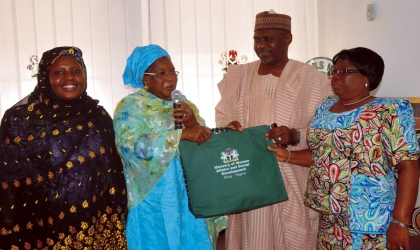
L-R: Permanent Secretary, Ministry Of Women Affairs, Hajiya Habiba Lawal; Minister of Women Affairs, and Social Development, Hajiya Zainab Maina; Head of The Civil Service of The Federation, Alhaji Bukar Goni-aji And Permanent Secretary, Ministry Of Tourism, Culture And National Orientation, Mrs Nkechi Ejele, During A Courtesy Visit By The Head of Service To The Minister Of Women Affairs In Abuja, yesterday.
Chidima Njoku


As Nigeria’s political arena thickens ahead of the January / February 2027 elections , the women folk stand on their resolve to remain a force to reckon with .
Not just in mobilisation as before but right there on the ballot papers . Rivers women this time , more than ever are determined to shake the space .
Through the creeks of Opobo, the bustling markets of Mile One in Port Harcourt, and the political wards stretching from Ogoni to Ahoada, Rivers women sought flags for political posts across the parties.
The story is that for the forthcoming January and February 2027 general elections, the women are undeniable the engine room of political mobilisation across the Treasure Base of the Nation.
Filling every campaign arena coordinating ward-to-ward voter drives, and sustaining the grassroots coalitions that determine who occupies Government House and the legislative chambers but their numerical strength still couldn’t translate to equivalent number of tickets granted them .The Final list of the Independent National Electoral Commission (INEC) unveiled , a familiar paradox. While women constitute the backbone of Rivers State’s electorate and party structures, their names on the actual ballot paper remain hard-won exceptions rather than the rule.
Against the backdrop of complex political realignments—most notably the reconciliatory Rainbow Coalition uniting allies of Governor Siminalayi Fubara and Federal Capital Territory Minister Nyesom Wike behind President Bola Tinubu’s re-election bid, a select group of determined women has stepped forward to claim space on the 2027 ballots.
In the female squad; the faces defining women’s quest for power in Rivers State in 2027 parades a lone female governorship contender challenging 18 men to seasoned labour leaders, lawyers, and grassroots strategists vying for legislative seats, The lone woman in the Brick House Race, to succeed Governor Siminalayi Fubarra among 19 governorship hopefuls, is West Ivy standard-bearer of the African Action Congress (AAC).
At 47, West Ivy is no stranger to the rough-and-tumble of Rivers politics. A lawyer holding multiple academic and legal credentials (including an LL.B, BL, and LL.M), she previously ran as the AAC’s deputy governorship candidate during the 2023 general elections.
West Ivy has anchored her 2027 campaign on ideological consistency and independence from political godfathers.
“I did not switch parties or sides. I kept faith with you, and I am back to lead,” she declared on the campaign trail, framing her candidacy around peace, job creation, and human dignity. Crucially, she has placed gender inclusion at the heart of her governance blueprint, pledging to reserve at least 35 percent of executive cabinet positions for women alongside signing a 13-point Citizens’ Charter. Running alongside her as deputy is Eletuo Ezekiel Ijendu, At the Deputy Governorship corridor, six women appear on the ballot as deputy governorship candidates across diverse party platforms:
Davies Joy Jebba Ikubogh ; and Running mate to Chibuzor Israel Rain on the Accord (A) ticket.
John-Woke Geraldine ; Running mate to Idoniboye-Obu Omangima of the All Progressives Grand Alliance (APGA).
Badom Zaavalo ; Running mate to Whyte Churchill Dagogo of the Allied Peoples Movement (APM).
Jumbo Jessica Robert ; Running mate to Labour Party (LP) candidate Boms Chima Ernest.
Ehuwa Pirinye Kabaka an accountant paired with Peoples Democratic Party (PDP) flag bearer Samuel Soni Ejekwu.
Membere Ibigbeye Deborah ; Running mate to Peoples Redemption Party (PRP) candidate Kieghe Nature Dumale.
The presence of women on the deputy tickets of legacy parties like the PDP and major opposition platforms like the Labour Party reflects an enduring tradition in Rivers politics following in the footsteps of amiable Dr. Ipalibo Harry Banigo, who broke the glass ceiling in 2015 as the state’s first female deputy governor.
Then the Law makers Zone ; battles for the Red Chamber: Women in the Senate Races: . In Rivers State, seven women are contesting across the three senatorial districts, bringing varied backgrounds in labour activism, law, business, and community organising to the January 16 National Assembly polls: Rivers East Senatorial District:Two women are vying to represent the state’s most populous senatorial zone. Leading the charge is Beatrice Itubo. of the Labour Party (LP). A veteran trade unionist and former chairperson of the Rivers State chapter of the Nigeria Labour Congress (NLC), Itubo was the Labour Party’s governorship candidate in 2023.
She is joined on the Rivers East ballot by Wokekoro Beauty Dike Chinonso of the Action Peoples Party (APP).
Rivers South-East Senatorial District: Lessi Naasi Susan flies the flag for the Social Democratic Party (SDP), carrying the banner for female representation in the Ogoni and Opobo/Nkoro axis.
Rivers West Senatorial District This riverine and upland district features the highest concentration of female senatorial contenders in the state, with four women on the ballot: *Ololube Charity Chizhim of the Action Alliance (AA), Abusi Tammy C. of the Action Democratic Party (ADP), Opoli Aneni Inyamoyio* of the Democratic Leadership Alliance (DLA), and *Sokari George Georgina* of the New Nigeria Peoples Party (NNPP).
Yet, the Rivers West race is also defined by the loud absence of Incumbent Senator *Distinguished Senator Ipalibo Harry Banigo, the former deputy governor who won the seat in 2023, and currently Chairs the Health Committee of the Senate . She couldn’t scale through at the primaries of the All Progressives Congress (APC) .
Her exit from the major-party ticket speaks loud of the vulnerablity of even high-ranking, experienced female politicians even with their huge grassroots popularity.
The House of Representatives and State Assembly Contests
In the lower chamber of the National Assembly and the Rivers State House of Assembly INEC’s final list( for the House of Representatives,) has women such as *Victor Igeh Happiness* (contesting the Abua-Odual/Ahoada East Federal Constituency on the Action Alliance platform), alongside candidates under the ADC, NDC, SDP, ZLP, and APM banners, are pushing to break male dominance in federal constituencies.
At the state legislative level —scheduled for February 6, 2027—women across local government areas from Tai to Abua/Odual women had many battles and are still battling internal party intrigues and post-primary litigation. It’s common seeing some female aspirants who clinched party tickets loose their victories immediately in court contests with male contenders Behind the faces on the Ballot are Mobilisers shaping the outcome. Let’s talk about them !
In Rivers State, electoral outcomes are frequently decided by powerful women-led mobilisation networks operating inside the major coalitions.
As the Rivers Rainbow Coalition bridging the political structures of Governor Fubara and Minister Wike under the APC and PDP umbrellas— women leaders have been central to translating high-level political truces into ward-level votes:
Hon. Tonye Briggs-Oniyide, a former two-term Commissioner for Culture and Tourism and Rivers State Coordinator of the Renewed Hope Initiative, has played a pivotal role in linking federal women-empowerment interventions with grassroots political mobilisation.
Barr. Onyii Ile; State Coordinator of the Simplified Grassroots Ladies (SGL), commands one of the most visible female political networks in the state, rallying women across the 23 local government areas behind Governor Fubara’s political alignments.
Prof. Adaeze Chidinma Oreh former Commissioner for Health, continues to bridge public health advocacy and community engagement, resonating strongly with female voters and professional networks.
Amb. Dr. Ruth Davies Ibiamu; Chairperson of the Rivers State chapter of the Nigeria League of Women Voters (NILOWV), leads non-partisan civic education, pushing for peaceful polls and encouraging women to vote beyond material inducements.
Rivers Women in Politics still have lots of hurdles to pull off.
Rivers state with all her dynamic, politically astute women still see men occupy over 90 percent of the top slots on the 2027 ballot.
Women folk; Rivers Women there’s every need to discuss the following barriers : The Patronage and Godfather System,, Prohibitive Campaign High Costs ,Political Volatility and Intimidation: Looking Ahead to January and February 2027 ballots our Women flag bearers have a dual burden. They are competing to win seats in a fiercely contested political environment, while simultaneously keeping the door open for the next generation of female leaders.
I believe through West Ivy’s bold solo run for Government House, Beatrice Itubo’s labour-backed push for the Senate, and the six women standing a heartbeat away from the governorship as running mates, Rivers women are fast going beyond mobilisation figures, aso – ebi wearers or mere spectators in Politics .True democratic representation in Rivers State will remain incomplete until the women who deliver the votes are equally entrusted with the power to govern.
Nneka Amaechi-Nnadi
Women
Hearty Cheers To Nigeria’s Flamingos …Kudos To All Nigerian Women Who Chose To Excel In Male Turfs

For ages, football and soccer pitch in Nigeria were literally identified as areas specifically meant for the menfolk, in line with the societal expectation that physical dominance belongs exclusively to men. Our pitches and the likes were formerly mapped out as men’s domain!
As years rolled by, a new generation of daughters arose. The barriers were broken. Our women and girls graced the pitches and took solid grounds. Not, just to watch and not just to participate, but to conquer.
Nigeria’s female national football teams have consistently flown the country’s flag high, serving as absolute power houses on the African continent and earning immense global respect.
The year 2026 will forever be etched in gold. In Nigeria, and African football history as the year Nigeria’s U-17 women’s national team, the Flamingos took over the male turf, rewrote the global script at the FIFA U-17 Women’s World Cup in Morocco, emerging the first African female Team to conquer the World and bring home the World Cup.
The journey through the seven matches were clearly tough and rough but the Nigerian teenage Queens defied all odds , faced the global big hooves , beat them in their games and made Africa; Nigeria proud . They broke all barriers and won their six matches. They conquered football behemoths like Brazil in the semi-finals with a stellar 3-1 victory, and stood face-to-face with multi-time global champions, Japan in the grand finale in Rabat. When the final whistle blew, sealing a tense 2-1 victory over Japan, the Flamingos achieved the unthinkable: they became the first African nation in history (male or female) to lift the FIFA U-17 World Cup trophy. .
I hail the Midfielder, Oluebube Umejiaku , who ignited the pitch and tamed the world former bests, clinching the prestigious ” FIFA Golden Ball as “ “Player of the Tournament.” Under the tactical brilliance of Head Coach Akeem Busari, the young Nigerian girls stood firm and displayed “what they got”
They did not just win; they dismantled barriers. After an initial setback, they surged forward with six consecutive victories.
As the African Queens landed home amidst thunderous ovations, the Presidency and the Senate took turns to celebrate the Young World Conquerors. Tuesday, the Senate, following the prayers of a Motion on the Flamingos glorious outing sponsored by Distinguished Senator Abdul Ningi applauded the U-17 World best. The World record attained by the players gave room for off politics deliberations in the Red Chamber as all Senators united in commendations over this national feat. The lawmakers took turns to eulogise the female players and splashed the team with cash sum of one hundred million naira.
Senate President Godwill Akpabio, speaking on behalf of his colleagues said, “I want to commend the Flamingos, the U-17 youth team of Nigeria, for defeating major countries such as Brazil and Japan to win the Under-17 World Cup for Africa for the first time and for Nigeria.”
He also appealed to the Federal Government and corporate Nigeria to adequately reward the players and invest in the foundational development of women’s sports. The lawmakers also commended the National Sports Commission (NSC) under Mallam Shehu Dikko for his good work which yielded the world trophy to Nigeria.
Wednesday, the Senate, President and his colleagues continued the shower of praises as they hosted the Flamingos in the National Assembly.
Same day, the team was hosted at the Presidential Villa by the First Lady, Senator Oluremi Tinubu. The players at the Villa received gifts of One hundred million Naira each from President Bola Ahmed Tinubu .
From the women’s world, the victory of the Flamingos speaks volumes. It is women breaking boundaries, venturing into male – dominated terrains not just to be seen but to excel not minding systemic hurdles.
Looking back, it is already established that soccer, the field of men had expanded. No longer a male preserve but a shared terrain where Nigeria’s female teams shake the world.
Before now, the Super Falcons (Senior Women’s National Team; undisputed Queens of Africa, dominated the Women’s Africa Cup of Nations (WAFCON) with multiple continental titles and historic triumphs. They qualified for every single edition of the FIFA Women’s World Cup since its inception in 1991. The Super Falcons maintained Continental Dominance and Rankings.
The Falconets, Nigeria’s U-20 Women’s National Team in turn carved their names in gold over the years as they consistently terrified traditional superpowers at the FIFA U-20 Women’s World Cup. They have a history of reaching deep into the tournament, famously securing runners-up position (Silver medals) at the FIFA U-20 Women’s World Cup on multiple occasions, fiercely challenging powerhouses like Germany and the USA. Maintaining African Supremacy, they routinely swept the African qualifiers, proving to be the ultimate conveyor belt of talent feeding straight into the senior Super Falcons squad.
Cheers to all Nigerian Women! Our Teams are the best!
Nneka Amaechi-Nnadi
-
News4 days ago
Parents Protest Scholarship Scheme Suspension At PAMO Varsity
-
 News4 days ago
US Hails Nigerian Military For Rescuing 125 Kidnap Victims
-
News23 hours ago
Bayelsa Boat Mishap: Tinubu Donates N250m As Death Toll Hits 29
-
News23 hours ago
Odu Pays Tribute To Late Chinwah, Describes Him As Courageous, Selfless Academic
-
Business4 days ago
Reps Raise Alarm Over N2trn Agricultural Loan Diversion
-

 Featured4 days ago
Presidents Xi, Trump, Putin Commit To Global Stability, Denuclearisation
-
Politics4 days ago
ADC Faults INEC’s Alleged Limited Capacity To Upload Election Result On IREV
-
Politics4 days ago
Tinubu Expands 2027 Campaign Tour To 19 States