
Business
Why Nigeria’s Industrial Dev Is Slow –UNIDO

The United Nation Industrial Development Organisation (UNIDO) yesterday attributed Nigeria’s slow pace development to inconsistency in the country’s industrial policy.
UNIDO Country Representative in Nigeria, Dr Patrick Kormawa, stated this in an interview with newsmen in Abuja.
Kormawa said that Nigeria’s over-dependence on export of raw materials would not enhance development, adding that dependence on export of finished product was a major key to economic development.
He said that Nigeria had over the years focused on export of raw materials, especially oil, without focusing on non-oil sector such as industry and agriculture.
“Nigeria did not address fundamental constraints to competitiveness; as a result of this businesses crumbled and products were rejected,” he said.
Kormawa also blamed the problem on lack of a well defined trade policy that was integrated with a clear investment policy and a detailed industrial policy plan.
“No country in the entire world can thrive by depending on exportation of raw materials rather than exporting finish products.
“The more a country specialises in the production of raw materials which, of course Africa has found itself in, the poorer it becomes.
“The Europeans and Americans have developed through value-added activities not by exporting oil or agricultural commodities but by making and doing things.
He pledged the commitment of UNIDO to offer necessary support that would enhance diversification of the nation’s economy by boosting trade and investment through public- private initiatives.
He said that UNIDO had concluded plans to set up quality infrastructure in Nigeria to facilitate international trade and competitiveness in international markets for Nigerian products.
Kormawa said that the project, if fully executed, would help to reduce rejection of made in Nigeria products due to low quality.



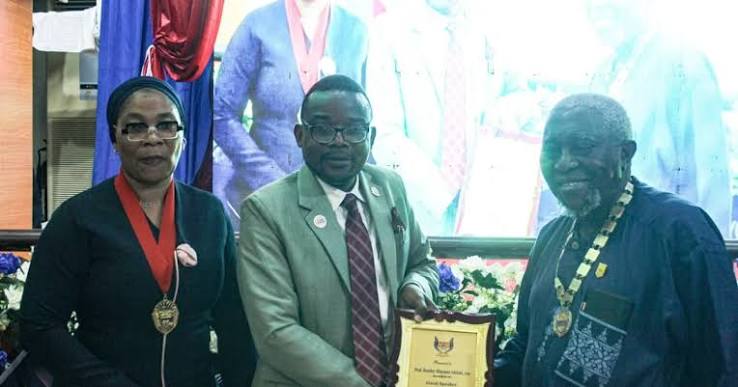
The NIM president also identified integrity, accountability, probity, honesty and efficiency as essential principles that needed to be strengthened in Nigeria’s workplaces and economy.
He argued that management failures extended beyond businesses to households and the wider society, making the promotion of sound management practices increasingly important.
Mustapha also renewed the institute’s call on the Federal Government to recognise 19 November as National Management Day, saying such recognition could strengthen its campaign for the United Nations to declare the date International Management Day.
The institute adopted 19 November for its annual celebration in 2016 to coincide with the birthday of Peter Drucker, widely regarded as the father of modern management.
Mustapha said the institute believed that official recognition by the Federal Government would strengthen its appeal to the United Nations to establish an international observance dedicated to the management profession.
The lecture featured Executive Director of the University of Lagos Business School, Prof. Sunday Adebisi, as guest speaker.
Other attendees included the Registrar and Chief Executive of NIM, Taiwo Olusesi, and a former president of the institute, Akinbayo Adenubi.

The Chief Executive Officer (CEO) of Moniepoint Microfinance Bank Babatunde Olofin, says transaction volume of the bank has hit one trillion naira daily.
Olofin said this at the unveiling of the bank’s North Central office in Abuja on Friday.
He said the bank also served a customer base of about 21 million and provided more than one million jobs in the country.
”Moniepoint is proudly Nigerian, owned by a Nigerian and managed by Nigerians.
?”With ?????????????????????our solid technologies and tailored-made products for businesses in Nigeria and retail customers as well, we are the bank to reckon with,” he said.
The CEO said the bank might be considering upgrade to a full-fledged commercial bank if the business required so.
According to him, this is a strategic decision which if the business requires it, we will communicate.
Fielding questions from newsmen, Edidiong Uwemakpan, the Vice-President Corporate Affairs of the bank, said the bank had been supporting agricultural activities to impact households.
”Moniepoint has always been hyper local and if you look at how we scaled our business, we understood how much Nigerians wanted to be able to interact with humans.
”From the very beginning, we built this distribution network of people that can be trusted, I think this is just an extension of our hyper-local strategy, getting closer to people,” she said.

-
News3 days ago
Bayelsa Boat Mishap: Tinubu Donates N250m As Death Toll Hits 29
-
News3 days ago
Odu Pays Tribute To Late Chinwah, Describes Him As Courageous, Selfless Academic
-
 Maritime3 days ago
Nigeria, Russia Customs Sign MOU To Trade Facilitations
-

 Sports3 days ago
World marathon champion gets three-year doping ban
-
 Maritime3 days ago
South-South Governors Urges To Shake Off Collective Lethargic To Embrace Blue Economy
-
 Maritime3 days ago
Oyetola Woos Investors With Nigeria’s Seabed Resources, Marine Biotechnology
-

 Business3 days ago
Moniepoint MfB transaction volume hits 1trn daily — CEO
-

 Oil & Energy3 days ago
Global Oil Market May Witness Supply Surplus Before The End Of 2026 …… Report