
Business
Shareholders, Dealers Differ On Certificates Verification Fees

Shareholders and dealers, have disagreed on the increasing
cost of verifying share certificates for the ongoing de-materialisation.
The disagreement among the capital market operators in Lagos
followed a circular by the Securities and Exchange Commission (SEC) stipulating
that the exercise was free.
Investigations showed that contrary to the SEC’s directives,
most stock broking firms still charge shareholders between N500 and N1,000 as
fees, depending on the location of the registrars.
SEC on March 13 issued the circular making January1, 2013,
the deadline for the de-materialisation of all share certificates.
According to the circular, all share certificates
de-materialised on or before January1, 2013, will be free while those that come
after attract an unspecified penalty.
It also said that the allotment of shares of public
offerings would be electronically transferred directly to the shareholders’
accounts in the Central Security Clearing System (CSCS).
Mr Sunny Nwosu, the National Coordinator, Independent
Shareholders Association of Nigeria (ISAN), said that shareholders were being
short changed by the dealers, in spite of their losses.
Nwosu described the charges for verification as part of the
market’s flaws affecting investor confidence.
The ISAN boss urged SEC to ensure that it implemented the
extant rules guiding the operations of the market.
He also charged SEC to emphasise inclusive capital market
regulation by partnering stockbrokers and shareholders on the development and
growth of the capital market.
Mr Boniface Okezie, the President of the Progressive
Shareholders Association of Nigeria (PSAN), described the inability of the
commission to protect the interest of local investors
as unfortunate.
Okezie said it was illogical that shareholders’ burden
increased daily through multiple taxes, in spite of the commissions earned by
the SEC, the Nigerian Stock Exchange (NSE) and dealers from their portfolio
investments.
Dr David Ogogo, the Chief Executive Officer of the Institute
of Capital Market Registrars (ICMR), Lagos, urged stakeholders who owned
capital to convene a meeting to address the current challenges facing the
market.
Ogogo suggested that the cost of verification should be
treated in isolation but in the context of service delivery in a depressed
capital market.
Mr Emeka Madubuike, the President of the Lagos-based
Association of Stock broking Houses of Nigeria (ASHON), said that the charges
were decided by the various firms.
Madubuike, who claimed the dealers were ignorant of the SEC
circular or notice on share certificate verification, noted that the commission
had failed to implement or enforce the order.
He said that the verification fee was for incidentals, such as
transportation and activities that would enable dealers’ personnel to follow up
on the investors’ instructions.
“The issue of brokers’ charges will be looked into and dealt
with so that it doesn’t act as an impediment to the de-materialisation policy,”
Madubuike said.
According to Alhaji Rasheed Yussuf, the immediate past
President of ASHON, the verification fees “are just transport expenses for the
prosecution of investors’ orders.



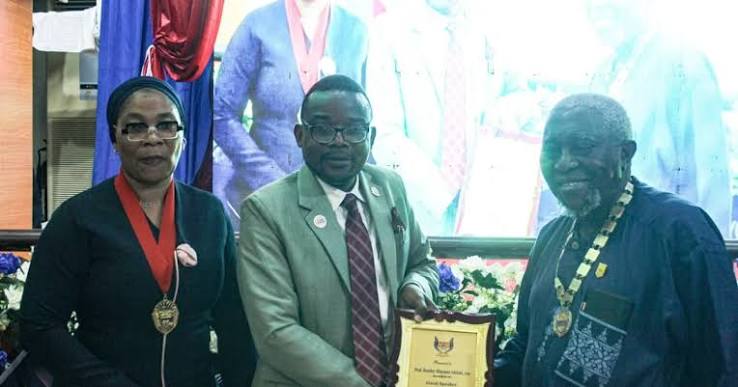
The NIM president also identified integrity, accountability, probity, honesty and efficiency as essential principles that needed to be strengthened in Nigeria’s workplaces and economy.
He argued that management failures extended beyond businesses to households and the wider society, making the promotion of sound management practices increasingly important.
Mustapha also renewed the institute’s call on the Federal Government to recognise 19 November as National Management Day, saying such recognition could strengthen its campaign for the United Nations to declare the date International Management Day.
The institute adopted 19 November for its annual celebration in 2016 to coincide with the birthday of Peter Drucker, widely regarded as the father of modern management.
Mustapha said the institute believed that official recognition by the Federal Government would strengthen its appeal to the United Nations to establish an international observance dedicated to the management profession.
The lecture featured Executive Director of the University of Lagos Business School, Prof. Sunday Adebisi, as guest speaker.
Other attendees included the Registrar and Chief Executive of NIM, Taiwo Olusesi, and a former president of the institute, Akinbayo Adenubi.

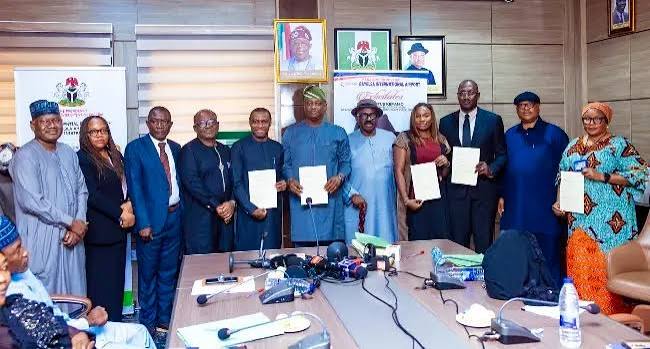
The Chief Executive Officer (CEO) of Moniepoint Microfinance Bank Babatunde Olofin, says transaction volume of the bank has hit one trillion naira daily.
Olofin said this at the unveiling of the bank’s North Central office in Abuja on Friday.
He said the bank also served a customer base of about 21 million and provided more than one million jobs in the country.
”Moniepoint is proudly Nigerian, owned by a Nigerian and managed by Nigerians.
?”With ?????????????????????our solid technologies and tailored-made products for businesses in Nigeria and retail customers as well, we are the bank to reckon with,” he said.
The CEO said the bank might be considering upgrade to a full-fledged commercial bank if the business required so.
According to him, this is a strategic decision which if the business requires it, we will communicate.
Fielding questions from newsmen, Edidiong Uwemakpan, the Vice-President Corporate Affairs of the bank, said the bank had been supporting agricultural activities to impact households.
”Moniepoint has always been hyper local and if you look at how we scaled our business, we understood how much Nigerians wanted to be able to interact with humans.
”From the very beginning, we built this distribution network of people that can be trusted, I think this is just an extension of our hyper-local strategy, getting closer to people,” she said.
-
News5 days ago
Parents Protest Scholarship Scheme Suspension At PAMO Varsity
-
 News5 days ago
US Hails Nigerian Military For Rescuing 125 Kidnap Victims
-
News2 days ago
Bayelsa Boat Mishap: Tinubu Donates N250m As Death Toll Hits 29
-
News2 days ago
Odu Pays Tribute To Late Chinwah, Describes Him As Courageous, Selfless Academic
-
Business5 days ago
Reps Raise Alarm Over N2trn Agricultural Loan Diversion
-

 Featured5 days ago
Presidents Xi, Trump, Putin Commit To Global Stability, Denuclearisation
-
Politics5 days ago
ADC Faults INEC’s Alleged Limited Capacity To Upload Election Result On IREV
-
Politics5 days ago
Tinubu Expands 2027 Campaign Tour To 19 States