
Editorial
2027: Beyond IGP’s Billboards Protection Order

As Nigeria moves toward the 2027 general elections and campaign activities intensify, violence against opposition politicians has become an issue that can no longer be overlooked. What should be a season of competing ideas is increasingly turning into a test of intimidation, and early signs suggest that those challenging the ruling establishment are the primary targets.
It was, therefore, welcome news when the Inspector-General of Police, Olatunji Disu, warned politicians, political thugs and others against destroying, defacing or removing campaign posters, banners and billboards. In a statement issued in Abuja by the Force Public Relations Officer, CSP Ani Iniedu, the police condemned such acts as political intolerance, directed Commissioners of Police in all 36 States and the Federal Capital Territory to take preventive measures, and warned that sponsors would also face prosecution. The police rightly described such vandalism as a criminal act that undermines parties’ and candidates’ freedom to canvass for votes.
But billboards are replaceable; human lives are not. While applauding the IGP’s stance, we urge him to extend the same stern warning and enforcement zeal to thugs who assault opposition members during campaigns. A police force that punishes the tearing of a poster but ignores the breaking of a skull will have its priorities questioned. Allowing such attacks to continue could erode the foundations of our democracy.
Consider the African Democratic Congress (ADC) presidential campaign flag-off in Sokoto State on November 4, 2026. The party alleged that the State Government denied it access to public facilities, sealed its campaign venue and pressured hotels to reject its delegates, forcing it to hold the rally at its secretariat. The Sokoto authorities, however, denied instructing hotels to turn guests away. More seriously, two suspected ADC supporters were reportedly shot along the Sokoto–Wurno Road while travelling to the venue, allegedly by operatives of the Sokoto State Community Guards.
Whatever the truth of these competing accounts, a shooting demands more than press statements. It requires a transparent, independent investigation and prosecution where warranted. Sokoto was not an isolated incident. The following day in Birnin Kebbi, the ADC presidential campaign convoy was reportedly attacked by armed gangs. Amnesty International said vehicles were vandalised, people assaulted with cutlasses and roads blocked, while the party’s Kebbi governorship candidate, Abubakar Malami, alleged that media equipment was destroyed and tear gas deployed. His convoy had suffered a similar attack in the city in September 2025.
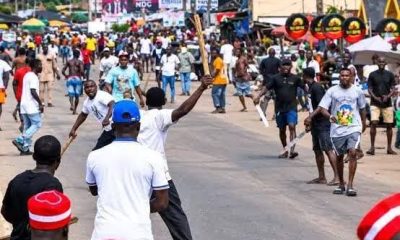
The Nigeria Democratic Congress (NDC) has suffered similar attacks. On November 4, hoodlums stoned the motorcade of its presidential candidate, Peter Obi, and running mate, Rabiu Musa Kwankwaso, at Watt Market roundabout in Calabar, Cross River State. Police reported arresting a 27-year-old suspect, Victor Edet, although it remains unclear whether he has been arraigned. The State Government has denied suggestions that ruling-party supporters were responsible. Worse, in Asaba, Delta State, one person was killed and five injured when suspected thugs attacked an NDC rally. A death at a political rally is no longer a warning; it is a damning indictment of the prevailing political climate.
Even critics of the establishment who are not frontrunners have not been spared. Omoyele Sowore, presidential candidate of the African Action Congress (AAC), was attacked by suspected thugs at a restaurant in Ado-Ekiti on October 30. He alleged that the assailants were linked to the Ekiti State Government House and that the Department of State Services leaked his location. Both the State Government and the security service denied involvement, while the police reported a minor injury and a discreet investigation. These conflicting accounts make an independent, publicly reported inquiry indispensable.
What deepens the concern is the Federal Government’s apparent silence. We are unaware of any specific, forceful condemnation of these assaults, even as All Progressives Congress (APC) rallies appear to proceed nationwide without incident. Such silence can easily be misconstrued as complicity, regardless of intent.
According to the Centre for Democracy and Development, 109 election-related deaths were recorded in the build-up to the 2023 polls. The Kimpact Development Initiative separately documented 238 incidents and 24 deaths during the general elections. Beyond Nigeria, Kenya’s 2007–08 post-election violence claimed more than 1,000 lives, according to the Waki Commission. Ghana, by contrast, enacted the Vigilantism and Related Offences Act in 2019 to curb party vigilante groups, a model worth studying.
The remedies are neither exotic nor expensive. The IGP should extend his directive to cover assaults on individuals and disruptions of rallies, while establishing a dedicated investigative unit to probe the Sokoto shooting and the attacks in Kebbi, Calabar, Asaba and Ado-Ekiti. It should publish the status of each case within a fixed period. Suspects must be prosecuted and their sponsors, regardless of party or position, brought to justice. State-backed security outfits, including the Community Guards, should be audited and barred from partisan duties.
The Federal Government must speak and act unequivocally. President Tinubu should specifically condemn attacks on opposition candidates and direct all security agencies to guarantee equal protection for every party. Governors must ensure equal access to public facilities for registered parties. The Independent National Electoral Commission (INEC), which has warned of fines and imprisonment under the Electoral Act 2026 for inflammatory campaign conduct, should enforce the Code of Conduct for Political Parties. Working with the Inter-Agency Consultative Committee on Election Security, it should publish a joint security plan covering campaigns, polling, and collation. Parties must discipline their supporters, courts expedite electoral-violence trials, and civil society and the media maintain a public record of incidents and their outcomes.
The credibility of the 2027 elections is at stake. An election is credible only when every contender can campaign, travel, assemble and speak freely, without fear. Without a free opposition, there can be no meaningful democracy. Nigeria is not a one-party State, and law enforcement agencies must demonstrate their neutrality through action, not communiqués. The campaign atmosphere is too tense to be left to chance. Billboards deserve protection, certainly, but citizens deserve it far more.



The Independent National Electoral Commission’s (INEC) disclosure of an alleged plot to target its ad hoc personnel ahead of the 2027 general elections demand urgent national attention. The reported arrest of suspects, with intelligence support from the Department of State Services (DSS), is encouraging, but must not breed complacency. Any attack on electoral workers threatens not only human lives but also Nigerians’ constitutional right to choose their leaders through credible elections. The alleged conspiracy must be thoroughly investigated, its sponsors identified and all those found culpable prosecuted.
Particularly troubling is the reported targeting of National Youth Service Corps (NYSC) members, who play a vital role in Nigeria’s electoral process. Many serve far from home and undertake sensitive assignments at polling units and other electoral locations. As civilians, they should not be exposed to intimidation, abduction or violence without adequate protection. If election workers are vulnerable, the safety of other officials, observers and voters cannot be guaranteed.
Nigeria’s electoral history offers painful lessons. Human Rights Watch reported in Nigeria’s Post-Election Violence, published in May 2011, that more than 800 people died in the violence following the 2011 general elections. NYSC members serving as electoral officials were among the victims. This tragedy underscores the deadly consequences of political tension, incitement and disputed outcomes. Nigeria must act on the latest warning before another preventable disaster occurs.
INEC deserves recognition for uncovering the alleged plot, while the DSS and other security agencies merit commendation for their reported assistance. However, arrests are only the beginning. Investigators must establish the suspects’ identities, motives, networks and intended targets, ensuring that evidence is admissible in court. The process must remain impartial and free from political interference. Credible public updates are also necessary, provided they do not compromise investigations or operational security.
The authorities must adopt a comprehensive, intelligence-led security strategy for 2027. INEC’s proposed security conference should produce practical measures developed in collaboration with the Inter-Agency Consultative Committee on Election Security (ICCES), the police, the DSS and other relevant agencies. Threat assessments should guide personnel deployment, secure transportation, emergency communications, evacuation procedures and rapid response. Protection must extend beyond polling day to the distribution of sensitive materials, collation centres and the safe return of ad hoc personnel.
Those who provide intelligence must also be protected from retaliation. Confidential reporting channels and appropriate safeguards should be established for informants and others assisting investigations. Equally, security deployments must not intimidate voters or facilitate political repression. Personnel should act professionally, impartially and proportionately, within the law. Clear mechanisms for reporting misconduct and investigating abuses are essential to maintaining public confidence.
The threat also highlights broader concerns about trust in the electoral system. The European Union Election Observation Mission’s June 2023 final report identified shortcomings in transparency and operational implementation during Nigeria’s 2023 general elections, alongside concerns about the legal framework and electoral dispute resolution. Credible elections require more than security; they depend on transparent procedures, accountable officials and consistent enforcement of electoral laws. INEC must demonstrate measurable progress in addressing previously identified weaknesses.
Voter apathy presents another challenge. INEC’s published figures indicate that approximately 25 million people voted in the 2023 presidential election, out of about 93.5 million registered voters, a turnout of roughly 26.7 per cent. Although insecurity is not the sole cause of low participation, threats against electoral personnel can heighten public anxiety and discourage voters from exercising their franchise. INEC should strengthen civic education, improve polling accessibility and communicate procedures clearly. Political parties, civil society and the media must promote peaceful participation and reject electoral intimidation.
Misinformation and manipulated digital content pose additional risks. False reports, fabricated announcements and deepfake videos can inflame tensions, impersonate officials and mislead voters. INEC should establish a well-resourced, rapid-response communication system supported by verified digital channels and timely public statements. Collaboration with credible media organisations and fact-checkers would help counter falsehoods without suppressing legitimate criticism. Clear, consistent communication is indispensable, as administrative confusion and delayed explanations often allow rumours to spread.
Electoral integrity must also begin within INEC itself. The chairman’s warning against partisanship, negligence, extortion and ethical misconduct deserves serious attention. Security measures cannot compensate for officials who abuse their positions or disregard established procedures. INEC should strengthen staff training, ensure transparent recruitment and deployment, provide secure channels for reporting misconduct and enforce disciplinary rules consistently. Allegations of bribery and political interference must be investigated regardless of rank, while ad hoc personnel should receive adequate briefing, support and prompt payment.
The legal framework also requires clarity and consistent enforcement. INEC should explain the precise provisions and applicability of Section 26 of the Electoral Act 2026, including the obligations of electoral officials and security personnel, and publish authoritative guidance on neutrality and professional conduct. Complaints by opposition parties that they have been prevented from campaigning in certain states must likewise be investigated impartially. Any established violations should attract appropriate corrective action. Electoral fairness requires not only impartial polling officials but also lawful campaigning, access to competing viewpoints and freedom from intimidation.
The alleged plot against INEC’s ad hoc personnel is a warning against complacency ahead of the 2027 general election. Governments, security agencies, INEC, political parties and civil society must work together to prevent violence, punish misconduct and protect citizens’ participation. The commission should communicate its security priorities, maintain accessible threat-reporting channels and provide periodic updates on preparedness. Nigeria’s democracy cannot be safeguarded by assurances alone; it requires demonstrable preparation, impartial law enforcement and an unwavering commitment to free, fair and credible elections.
-
 Politics4 days ago
LG CITY BOY COORDINATOR HAILS WIKE’S SUPPORT FOR ONYESOH, TINUBU
-
Politics4 days ago
DIRI INAUGURATES APC CAMPAIGN COUNCIL, SETS MILLION VOTES TARGET FOR TINUBU
-
 Politics4 days ago
NDC Candidate Urges Oborevwori To Probe Asaba Political Violence
-

 News4 days ago
Army Recovers X Account After Hack Attempt
-
Politics4 days ago
2027: Oborevwori Tasks Media On Fair, Accurate Reporting
-
Politics4 days ago
2027: AKPABIO ENVISAGES TINUBU’S VICTORY IN SOUTH SOUTH REGION
-
 Business4 days ago
Nigeria Loses N17tr Yearly To Abandoned Projects
-
Politics4 days ago
Asaba Political Violence: Police Confirm One Dead, Delta Govt Urges Probe