
City Crime
FUBARA PRESENTS N1.188TRN AS 2025 BUDGET TO RSHA

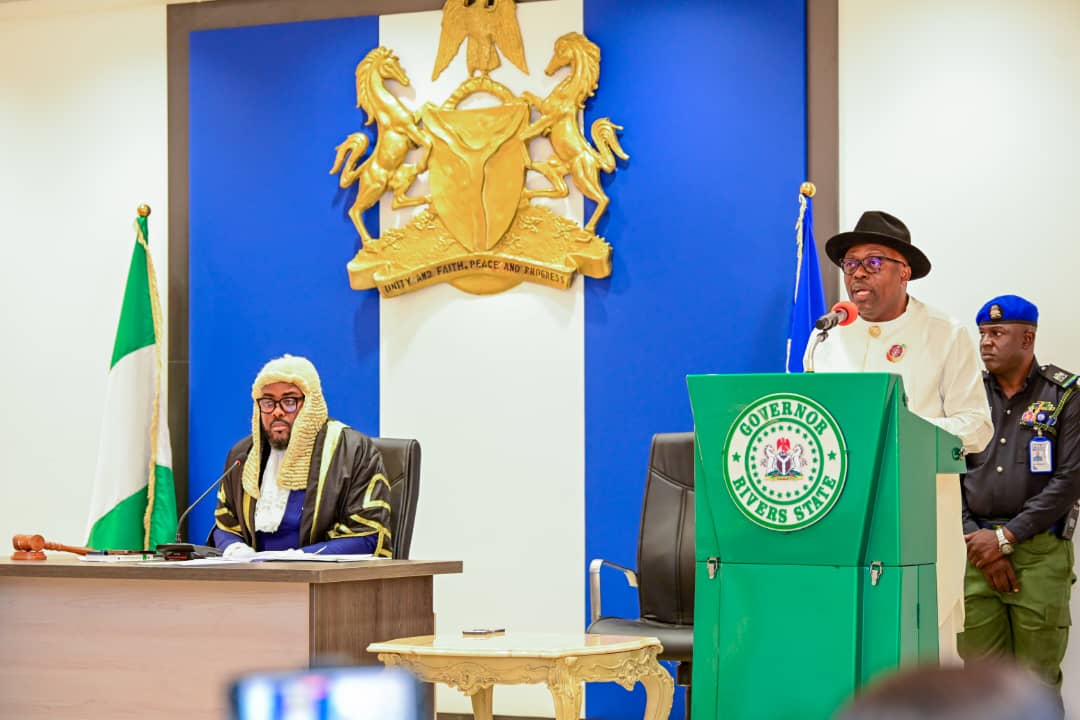
Rivers State Governor, Sir Siminalayi Fubara, has presented N1.188 trillion as budgetary estimate for the year 2025 to the State House of Assembly for consideration and approval.
This figure is an increase from the 2024 budget of N800 billion that was presented in 2023 to the Assembly.
Governor Fubara presented the 2025 Appropriation Bill shortly after delivering his address to lawmakers at the Assembly Auditorium, Administrative Block of Government House in Port Harcourt on Monday.
He said the 2025 budget christened: “Budget of Inclusive Growth and Development”, will be implemented to achieve sustainable economic growth, accelerate the development of the State, while improving the living standards of all residents in the State.
Governor Fubara explained that with the set out objectives, the 2025 budget will strengthen the capacity of the State to weather possible external shocks from the volatility of the national economy while building a resilient economy that will advance the collective development and prosperity of the people.
He said, “The total projected revenue for Rivers State for the 2025 Fiscal Year is N1,188,962,739,932.36.
Two components of the budget are constituted as follows: Recurrent Expenditure of N462,254,153,418.98; Capital Expenditure of N678,088,433,692.03; Planning Reserve of N35,688,864,931.16; and a closing balance of N12,931,287,890.1935. This gives a Recurrent/Capital Expenditure ratio of 44:56%, indicating the sincere commitment of our administration to both infrastructural and human capital development of our people and state.”
Governor Fubara said nearly N31 billion has been allocated to support interventions in agricultural development to ease the implementation of a comprehensive agriculture transformation and support programme for Rivers youths in order to significantly resolve issues of youth unemployment and poverty.
He emphasised that the commitment is also to address food insecurity in Rivers State, provide land preparation, farm inputs and extension services, including training, tractors, and access to improved seedlings and fertilizers to farmers to enhance their productivity and farm yields.
In education, Governor Fubara assured that his administration will continue to provide access to quality education at all levels, enabling Rivers children have the knowledge and skills they need to excel in their careers and contribute to the development of the State.
The Governor said, “Consequently, we have proposed to spend over N63 billion, representing 9.3% of the budget on education in fiscal year 2025. With this, we shall access all outstanding matching grants from the Universal Basic Education Commission to rehabilitate, equip and furnish dilapidated public primary and junior secondary schools, and continue to provide free basic education to our children.
“We will also rehabilitate, equip and furnish as many senior secondary schools as possible across the State, including the provision of new classrooms, perimeter fencing, water and electricity, to provide a conducive environment for effective teaching and learning to take place.
“We shall work with the school-based management boards, administrators, parents and teachers to fix our broken school system, improve enrollments, keep learners in school, promote effective teaching, and improve learning outcomes.”
Governor Fubara said with the proposed N97.750 billion for the health sector, representing 14.4% of the budget, all zonal hospitals, the upgraded neuropsychiatric hospital, and the new general hospital at Rumuigbo under reconstruction will be completed to provide quality and affordable healthcare services to the people of the State.
He also assured of rehabilitating more general hospitals, health centres across the State, ensure the procurement of essential drugs, medical supplies and equipment for effective and efficient healthcare delivery, while also providing more infrastructure to strengthen the capacity of the Rivers State University Teaching Hospital for quality, effective, and efficient tertiary healthcare services.
On Road and Transport Infrastructure, Governor Fubara said over N195 billion has been earmarked to complete all ongoing road projects and initiate new ones, support and facilitate the modernization of the public transport system through necessary incentives to improve the quality of public transportation services in the State.
Governor Fubara assured that all ongoing electrification projects, including delivering transformers and replacing the generator-powered streetlights with solar energy-powered streetlights across Port Harcourt and Obio/Akpor Local Government Areas will be concluded, and restated the determination to ensure the passage of the Rivers State Electricity Market Bill to regulate and open the State’s energy sector for private sector investments in order to achieve energy security and accelerate the industrialization of Rivers State.
He said, “In Social Development and Investments, Mr Speaker, we have proposed to spend N15.4 billion for the social development subsector of our economy to advance youth and gender empowerment, jobs and wealth creation, sports development, and social inclusion.
“We will collaborate with Local Government Councils to establish youth resource and digital transformation centres to enable access to digital tools, Internet services and training programmes for our youths to become economically successful and sufficiently self-reliant.
“We will also continue to support and strengthen the capacity of State-owned sporting teams, especially Rivers United, Rivers Angels, and the Hoopers to enable them excel and win more laurels in both national, regional and international contests.”
Governor Fubara, who said the 2025 will be funded from FAAC, Internally Generated Revenue, Statutory Allocations, Mineral Funds, Valued Added Tax, Refunds/Escrow/ECA and others, explained that the 2014 budget performed excellently with IGR figure hitting N100billion increase over the 2023 figure.
In his speech, Speaker, Rivers State House of Assembly, Rt Hon Victor Oko-Jumbo, applauded Governor Fubara for recording over N100 billion increase in IGR, which shows high level of transparency and accountability in governance, with the plugging of financial leakage, adding that it is also a testament to how attractive Rivers investment climate has become.
Rt Hon Oko-Jumbo pledged the continual support of the Legislature to the Excutive to ensure that the Governor remained focused, sustain financial prudence, deliver democratic dividends, and make life better for the people.





Team Nigeria recorded its best-ever appearance at the Youth Olympic Games, winning three gold medals at Dakar 2026 in Senegal to surpass the country’s previous best performance at the competition since its debut.
It was a remarkable campaign defined by historic victories, record-breaking performances and the emergence of a new generation of Nigerian sporting talents, with three athletes etching their names into the country’s sporting history.
According to a press statement from the Special Assistant, SA to the Director -General of the National Sports Commission, Kola Daniel, Nigeria’s gold-medal haul came through Bright Gift, Rosemary Nwankwo and Praise Ugoh, whose outstanding performances in athletics delivered an unprecedented sprint double and a landmark victory in the women’s 400m.
Bright Gift made history by becoming the first Nigerian to win the men’s 100m title at the Youth Olympic Games, clocking an impressive 10.28 seconds to claim gold and set a new Games record.
Rosemary Nwankwo’s victory in the women’s 100m, completing Nigeria’s historic sprint double. Her 11.16-second performance made Nigeria the first country to win both the men’s and women’s 100m titles at the same edition of the Youth Olympic Games.
Praise Ugoh completed Nigeria’s golden campaign by winning the women’s 400m in a personal best of 52.76 seconds, becoming the first Nigerian to claim the event’s title at the Youth Olympic Games.
The three victories represent a new high for Nigeria at the competition, surpassing the two gold medals won at the inaugural edition in Singapore in 2010.
The National Sports Commission (NSC) has attributed the progress of Nigerian youth sports to sustained efforts in grassroots development, talent identification and the creation of competitive platforms through which young athletes can be discovered, nurtured and prepared for international competition.
The two technocrats, Mallam Shehu Dikko, and Hon. Bukola Olopade’s commitment to grassroots sports development has continued to drive initiatives aimed at building a strong pipeline of future champions.
A major component of this strategy is the Commission’s Invited Junior Athletes Initiative, alongside the National Sports Festival and the hosting of the CAA Africa U18/U20 Athletics Championships in Abeokuta. These platforms have provided opportunities for emerging talents to compete, gain exposure and progress towards representing Nigeria on the international stage.
The Director of Grassroots Sports Development at the Commission, Prince Niyi Beyeku, and other key players including Lekan Alabi epitomize the dedicated team behind implementing programmes and initiatives that strengthen talent discovery and development across the country.
The Nigeria Olympic Committee, under the leadership of its President, Engr. Habu Gumel, remained consistent in its support and leadership in coordinating Nigeria’s participation at the Games.
The Commission applauds all athletes’ coaches, technical officials, medical personnel and backroom staff whose hard work, preparation and dedication contributed to the team’s historic outing.
Beyond the medals, Nigeria’s performance in Dakar represents a significant statement about the country’s sporting future. The emergence of these young champions reinforces the importance of sustained grassroots investment and provides renewed optimism about Nigeria’s capacity to produce world-class athletes.
President Bola Tinubu on Wednesday announced the award of a ?100 million Federal Government Savings Bond to each player on Nigeria’s victorious U-17 women’s football team, the Flamingos.
The bonds attract an annual interest rate of 14 per cent. The investment by the government for the players is for five years.
President Tinubu also announced a cash gift of ?100 million for the coach and ?50 million for each member of the technical crew.
The President announced the rewards during a reception at the Presidential Villa in Abuja for the Flamingos, who reportedly won the U-17 Women’s World Cup in Morocco.
The Flamingos defeated Japan to become the first African team to win the tournament.
President Tinubu was represented at the reception by the First Lady, Senator Oluremi Tinubu.
-
News5 days ago
RSG Reaffirms Commitment To STEM Education, Technological Advancement
-
 News5 days ago
IGP Warns Police Officers Against Partisanship …Directs Regular Engagement With Journalists
-
Business2 days ago
BSG Partiner American Coy To Invest $100m In Gas Processing
-

 Oil & Energy2 days ago
FG To Double Oil, Gas Reserves, Moves To Intensified fresh Exploration
-
Business2 days ago
Seme Customs Intercepts Live Pacific Ridley Sea Turtle
-
 News5 days ago
Customs To Deploy AI, Scanners Against Snuggling
-
Sports5 days ago
CAF Awards 2026 Gets A New Date
-
 Politics5 days ago
2027: INEC Begins Deployment Of Non-Sensitive Materials