
Business
Nigeria’s Trade Costs Too High To Attract Investments, WTO DG Laments

The Director General of the World Trade Organization (WTO), Dr Ngozi Okonjo-Iweala, has told President Muhammadu Buhari, ministers and other top government officials that Nigeria’s trade costs are too high.
Okonjo-Iweala, who was a former Minister of Finance and Coordinating Minister of Economy under the administration of former President Goodluck Jonathan, stated this via a video link on the second day of the Mid-term Ministerial Performance Review at the Presidential Villa, Abuja, yesterday.
She further spoke of the need to improve the nation’s security in order to attract foreign and domestic investments.
The WTO DG said the country must cut down not only on trade cost but also infrastructure cost, linkage cost, regulatory cost, customs cost, and all costs associated with moving goods from the factory to the final consumer to complement investment facilitation.
She pointed out that Nigeria’s trade cost was equivalent to 306 per cent tariff, one and half times higher than the cost in high-income countries.
According to her, congestion, capacity constraints and high costs at Nigerian ports do not encourage investment as they make it difficult to build supply chain operations in the country.
She said: “Improving security and lowering transaction cost for foreign investment, even for domestic investment, would be necessary. And Nigeria is part of a group of countries negotiating an agreement on investment facilitation at the WTO.
“Once this agreement is negotiated, ratified and is being implemented, it could be instrumental in attracting additional trade-oriented investment.
“To complement investment facilitation, Nigeria has to cut down on trade cost, infrastructure cost, linkage cost, regulatory cost, customs cost, basically, all costs associated with moving goods from tie factory or farm gate to the final consumer.
“Nigeria’s trade costs are too high. According to the World Bank-ESCAP trade costs for 2019, trade costs for African countries are on average equivalent of a 304% tariff and for Nigeria, it’s even slightly higher at 306%.
“These numbers are one and half times higher than trade cost in high-income countries. Such high costs are not conducive to forming regional value chain.
“Congestion, capacity constraints and high costs in our ports make life difficult for anyone seeking to build supply chain operations in Nigeria and hence, expand trade from there.”



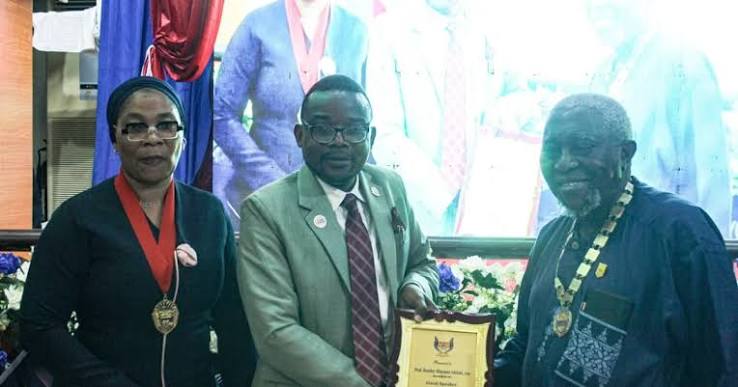
The NIM president also identified integrity, accountability, probity, honesty and efficiency as essential principles that needed to be strengthened in Nigeria’s workplaces and economy.
He argued that management failures extended beyond businesses to households and the wider society, making the promotion of sound management practices increasingly important.
Mustapha also renewed the institute’s call on the Federal Government to recognise 19 November as National Management Day, saying such recognition could strengthen its campaign for the United Nations to declare the date International Management Day.
The institute adopted 19 November for its annual celebration in 2016 to coincide with the birthday of Peter Drucker, widely regarded as the father of modern management.
Mustapha said the institute believed that official recognition by the Federal Government would strengthen its appeal to the United Nations to establish an international observance dedicated to the management profession.
The lecture featured Executive Director of the University of Lagos Business School, Prof. Sunday Adebisi, as guest speaker.
Other attendees included the Registrar and Chief Executive of NIM, Taiwo Olusesi, and a former president of the institute, Akinbayo Adenubi.

The Chief Executive Officer (CEO) of Moniepoint Microfinance Bank Babatunde Olofin, says transaction volume of the bank has hit one trillion naira daily.
Olofin said this at the unveiling of the bank’s North Central office in Abuja on Friday.
He said the bank also served a customer base of about 21 million and provided more than one million jobs in the country.
”Moniepoint is proudly Nigerian, owned by a Nigerian and managed by Nigerians.
?”With ?????????????????????our solid technologies and tailored-made products for businesses in Nigeria and retail customers as well, we are the bank to reckon with,” he said.
The CEO said the bank might be considering upgrade to a full-fledged commercial bank if the business required so.
According to him, this is a strategic decision which if the business requires it, we will communicate.
Fielding questions from newsmen, Edidiong Uwemakpan, the Vice-President Corporate Affairs of the bank, said the bank had been supporting agricultural activities to impact households.
”Moniepoint has always been hyper local and if you look at how we scaled our business, we understood how much Nigerians wanted to be able to interact with humans.
”From the very beginning, we built this distribution network of people that can be trusted, I think this is just an extension of our hyper-local strategy, getting closer to people,” she said.
-
News4 days ago
Parents Protest Scholarship Scheme Suspension At PAMO Varsity
-
 News3 days ago
US Hails Nigerian Military For Rescuing 125 Kidnap Victims
-
News14 hours ago
Bayelsa Boat Mishap: Tinubu Donates N250m As Death Toll Hits 29
-
News14 hours ago
Odu Pays Tribute To Late Chinwah, Describes Him As Courageous, Selfless Academic
-
Business4 days ago
Reps Raise Alarm Over N2trn Agricultural Loan Diversion
-

 Featured3 days ago
Presidents Xi, Trump, Putin Commit To Global Stability, Denuclearisation
-
Politics4 days ago
ADC Faults INEC’s Alleged Limited Capacity To Upload Election Result On IREV
-
Politics4 days ago
Tinubu Expands 2027 Campaign Tour To 19 States