
City Crime
Covid-19: FG Removes India From Restricted Countries’ List

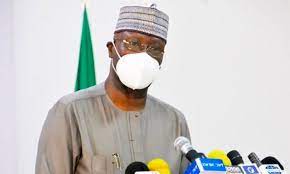
The Federal Government has lifted the ban placed on flights coming into the country from India.
The government had banned passengers, who visited India, Brazil, South Africa, and Turkey in the last 14 days from entering the country as part of precautionary measures to contain the virus in the country.
But in the new travel protocol released, yesterday, the Chairman, Presidential Steering Committee on Covid-19, Boss Mustapha, indicated that the ban placed on passengers from India has been lifted.
The reviewed protocol took effect from September 14, 2021.
However, the sanctions placed on airlines that convey passengers from restricted countries and travellers who are non-Nigerians remain.
Mustapha said, “Non-Nigerian passport holders and non-residents who visited Brazil, Turkey or South Africa within 14 days preceding travel to Nigeria, shall be denied entry into Nigeria. This regulation, however, does not apply to passengers who transited through these countries.
“Airlines who fail to comply shall mandatorily pay a penalty of $3,500 defaulting passenger; and non-Nigerians will be denied entry and returned to the country of embarkation at cost to the Airline; Nigerians and those with a permanent resident permit who visited Brazil, Turkey, and South Africa within 14 days preceding travel to Nigeria shall be made to undergo seven days of mandatory quarantine in a government approved facility at the point-of-entry city and at cost to the passenger.
“The following conditions shall apply to such passengers: Within 24 hours of arrival shall take a Covid-19 PCR test; if positive, the passenger shall be admitted within a government-approved treatment centre, in line with national treatment protocols; and if negative, the passenger shall continue to remain in quarantine and made to undergo a repeat PCR test on day-7 of their quarantine.
“False declaration: passenger(s) who provided false or misleading contact information will be liable to prosecution; and person(s) who willfully disregard or refuse to comply with directions of Port-Health staff, security agencies or evade quarantine shall be prosecuted in accordance with the law.
“This protocol comes into effect from September 14, 2021.”
He said before departure from exit country, passengers must perform a Covid-19 PCR test not more than three days before boarding, adding that the PCR tests done more than 72 hours before departure are not valid and persons will not be allowed to board.
The PSC chairman stressed that airlines have been directed not to board passengers with non-PCR Covid-19 tests (such as antigen/or antibody tests), a positive Covid-19 PCR test result, or tests performed beyond 72 hours of boarding.
He added, “Airlines that board passengers without any of the two documents (a negative Covid-19 PCR test done not more than 72 hours prior to boarding and a Permit to Travel Certificate/QR code), shall be sanctioned as follows: passengers, who are non-Nigerians, will be refused entry and returned to the point of embarkation at a cost to the airline;
“Passengers who are Nigerians or holders of a permanent resident permit will be allowed entry but subjected to the procedure outlined in Section D.
“In addition, passengers arriving with forged (fake) Covid-19 PCR results shall be referred for prosecution; airlines shall be fined $3,500 per passenger.”
He said all passengers arriving in Nigeria will be required to go through the routine Port Health screening and present electronic or print-out evidence of pre-boarding Covid-19 PCR test and the Permit to Travel Certificate/QR Code as well as Present their international passports for clearance through the Nigerian Immigration Service System’s Migrants Identification Data Analysis System.



The company’s General Manager, Health, Dr. Akinwumi Fajola, said the proposed partnership would involve the constitution of a joint team comprising representatives of Renaissance and RIVCHPP to deliberate on and develop modalities for deeper collaboration.
Fajola, who spoke during the visit, said the engagement would help strengthen the agency’s operations and advance the attainment of Universal Health Coverage in Rivers State.
He noted that the seeming bottlenecks often associated with government agencies had made some organisations and individuals sceptical about engaging with them.
According to him, the leadership style of the RIVCHPP Executive Secretary had demonstrated positive changes capable of attracting public and private-sector partners.
He stated that Renaissance Energy Limited would further strengthen its engagement with RIVCHPP, particularly in promoting health insurance within its operational areas.
Earlier, Agala described RIVCHPP as a legacy project of the State Governor, Siminalayi Fubara, established to ensure that Rivers residents have access to quality and affordable healthcare in line with the administration’s #Health4AllRivers vision.
She said since the agency became operational in January 2024, it had sustained awareness campaigns across the formal and informal sectors, resulting in steady growth in enrolment.
Agala disclosed that RIVCHPP had enrolled more than 160,000 residents across the state’s 23 Local Government Areas, giving them access to healthcare services.
She also said although Rivers was among the last states in the country to operationalise a health insurance agency, it had risen to 13th position in Universal Health Coverage and was recognised as the most improved state at the Federal Ministry of Health’s 2025 joint annual review meeting.
The Executive Secretary said the agency was implementing comprehensive healthcare plans covering all population groups, including vulnerable residents, to protect households from health poverty and catastrophic health expenditure.
She commended Renaissance Energy Limited for promoting health insurance in its operational areas and congratulated Fajola on his recent promotion.
The visit featured the exchange of promotional materials and souvenirs between the two organisations.
-
 Education1 day ago
FCE Yola Graduates 3,555 Teachers , Seeks Upgrade to University
-

 Sports1 day ago
Nigerian Trio Target Titles At PFL Africa Finals
-
 Niger Delta1 day ago
Diri Restates Stance On Lagos-Calabar Coastal Highway
-
 Niger Delta1 day ago
C’River, NUJ Pay Tribute To Late Guardian Editor
-

 News1 day ago
NDLEA Recovers Tons Of Illicit Drug Consignments In Nine States
-
 Opinion1 day ago
Checking Voter Apathy In Nigeria’s Electoral Process
-
 Politics1 day ago
2027: DICKSON’S EX-ALLY VOWS TO WORK AGAINST NDC INTEREST IN BAYELSA
-

 Politics1 day ago
2027: GROUP PLEDGES 40,000 SUPPORTERS FOR COALITION CANDIDATES IN RIVERS