
Featured
Classifying Nigerians As Indigenes, Non-Indigenes Is Apartheid -Osinbajo

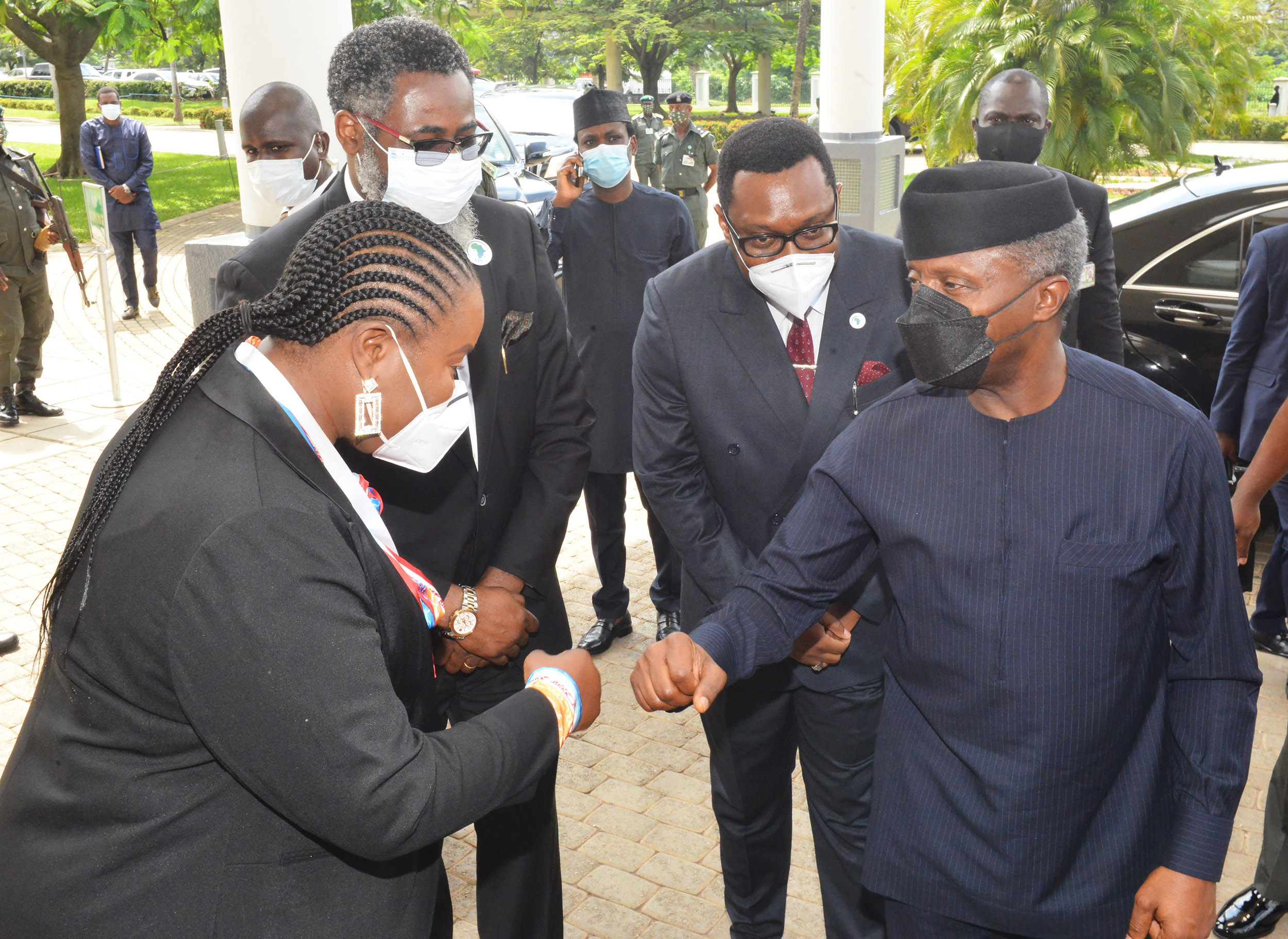
The Vice President, Prof Yemi Osinbajo, yesterday, described the classification of Nigerians as ‘indigenes’ and ’non-indigenes’ as a form of apartheid.
The Vice President stated this at the National Social Cohesion Dialogue organized by the Africa Polling Institute, at the Shehu Musa Yar’Adua Centre, Abuja.
Osinbajo was speaking against the common practices of exclusion and discrimination against citizens, based on the factor of state of origin.
He said Nigerians resident in parts of the country other than their states of origin have continued to suffer discrimination from their fellow citizens as well as governments of the states of residence, perpetually denied rights to common provisions and opportunities to further their personal goals because of the indigene and non-indigene factor, thereby making them feel that their identities as a weapon against them.
He, however, noted that such practices are opposed to the provisions of the Nigerian Constitution, adding that Nigerians are a people, whose destinies have become so interlinked and inseparable, urging all Nigerians to embrace unity and cohesion.
The Vice President in a statement issued by the Senior Special Assistant to the President on Media and Publicity, Office of the Vice President, Mr Laolu Akande, said, “in many quarters, there are feelings of alienation and exclusion. To this point, we must recognize the ways in which we perpetuate institutional discrimination and cause people to see their identities as weapons for procuring opportunity, often at the expense of others.
“We see this whenever Nigerians are denied opportunity on the basis of their state of origin or because they are ‘non-indigenes’. We see it when a Nigerian that has been resident in a state all his life is suddenly excluded from admission into an educational institution or an employment opportunity because he is not considered an ‘indigene’.
“All Nigerians have a constitutional right to live, work and enjoy their lives in peace and safety under the law. The classification of Nigerians as ‘indigenes’ and ‘non-indigenes’ is a form of apartheid and contradicts our declared aspirations towards equality and unity.
“Our Constitution enjoins government to ‘secure full residence rights for every citizen in all parts of the Federation’ and this is an imperative that we must commit to across all tiers of government. All that should matter in evaluating ourselves is where we live and fulfill our civic obligations.
“This is why when we launched our Social Investment Programmes, the eligible beneficiaries were selected based on their states of residence and none was discriminated against on any basis. This was in keeping with the idea that the only true path to national progress lies in broadening access to opportunity for all Nigerians without qualification.
“Our destinies have become so interlinked as to be inseparable. This is why this administration is investing heavily in transportation infrastructure – road, rail, sea and river ports – to reduce the distances between our people and link localities to markets and enable trade, travel and tourism.
“Our constitution guarantees a full portfolio of civil liberties and it is the responsibility of government at all levels to give life to these provisions. For example, states should as a matter of deliberate policy ensure that the freedom of worship and provide spaces in which citizens can lawfully erect places of worship”, he said.
He noted that despite the activities of those with divisive agenda, Nigeria will prevail over her tribulations due to the resilience, faith, hope and strength of its people.
Describing Nigerians as “an unbreakable people”, the Vice President emphasized the shared interests of Nigerians across different facets of life, noting that Nigeria’s diversity can be used to drive further economic growth.
He explained, “And in the face of the challenges confronting us, we must remind ourselves of certain truths. The first is that our present challenges are neither unique nor exceptional. Various nations at various points in their histories underwent similar tribulations. It is within our power to address these issues and emerge from them even stronger as a people.
“Despite the divisive rhetoric of demagogues and the utterances of those who profit from disharmony, Nigerians do not hate each other. Every day, millions of Nigerians of different ethnicities and creeds comingle, make common cause and forge friendships across our fabled fault lines. While we have our share of such acrimony, the situation does not support the narrative that we are a nation of fragments condemned to be perpetually at each other’s throats.
“What matters is how committed we are to the constructive management of diversity and the peaceful resolution of such conflict. This is where we can and should certainly work much harder.”
Advocating for unity despite sundry differences, the VP warned against “polarising identity politics”.
He said, “The truth is that Nigeria has evolved beyond the sort of easy balkanization that is proposed by some separatists. Politicians who continue to traffic in division and discord are behind the times and have failed to take note of how much more integrated our society has become.”
Noting that the fair, swift and equitable dispensation of justice to address both everyday grievances and long-suffered wrongs is essential for fostering social cohesion, the Vice President added that, “we must strengthen institutions which at every level can deliver justice, inclusion and mutual security.”
According to the Vice President, “an abiding feature of being a Nigerian is our optimism… Our capacity for hope is a creative optimism… Every day, millions of our people armed with their faith, skills, determination and wits take their destinies into their hands, working hard to forge a better life for themselves and their families.
“Nigerians of this ilk are everywhere repairing, healing, building, trading and doing business. They believe that tomorrow will yield a greater harvest than that of today and that as long as they have breath in them they can change their material conditions. It is this capacity for hope that makes us resilient in the face of incredible odds and even in the teeth of adversity. This is who we are as a people and it is why I believe that we will prevail over today’s tribulations.”
He further noted that even as the Federal Government continues to ramp up efforts in tackling the nation’s security challenges, a united citizenry would further help, especially in local policing strategies.
He said, “As we address the challenge of insecurity and the profusion of threats to public safety, we are increasingly turning to multilevel policing strategies that are consonant with our federal architecture. It is important that the localized security mechanisms being established by sub-national authorities are constituted in an inclusive manner and reflect the true diversity of those that live in local communities. No truly sustainable security umbrella can be built on the basis of exclusion.”
According to the Vice President, criminal elements should not be generalized as representation of ethnic or religious groups.
However, he noted that, “we must ensure that we see it for what it is – a criminal act which must be punished according to the law and not an ethnic conflict. Criminals must not be seen or treated as anything other than criminals and certainly not as representatives of any ethnic or religious group.
“We will not defeat crime by dividing ourselves. We can only overcome it by uniting against our common enemy – the criminals who terrorize our people.”
The Vice President further said that nation-building was hard work and an inter-generational endeavour.
He urged that all Nigerians “must renew the social contract and deepen the meaning and durability of our citizenship.”
The Vice President further highlighted the significance of unity in diversity in driving economic and social inclusion, stating that “Nigeria has what it takes to operate favourably in this world.”
The VP added, “Nigeria will be a great loser if we were to break up; when we see the greatest economic advantage to our size about to come to life. In short, staying together as a collective affords each of our communities far more opportunities for prosperity than they would have if they went their separate ways. We have all that it takes to be truly more than the sum of our parts.
“It is our responsibility to harness and consolidate these assets for the common good of all Nigerians. We will continue to work hard to create an umbrella of inclusive prosperity over our people. This is the defining task of our generation.”
He also highlighted examples that showed the power of unity over division, including that of 83-year-old Islamic cleric, Mallam Abdullahi Abubakar, who saved the lives of hundreds of Christians from terrorists in Barkin Ladi, Plateau State in 2018; as well as the reported ethnic conflict between Hausas and Yorubas in Shasha market, Ibadan, in 2021, where the VP stated that “members of both groups protected and shielded each other from harm.”
“Our resilience as a nation owes a great deal to this truth – that Nigerians are a deeply warm, peace-loving, humane people and they are capable of great courage and compassion. Our task is to strengthen and transform our institutions so that they better reflect these values,” Osinbajo stated.
The Vice President commended the Africa Polling Institute for organizing the event, which he noted was a significant work or social research that will help drive a more informed and constructive debate about Nigeria’s present and future.














Fubara gave the assurance last Friday at the NYSC permanent orientation camp, Nonwa-Gbam, Tai Local Government Area in the State, during the swearing-in ceremony of 2026 Batch B Stream II orientation course.
Represented by the Permanent Secretary, Cabinet Bureau, Office of the Secretary to the State Government, Dr. Promise Oguzie, the governor said the State Government would remain intentional in providing the necessary support to improve the NYSC scheme and enhance the experiences of corps members deployed to the state.
He charged the corps members to be role models and quality nation-builders in their service to the good people of Rivers State in particular, and Nigeria at large.
“I charge you to be exemplary, dedicated and committed in all you do. Take full advantage of all the camp programmes and activities to enrich yourselves”, he said.
In his welcome address, the State Coordinator of NYSC in Rivers State, Mr. Moses Oleghe, urged corps members to see their deployment to Rivers State as a “veritable opportunity to make meaningful contribution to the growth of the State in particular and Nigeria at large.”
He further charged them to serve with all sense of “integrity, discipline, and the fear of God, especially when they will be engaged as INEC ad-hoc staff that will conduct the 2027 general elections.”
A total of 3,584 corps members composed of 1,421 males and 2,163 females were sworn in by the Chief Judge of Rivers State, who was represented by Justice Godspower Aguma.

The Governor stated this yesterday when he received in audience, the World President of the Seventh Day Adventist Church, Pastor Erton Kohler; his wife, Andriene Marques Kohler; daughter Mariana Marques Kohler and a retinue of ministers of the church at Government House, Port Harcourt.
Fubara who hailed the Seventh Day Adventist Church for its contributions to education and the grooming of future leaders in Nigeria, expressed delight that the Church had over the years, been investing in education at various levels and currently runs two universities in the country.
He commended the church for not only using its institutions to spread the gospel of Christianity but to groom future leaders for the country.
According to him, religion should not be just about defending one’s faith, but also making meaningful impact on the lives of the people.
He said that by floating these educational institutions, the church has demonstrated capacity to support Nigeria in the task of producing not only educated people but a breed of God-fearing leaders.
“Our country is where it is today because we lack the fear of God. If you have the fear of God, there should be a limit to what you can do because you understand the supremacy of God. But when God is not in your equation, you’ll go beyond the line and that is what has brought us to where we are today.
“So, I feel very happy that you are contributing to the development of our future leaders in this country. We need the right people being in the right place; prepared properly with good minds; that is what we need, not just in Nigeria but round the whole world.,” he said.
Governor Fubara further observed that the absence of God-fearing people in high places to take the right decisions that could impact positively on the society, has also given rise to other problems such as social inequality, poverty, corruption and criminality. According to him, Nigeria needs a system where the average parent could afford quality education for their children and a guarantee that upon graduation, the average child will have the capacity to compete favourably with anybody, anywhere in the world.
“If we have a situation where the little money that you’re being paid as wage can also afford you quality healthcare and after working at least for 15-20 years, you have a roof over your head, tell me why you should be involved in any kind of crime? At that point, you’ll feel secured and this attitude of insecurity about the future that leads to all the social vices we have today won’t be there,” he said.
Governor Fubara expressed appreciation to the delegation for the visit and for their prayers for Rivers State, assuring them of his continued support for their programmes in the state.
Leader of the delegation and World President of the Seventh Day Adventist Church, Pastor Erton Kohler said he was in Nigeria for a special conference of the church during which thousands of the church’s ministers will be undergoing an empowerment programme to further equip them for the task of herding their flocks and serving the society.
He expressed gratitude to the Governor for the warm reception accorded his entourage, saying the memory of the visit will linger in his mind for a lifetime.
Kohler disclosed that the Church has over twenty -four million (24,000,000) members and more than 182,000 places of worship, spread across 212 countries of the world.

This reaffirms the lawmakers’ commitment to enacting laws and taking legislative actions geared towards the overall development of the State.
The Assembly gave the approval during its Second Legislative Sitting of the Fourth Session held last Friday.
Speaking on the MTEF document during plenary, the House Speaker, Rt. Hon. Martin Amaewhule, noted that by the provision of Section 10(1)(b) of the Rivers State Fiscal Responsibility Law No. 8 of 2010, the MTEF ought to have been laid before the House in September 2025.
Amaewhule explained that traditionally, the document is expected to be presented four months before the commencement of the next financial year and immediately after the expiration of every three-year fiscal cycle.
He, however, stated that in the interest of the State and its people, the House considered it necessary to deliberate on the document, describing it as a precursor to the 2026 Budget Estimates.
The Speaker expressed concern that the year had already progressed significantly before the presentation of the framework.
During deliberations on the document, members examined the assumptions and projections contained in the MTEF and observed that strict adherence to the outlined fiscal parameters would ultimately serve the interest of Rivers people.
The lawmakers maintained that effective implementation of the framework would promote prudent financial management and enhance developmental planning across the State.
Following the debate and positive consideration by members, the Speaker put the question to the House and members voted overwhelmingly in support of the approval of the MTEF.
Meanwhile, during the same sitting last Friday, the House also received a petition from the Chairman of Obio/Akpor Local Government Council, Dr. Gift Worlu.
The petition was presented by the member representing Obio/Akpor Constituency II, Hon. Emilia Amadi.
According to the petition, concerns were raised over an imminent security breach, threats to lives, destruction of property and alleged forceful takeover of property by some lawless persons within parts of the Local Government Area.
Presenting the petition before the House, Hon. Amadi appealed to the lawmakers to revisit the matter and take necessary steps aimed at safeguarding lives and property in the affected communities.
The House is expected to further deliberate on the petition and consider measures to address the concerns raised in order to sustain peace and security in the area.
King Onunwor
-

 News2 days ago
RSG Targets Nine Million Residents in Mosquito Net Distribution Campaign
-

 Oil & Energy2 days ago
Aiyedatiwa Signs New Electricity Bill
-

 Oil & Energy2 days ago
NLNG Commissions Research And Innovation Centre In RSU
-

 Maritime2 days ago
Marine Minister Commends President Tinubu On NPERA Bill Assent
-

 News2 days ago
KenPoly Holds Eight Convocations, August 29
-

 News2 days ago
RSG Begins Another Phase of Projects Commissioning Today
-

 News2 days ago
RMAFC Completes Revenue Sharing Review, Proposes New Pay
-

 Maritime2 days ago
NAGAFF Petitions IGP Over Alleged Maritime Police Harassment