Connect with us

Education

Abia College Moves To Investigate Results Issued By Institution

Published

on

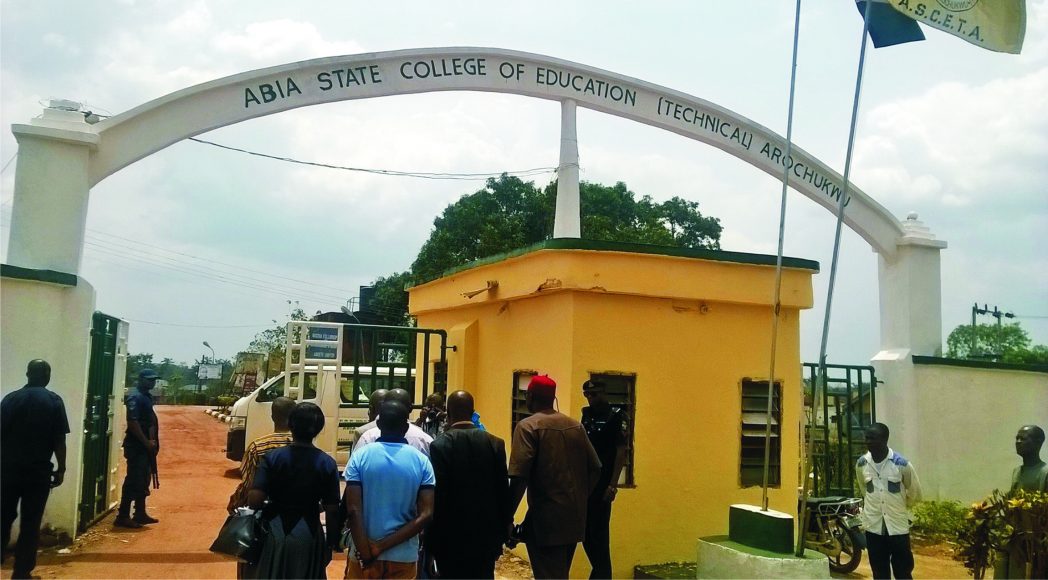
The Abia State College of Education (Technical), Arochukwu (ASCETA) has set up a three-man ad-hoc committee to investigate results issued by the institution from 2016 to date with a view to establishing their authenticity.
The provost of the college, Dr Philips Nto, announced this at the end of the institution’s emergency Academic Board Meeting in Arochukwu.
Dr Nto who disclosed that the committee is headed by Dr Abdulkareem Jubril explained that the measure was adopted to ensure that fraudulent people do not forge and use the results of the Institution.
He said information at the disposal of the college indicates that unscrupulous persons were colluding with dishonest ASCETA staff to produce fake results which did not emanate from the college.
He said while the college had taken proactive measures to check such an unwholesome practice, the committee will dig deeper to ensure that culprits are punished.
The provost said the committee which has two-weeks within which to submit its findings will focus on students who were previously admitted under it’s distance learning programme.
Describing as unfortunate the attempt by unqualified people to fake the results of ASCETA, Dr Nto vowed that such would not happen under his watch.
He charged the committee members to be thorough and professional in the discharge of their assignments, warning that any staff established to be aiding and abetting the issuance of fake results would not be spared.


Continue Reading

Education

FG, ASUU Set Date to Sign Agreement

Published

on

The Federal Government is set to formally sign an agreement with the Academic Staff Union of Universities following weeks of negotiations.
The development may be linked to the 40 per cent salary increase for academic staff proposed by the FG last month and accepted by the union.
A circular issued by the Ministry of Education invited Vice-Chancellors and Registrars of federal universities to witness the signing ceremony scheduled for Wednesday, January 14, 2026, at 11:00 a.m. at the Tertiary Education Trust Fund Conference Hall, Abuja.
The circular, dated January 5, 2026, and referenced FME/IS/UNI/ASUU/C.11/Vol.V/82, was signed by the Director of University Education, Rakiya Ilyasu, on behalf of the Minister of Education.
It was titled ‘Invitation to the Ceremony for the Signing of Agreement Between the Federal Government and the Academic Staff Union of Universities.’
The circular was sighted by our correspondent on Saturday and confirmed by the Ministry’s Director, Press and Public Relations, Boriowo Folasade.
 “This signing represents a critical milestone in promoting industrial harmony and improving teaching and learning in our universities.
“It also reaffirms the Federal Government’s commitment to the sustainable development of education in line with the Renewed
Attendance at the ceremony was declared mandatory for all invited university administrators, highlighting the importance attached to the agreement and its implementation.
Last month, the industrial crisis that had burdened Nigeria’s university system for 16 years following the 2009 Federal Government–ASUU Agreement saw the union accept the Federal Government’s proposed 40 per cent salary increase for academic staff.
It was reported that the deal, effective from January 1, 2026, would be reviewed after three years
  Why FG Shouldn’t Be Blamed for Non-Implementation of Council Autonomy
Under the new terms, professors will earn a pension equivalent to their final annual salary upon retirement at age 70. The agreement also provides for the establishment of a National Research Council to fund research with at least one per cent of Nigeria’s Gross Domestic Product.
Other provisions include improved funding for libraries, laboratories, equipment and staff development, greater university autonomy, and the election of academic leaders, with only professors eligible to serve as deans and provosts. The pact also guarantees that no staff member involved in past industrial actions will be victimised.
Continue Reading

Education

DSS, Rector Warn Kogi Poly Students Against Vices,Rumours

Published

on

The Kogi State Directorate of the Department of State Services (DSS) has warned fresh students of Kogi State Polytechnic, Lokoja, that security on campus is a shared responsibility, stressing that carelessness, poor judgment and rumour-mongering pose and ostentatious living pose greater dangers than most real threats.
The Director of the Department in the state, gave the warning in his speech, titled,”MANAGING SECURITY AND RUMORS ON CAMPUS at the 33rd Matriculation Ceremony for the students of 2025/2026 academic session of the Polytechnic on Thursday in Lokoja.
The director, represented by A. S. MUSA, emphasised that while Lokoja remains largely peaceful, no campus is immune from security challenges.
He identified theft of phones, laptops and wallets, infiltration of hostels by unauthorised persons, risky late-night movements and online scams targeting fresh students as recurring threats, most of which, he noted, are preventable through vigilance and discipline.
The security agency cautioned students against behaviours that weaken personal safety, including lack of security consciousness, predictable routines, drug abuse, drunkenness, sexual recklessness, ostentatious living and the lure of secret cults.
According to the DSS director,cultism, often disguised as “protection,” ultimately places students under violent control systems with devastating consequences, while flamboyant lifestyles and careless displays of wealth attract criminal attention.
Our correspondent reports that a major focus of the lecture was the danger of rumours, which the DSS described as “more destructive than real threats.”
According to him,false alerts about kidnappers, armed attacks, school closures or emergency evacuations,often spread through WhatsApp messages and voice notes,have previously triggered panic, stampedes and academic disruption on campuses, sometimes putting lives at risk without any verified danger.School supplies
He, therefore, advised to verify information strictly through official Polytechnic channels such as management announcements, Student Affairs notices and campus security units. The DSS boss warned that forwarding unconfirmed messages makes students unwitting accomplices in spreading fear and destabilising the academic environment.
On personal safety, he also urged students to always carry their identity cards, avoid lonely and poorly lit areas at night, secure their hostel rooms, challenge suspicious strangers and promptly report unusual activities.
He cautioned students to remain calm, obedient to lawful instructions and refuse to act on hearsay, adding that these virtues are critical responses during emergencies.
The DSS director reminded the matriculating students that security goes beyond physical safety to include protection of reputation, mental stability and future prospects.
By rejecting rumours, cultism and reckless living, and by embracing responsibility and alertness, students can be rest assured that Kogi State Polytechnic can remain a safe, peaceful and conducive centre of learning for all.
Declaring event open, the Rector of the Polytechnic, Prof.Salisu Ogba Usman, matriculated 4,591 students into seven schools and 57 academic programmes of the Polytechnic.
“Of this number,2460 students (54 percent) are admitted into National Diploma Progrmes, while 2,131 students (46 percent)are admitted into Higher National Diploma 1 programmes”,Usman said.
He further reviewed that 19 out of the 57 Programmes currently run by the polytechnic were introduced under the present administration in the state.
Prof.Usmam expressed the continued commitment of the Polytechnic to uphold discipline, transparency,and zero tolerance for all forms of social Vices ,while promoting peaceful coexistence,responsible leadership and mutual respect.
“Our emphasis on security, moral discipline and academic integrity is non-, negotiable and central to our institutional philosophy,” the Rector stressed.
He urged the new students to take full advantage of the opportunities available in the Polytechnic and to conduct themselves in ways that will bring honour to their families ,the Polytechnic and the nation at large.
Usman said the polytechnic has pursued inclusive leadership by institutionalizing transparency, strengthening staff welfare engagement,and integrating student leadership into governance processes.
According to him the gender distribution is equally encouraging, with 52 percent, male and 48 percent female, representing steady progress in the gender balance of the Polytechnic.
He promised that the “shall continue to uphold discipline, transparency and zero tolerance for all forms of social vices,while promoting peaceful coexistence,responsible leadership and mutual respect.
The Rector stressed that the emphasis of the Polytechnic on security, moral discipline and academic integrity is non-negotiable and central to its institutional philosophy.
He urged the new students to take full advantage of the opportunities available in the polytechnic and conduct themselves in ways that will bring honour to their families,the polytechnic and the nation at large.
“Together we shall continue to reposition Kogi State Polytechnic as a reference point for excellence in polytechnic education in Nigeria,” he promised.
Continue Reading

Education

FG Bans Disposable workbooks, introduces reusable textbooks in schools

Published

on

The Federal Government has rolled out a new education policy banning disposable workbooks and mandating the use of reusable, high-quality  textbooks in schools, in a move aimed at reducing the rising cost of education for parents, improving learning outcomes and promoting environmental sustainability.School supplies
The policy was unveiled by the Minister of Education, Tunji Alausa, alongside the Minister of State for Education, Prof. Suwaba Sai’d, as part of sweeping reforms targeted at repositioning Nigeria’s education sector and easing the financial burden on families.
Under the new framework, schools are required to adopt standardised and durable textbooks designed to last between four and six years.
The policy expressly prohibits the practice of bundling disposable workbooks with textbooks, a practice the government says has inflated school expenses and contributed to unnecessary waste.
According to the ministers, the reusable  textbook initiative will enable siblings to share learning materials across academic sessions, significantly reduce recurring education costs for parents and limit waste generation within the school system, thereby advancing national sustainability goals.
As part of the broader reforms, the Federal Government has also introduced a uniform academic calendar to ensure consistency in teaching, learning and school planning across the country.
Continue Reading

Trending