
Agriculture
Why Are Some Nigerians Eager To Migrate?

Joyce Esosa, 29, is from Edo but finds herself roaming the streets of Abuja after an attempt to migrate to another country without valid documents failed.
Earlier, she had also made frantic efforts to study medicine in one of the nation’s universities but she was not lucky and she believes something ought to be done quickly because she is ageing.
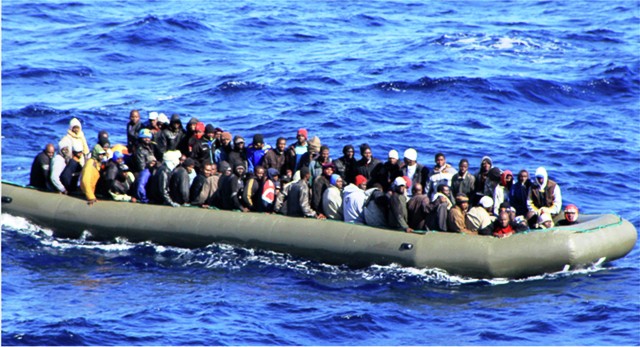
She finally got involved in discussions with some friends on how Nigerians move to other countries to seek job and comfort in most of European countries, especially, Spain, via crossing the Mediterranean Sea in Libya coasts to the country.
Migrants preparing to cross to Europe through the Mediterranean Sea
Telling her story to justify her decision to travel out, she says “each day in Nigeria feels like hell for me and all I want is an opportunity to travel abroad and make a better living.
“I have nine siblings and I am the third; my father died years back and my mother is a petty plantain trader; life has been very difficult for the family.
“Two of my siblings died due to lack of money; the first one died in an accident where she hawked sachet water.
“Eight months after, I lost the second to a sickness that required blood transfusion and because the family did not have money to buy blood, he had to die.
“I decided to seek a better life for both myself and family at all cost, I ran away from home four years ago.
“I made several attempts to travel out of the country but it never worked out when a friend took me up in Abuja, promising to help me to get a job, only for her to introduce me to different men.’’
Similarly, 34-year old Musa Ahmed, a commercial motorcycle operator from Zamfara believes that people are willing to do anything to improve their living standard, attributing the development to level of poverty in the country.
“That is why the crime is high in Nigeria because it hurts a lot to see your loved ones suffering and you can’t help or do much.
“I live in an uncompleted building with my family; I was a farmer back in Zamfara now in Cross River. I relocated because I wanted a better life for myself and for my family.
“Life is not getting better here either for me and my family, I ride motorcycle in which each drop is N50 and I make at least N1, 500 per day, but it is usually not enough.
“If government can create opportunities and bring down the cost of living, things will get better and Nigerians will not waste time in seeking comfort elsewhere,’’ he said.
Observers, therefore, note that poverty, lack of job opportunities and uncertainty about life, somewhat, contribute to the desire of some Nigerians to flee the country.
The note that although government authorities and other stakeholders have been warning against illegal migration on many occasions, some people are bent on such mission that, in most cases, can end in regret.
Yet, statistics from European Union show that Nigeria has the fifth highest number of citizens illegally migrating to Europe in the search for illusive greener pastures.
Worried by the development, the Chief Executive Officer of a non-governmental organisation, Connected Development, Mr Hamzat Lawal, called on the youth to leverage on the climate change to create sustainable job opportunities using emerging technology instead of travelling overseas.
Lawal noted that climate change was a 21st century problem which could also have its advantages to check illegal migration.
He said as much as climate change was viewed as a problem, it was also an opportunity for the country to manage its limited and scare resources.
“We can generate electricity from solar energy or sunlight. We can use new and emerging technology to cook and reduce greenhouse gas; this is how it can become an opportunity.
“Climate change has affected our economy negatively; also our forest cover has been depleted over time by people cutting down trees for fire or furniture.
“The Lake Chad region which used to be a business hub for Nigeria and even other African countries, where they have fishermen and women doing businesses, is no longer so.
“This means that the young energetic people have now migrated and left the region in search of greener pasture whereas they can use new and emerging technology created by climate change to develop in their own country,’’ he said.
Lawal said migration of Nigerians had also increased because of the economic crisis in the country, observing that there were still hope and opportunities.
“We are losing talents and young minds that are supposed to build our growing economy because people are leaving the country because of lack of opportunities,’’ he said.
“Government needs to look at how we can thrive by tapping into new and emerging technologies such as the clean cooking stoves that emit lesser greenhouse gas to engage the youth.
“If we can invest more in solar technology, build capacity and also reduce taxes to businesses, it will create value and jobs.
“If there is an enabling environment where there is hope of prosperity, people will not want to travel out of the country.
“People will not want to leave their comfort zone to undertake the risk of travelling for days and putting their lives in danger.
“But, because things are not the way they should be, that is why people are willing to take all manner of risks to better their lives; simply because they believe that there is hope and prosperity on the other side,’’ he observed.
In the light of this, Mr Nnimmo Bassey, an environmentalist, advised the Federal Government to implement existing expert research findings to recharge the Lake Chad basin.
Bassey, the Executive Director, Environmental Rights Action, an environmental rights advocacy group, observed that it was a good development that Germany offered to pump 18 billion Euros to recharge the Lake Chad Basin.
He said implementing the research findings, already analysed by experts, would contribute to the success of the project.
The environmentalist, who attributed the shrinking of the lake largely to climate change, said that research had been conducted over the years on ways to tackle the problem.
Bassey, therefore, commended Nigerian and German governments for their efforts to revive the lake, noting that vibrant Lake Chad business communities would, to some extent, check illegal migration among Nigerian youths.
“We do not have details of what the assistance from Germany will be directed to, but we hope it addresses the research findings of appropriate bodies that have worked on the challenge.
“There is the need to rebuild the overall environment but this must be phased with short, medium and long term outlays.
“Efforts must be made holistically with all countries in the Lake Chad basin playing their roles.
“There is urgent need for us to step up our watershed management because sometimes, we tend to think that water supply is inexhaustible,’’ he said.
Bassey suggested intensive planting of indigenous trees and crops that were well adapted to the region to protect watersheds and the environment.
All the same, concerned citizens believe that implementation of good policies and making the governance process more citizen-friendly, are some of the methods of discouraging more Nigerians from travelling abroad illegally.
Onyegbula writes for News Agency of Nigeria.
Jessica Onyegbula


The President of the Capital Market Academics of Nigeria, Prof. Uche Uwaleke, has called for urgent agricultural reforms and stronger support for farmers to improve food security in the country.
Uwaleke made the call in an interview with Newsmen Wednesday while reacting to the United Nations projection that millions of Nigerians could face acute hunger in the coming months.
The United Nations Humanitarian Country Team had warned that about 35 million Nigerians could face acute food insecurity between June and August.
According to the organisation, nearly one in seven Nigerians may experience severe food shortages during the 2026 lean season.
Uwaleke said the projection underscored the urgent need for Nigeria to strengthen its food production systems and address factors driving food insecurity.
“The warning should be taken seriously because it reflects the difficult realities many Nigerians are already experiencing, especially vulnerable households.
“A projection of about 35 million people facing acute hunger is disturbing for a country with enormous agricultural potential,” he said.
He attributed worsening food insecurity to inflation, insecurity in farming communities, climate-related challenges, naira depreciation and high transportation costs.
According to him, the combined effects of fuel subsidy removal and declining purchasing power have further reduced access to food for many Nigerians.
Uwaleke said the situation required immediate and coordinated interventions to prevent a deeper humanitarian crisis.
“The lean season is usually difficult, but the scale being projected by the United Nations suggests the need for urgent action from both government and development partners,” he said.
He acknowledged recent government measures aimed at improving food supply, including food imports and tariff reductions on selected commodities such as rice and palm oil.
He, however, said the interventions might not yield the desired results without stronger investments in local agricultural production and improved security for farmers.
“I believe the government has made efforts to address the situation, particularly through policies aimed at boosting food availability.
However, insecurity continues to disrupt farming activities in major food-producing areas, while inflation and weak purchasing power remain major concerns for ordinary Nigerians,” he said.
Uwaleke urged the Federal Government to increase support for farmers through subsidies on fertilisers, improved seedlings and other agricultural inputs ahead of the peak farming season.
He also stressed the need to improve security in farming communities to enable displaced farmers to return safely to their farms.
According to him, targeted food distribution programmes should be expanded to support vulnerable households across the country
Uwaleke further called for long-term investments in irrigation, mechanisation, storage facilities, rural infrastructure and agricultural research to strengthen food security.
He added that food security should be treated as both an economic and national security priority requiring sustained policy implementation and adequate funding.
Agriculture
Livestock Minister Reaffirms Commitment To Integrating Apiculture Development Into NL-GAS

The Minister made this known in a keynote address at the World Bee Day 2026 celebration, held in Abuja, where he emphasised that the livestock value chain can be significantly transformed through targeted investments, innovation, private sector participation, youth empowerment, and inclusive economic growth.
In her remarks, the Permanent Secretary of the Ministry of Livestock Development, Dr. Chinyere Ijeoma Akujobi, said the Ministry remains committed to strengthening interventions aimed at improving the apiculture subsector, promoting sustainable beekeeping practices, enhancing production standards, expanding market access, and protecting pollinator habitats across the country.
The Director of Ruminants and Monogastric, Mr. Victor Egbon, representshe also commended the Youth for Agriculture Initiative (YFAI) for its sustained partnership and commitment to the annual commemoration of World Bee Day.
In a goodwill message, the representative of the Permanent Secretary, Federal Ministry of Industry, Trade and Investment, Dr. Osas Isokponomu, reaffirmed the Ministry’s commitment to supporting policies and programmes that promote value addition, industrialisation, export competitiveness, and market integration within the framework of the African Continental Free Trade Area (AfCFTA).
Earlier in his opening address, the President of the Youth for Apiculture Initiative (YFAI), Mr. Kingsley Nwagwu, called for the establishment of a National Apiculture Policy as a foundation for unlocking Nigeria’s emerging apiculture economy.
Participants at the event were drawn from relevant Ministries, Departments and Agencies, stakeholders, students, academia, research institutions, and development partners.
According to a statement, President of the AFBTE, Chinedum Okereke, gave the warning during the association’s 47th Annual General Meeting held recently in Lagos.
He stated that the food and beverage industry remained a critical pillar of the Nigerian economy because of its significant contributions to employment, public health, and economic growth, adding that government policies should support the sector rather than weaken it.
Okereke noted that many companies in the industry are struggling with rising operational costs and multiple taxes and charges imposed by government agencies without adequate consultation.
“The food and beverage sector remains a major player in the Nigerian economy in terms of its criticality to the financial and physical health of the nation, as well as the well-being of the people. Government support is therefore imperative,” Okereke said.
He added that the relationship between government institutions and businesses should be driven by collaboration, dialogue, and fairness to create a sustainable business environment.
The AFBTE chief also renewed the association’s opposition to the proposed ban on the packaging and sale of alcoholic drinks in sachets and small PET bottles, warning that the policy could worsen unemployment, reduce investment, and shrink government revenue.
“We are in the age of data and analytics Policies that affect businesses and livelihoods should be evidence-based,” Okereke said.
He noted that the industry had repeatedly demanded empirical evidence and statistical data to justify the proposed ban but claimed relevant authorities had yet to provide such information.
The AFBTE president further appealed to the Federal Government to introduce incentives and relief packages for manufacturers battling rising production costs, foreign exchange challenges and infrastructure deficits.
He also advocated the creation of more Free Trade Zones through the upgrade of existing industrial clusters, especially for long-established companies that have contributed significantly to Nigeria’s economic development but now face disadvantages compared to firms operating within free trade zones.
He observed that the absence of dialogue between the government and the private sector often creates avoidable disputes and weakens investor confidence.
Okereke added that the objectives of the Presidential Enabling Business Environment Council should remain a guiding principle for regulators and government agencies in promoting ease of doing business in the country.
Meanwhile, the Treasurer of AFBTE, Osaro Omogiade, disclosed that the association recorded a total income of N165.45m for the 2025 financial year, representing a 10.13 per cent increase from the N150.24m generated in 2024.
He attributed the increase largely to improved returns on investments in the money market through Stanbic IBTC and United Capital.
Omogiade, however, noted that the association’s expenditure rose by 14.22 per cent to N138.25m due to the increasing cost of running its secretariat, leaving a surplus of N27.21m compared to N29.19m recorded in the previous year.
-

 News2 days ago
RSG Targets Nine Million Residents in Mosquito Net Distribution Campaign
-

 Oil & Energy2 days ago
Aiyedatiwa Signs New Electricity Bill
-

 Maritime2 days ago
Marine Minister Commends President Tinubu On NPERA Bill Assent
-

 Oil & Energy2 days ago
NLNG Commissions Research And Innovation Centre In RSU
-

 News2 days ago
KenPoly Holds Eight Convocations, August 29
-

 News2 days ago
RMAFC Completes Revenue Sharing Review, Proposes New Pay
-

 News2 days ago
RSG Begins Another Phase of Projects Commissioning Today
-

 Maritime2 days ago
NAGAFF Petitions IGP Over Alleged Maritime Police Harassment