Connect with us

Oil & Energy

Criminals, N’Delta Enemies, Behind Recent Attacks –Clark

Published

on

The leader of the Pan Niger Delta Forum (PANDEF), Chief Edwin Clark, has described continued destruction of oil installations in the region as criminal acts by enemies out to sabotage the progress of the region.

Speaking at a press briefing Friday in Warri, Delta State, Clark urged the Federal Government not to be deterred by the ugly development but to rather go ahead with its decision to consider requests recently presented to it.

The Ijaw leader who spoke in the company of some other stakeholders stated that a number of factors were responsible for the pattern manifested in the destruction of critical oil and gas assets in the region, remarking that political and pecuniary reasons were responsible.

Noting that continued militant activities in the region, especially the destruction of oil facilities had gone beyond matters of expression of grievances to a calculated attempt to derail the peace process in the region.

Clark, who decried the adverse effect of the recent destructive actions of the militants on both the innocent members of the communities in the region and the environment, warned that PANDEF would no longer condone the activities of the militants.

According to him, “our boys were still boasting in the social media that they were going to attack, they would do this or do that.

“I was in my house when they informed me that FG has sent troops to the creeks in a house boat opposite Oporoza and that some boys had been arrested. We intervened and those boys were released.

“So the question is, what do we want, particularly these boys? What are they looking for? They are enemies of the people. They are criminals”.

Clark who disclosed that PANDEF would hold another meeting soon to take position on the current attacks, said, “Let me also warn that there are some politicians who are also members of the Niger Delta that are fighting themselves and it is not unlikely that some of these people are involved in these bombings to discredit each other.

He particularly noted that the recent blowing up of Trans-Forcados Pipeline operated by Nigerian Petroleum Development Company (NPDC) was not a matter arising from grievances but rather designed to sabotage the present peace process.

He regretted that it is the innocent members of the communities that would bear the brunt of reprisal attacks by the military as no government would sit back and watch its critical infrastructure being destroyed.


Continue Reading

Oil & Energy

NERC, OYSERC  Partner To Strengthen Regulation

Published

on

THE Nigerian Electricity Regulatory Commission (NERC) has stressed the need for strict adherence to due process in operationalizing state electricity regulatory bodies.
It, however, pledged institutional and technical support to the Oyo State Electricity Regulatory Commission (OYSERC).
The Chairman, NERC, Dr Musiliu Oseni, who made the position known while receiving the OYSERC delegation, emphasised that the establishment and take-off of state commissions must align fully with the law setting them up.
Oseni said that the NERC remains committed to partnering with State Electricity Regulatory Commissions (SERC) to guarantee their institutional stability, operational effectiveness and long-term success.
He insisted that regulatory coordination between federal and state institutions is critical in the evolving electricity market framework, noting that collaboration would help to build strong institutions capable of delivering sustainable outcomes for the sector.
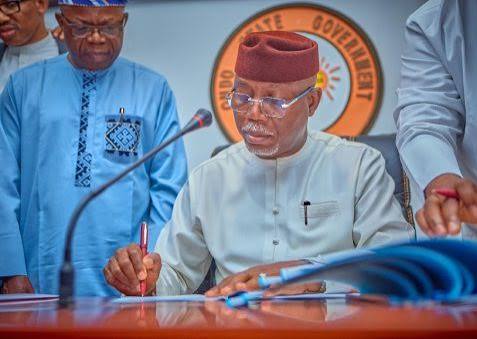
Also speaking, the Acting Chairman, OYSERC and leader of the delegation, Prof. Dahud Kehinde Shangodoyin, said that the visit was aimed at formally introducing the commission’s acting leadership to the NERC and laying the groundwork for a productive working relationship.
Shangodoyin said , the acting members were appointed to provide direction and lay a solid foundation for the commission during its transitional period, pending the appointment of substantive members.
“We are here to formally introduce the acting leadership of OYSERC and to establish a working relationship with NERC as we commence our regulatory responsibilities,” he said.
He acknowledged NERC’s readiness to provide technical and regulatory support, particularly in the area of capacity development, describing the backing as essential for strengthening the commission’s operations at this formative stage.
“We appreciate NERC’s willingness to support us technically and regulatorily, especially in building our capacity during this transition,” he added.
Continue Reading

Oil & Energy

NLC Faults FG’s 3trn Dept Payment To GenCos

Published

on

The Nigeria Labour Congress and the Association of Power Generation Companies have engaged in a showdown over federal government legacy debt.
NLC president Joe Ajaero has faulted the federal government’s move to give GenCos N3 trillion from the Federation account as repayment for a power sector legacy debt, which amounts to N6.5 trillion.
In a statement on Thursday, Ajaero said the Federal Government proposed the N3 trillion payment and the N6 trillion debt as a heist and grand deception to shortchange the Nigerian people.
“Nigerians cannot and should not continue to pay for darkness,” Ajaero stated.
Meanwhile, the Chief Executive Officer of the Association of Power Generation Companies, APGC, Dr. Joy Ogaji, said Ajaero may be ignorant of the true state of things, insisting that the federal government is indebted to GenCos to the tune of N6.5 trillion.
She feared the longstanding conflict could result in the eventual collapse of the country’s power.
According to her, the federal government’s N501 billion issuance of power sector bonds is inadequate to address its accumulated debt.
Continue Reading

Oil & Energy

PENGASSAN Rejects Presidential EO On Oil, Gas Revenue Remittance  ……… Seeks PIA Review 

Published

on

The Natural Gas Senior Staff Association of Nigeria(PENGASSAN) Festus Osifo, has faulted the public explanation surrounding the Federal Government’s recent oil revenue Executive Order(EO).
President of the association, Festus Osifo, argued that claims about a 30 per cent deduction from petroleum sharing contract revenue are misleading.
Recall that President Bola Ahmed Tinubu, last Wednesday, February 18, signed the executive order directing that royalty oil, tax oil, profit oil, profit gas, and other revenues due to the Federation under production sharing, profit sharing, and risk service contracts be paid directly into the Federation Account.
The order also scrapped the 30 per cent Frontier Exploration Fund under the PIA and stopped the 30 per cent management fee on profit oil and profit gas retained by the Nigerian National Petroleum Company Limited.
In his reaction, Osifo, while addressing journalists, in Lagos, Thursday, said the figure being referenced does not represent gross revenue accruing to the Nigerian National Petroleum Company Limited.
He explained that revenues from production sharing contracts are subject to several deductions before arriving at what is classified as profit oil or profit gas.
Osifo also urged President Bola Tinubu to withdraw his recently signed Presidential Executive Order to Safeguard Federation Oil and Gas Revenues and Provide Regulatory Clarity, 2026.
He warned that the directive undermines the Petroleum Industry Act and could create uncertainty in the oil and gas industry, insisting that any amendment to the existing legal framework must pass through the National Assembly.
Osifo argued that an executive order cannot override a law enacted by the National Assembly, describing the move as setting a troubling precedent.
“Yes, that is what should be done from the beginning. You can review the laws of a land. There is no law that is perfect,” he said.
He added that the President should constitute a team to review the PIA, identify its strengths and weaknesses, and forward proposed amendments to lawmakers.
“When you get revenue from PSC, you have to make some deductibles. You deduct royalties. You deduct tax. You also deduct the cost of cost recovery. Once you have done that, you will now have what we call profit oil or profit gas. Then that is where you now deduct the 30 per cent,” he stated..
According to him, when the deductions are properly accounted for, the 30 per cent being referenced translates to about two per cent of total revenue from the production sharing contracts.
“In effect, that deduction is about two per cent of the revenue of the PLCs,” he added, maintaining that the explanation presented in the public domain did not accurately reflect the structure of the deductions.
Osifo warned that removing the affected portion of the revenue could have operational implications for NNPC Ltd, noting that the funds are used to meet salary obligations and other internal expenses.
“That two per cent is what NNPC uses to pay salaries and meet some of its obligations.The one you are also removing from the midstream and downstream, it is part of what they use in meeting their internal obligations. So as you are removing this, how are they going to pay salaries?” he queried.
Beyond the immediate impact on the company’s workforce, he cautioned that regulatory uncertainty could affect investor confidence in the sector.
“If the international community and investors lose confidence in Nigeria, it has a way of affecting investment. That should be the direction. You don’t put a cow before the horse,” he added.
According to him, stakeholders, including labour unions and industry operators, should be given the opportunity to make inputs at the National Assembly as part of the amendment process saying “That is how laws are refined,”
Continue Reading

Trending