
Niger Delta
Calabar Traders Decry Low Patronage

Traders at the various markets in Calabar have complained of low patronage of their businesses in the recent months, saying that the situation has made life difficult for them.
A cross section of the traders decried the situation in separate interviews with our correspondent in Calabar, recently.
Mr Innocent Muoka, a shoe seller at Watt Market, said that he had been experiencing low patronage in his business for some time now.
Muoka said that the drastic reduction in the volume of sales had affected his turnover.
“Now we sell our wares without gain; we sell our wares just to have money to feed and this is very bad.
“I do not know what is happening, but I only appeal to government to release money into the economy so that business can boom again,’’ he said.
Mrs Iyabo Omisore, who sells kitchen utensils, said that business this time was at a very low level.
Omisore also said the situation was made worse by the current petrol scarcity in the state which had increased the cost of transportation in the state and the country.
“There is nothing going on at all; now is a very dull moment. Transport fares within the state and other parts of the country have increased.
“Sometimes we come to the market only to sleep in the shop. The situation is really difficult for us,” she said.
A dealer in textiles at Marian Market, Mr Michael Daniel, also decried the poor sales experienced by traders in the Cross River capital.
According to Daniel, the situation may have resulted from the delay in the passage and implementation of the 2016 budget.
“People say it is because of the delay in passing the budget. I am worried because the situation is affecting me and my family.
“I even hawk around this time just to see if I can sell something and get money in order to feed my family; and after the hustling, I come back with little or nothing.
“It is really a though situation,’’ Daniel said.




The Publisher and Editor-In-Chief of a Yenagoa-based tabloid, Niger Delta Herald, Mr. Francis Dufugha, has commended the Bayelsa State Governor, Senator Douye Diri, for the relative peace in the State.
Dufugha, however, expressed resentment over what he described as stringent measures against assessing the State’s Students Loan Scheme, especially for the common citizens.
He made the observations while briefing journalists at the Earliest Ikoli Press Centre, Ekeki, in Yenagoa, the State capital.
“I commend the Governor for the relative peace in the state owing to his approach to the security of lives and properties in the State.
“For now, the police in Bayelsa State is using drones to monitor red flag areas that can cause security breaches and that has really encouraged the peace in the State.
“The security situation has improved and we commend the government for that. We cannot deny the fact that there is relative peace in the State”, he said.
On the State’s students loan, the publisher accused the scheme of having elitist posture due to its accessibility process.
He argued that it would be difficult for the ordinary Bayelsan to provide a Level-17 civil servant as guarantor to be able to benefit from the scheme, describing it as a systemic denial of the less privileged.
He noted that the loan was supposed to be a succour to indigent Bayelsa parents and students who could not assess education easily, noting that such persons should not be made to face cumbersome situations before assessing the financial instrument.
On road infrastructure, the Niger Delta Herald Publisher and Editor-in-chief praised the Diri’s administration on the work done on the three senatorial district roads and tasked the government to do more.
Dufugha, who described Bayelsa State as a wealthy State, asserted that the oil rich state needed to see more developmental strides comparative to its current financial status.
“Bayelsa is not a poor state in terms of public revenue. We’re an oil producing state. We receive federal allocations. We receive derivation revenue. We have access to enormous public resources.
“We receive interventions. Yet, after all these years, the ordinary citizen is still asking, what exactly are we getting for our money? Where are the industries? Where are the jobs? Where are the functional health institutions? Where is the agricultural transformation? Where is the human capital development? Where is the economic diversification?,” he argued.
He enjoined the government to redouble effort in the education and health subsectors, adding that it would pay the state a lot if there were centres for the treatment of critical health cases such as cancer and others in order to save lives and avoid capital flight.
The Publisher urged the Senator Diri-led government and the public not to misunderstand his message as hatred or personal issues with the Governor, but see it as a constitutional and professional duty to hold government accountable.
By: Ariwera Ibibo-Howells, Yenagoa

The Bayelsa State Government has stated its stance on zero tolerance for corruption in governance and cautioned residents against writing frivolous petitions to anti-graft agencies.
Deputy Governor of the State, Dr. Peter Akpe, stated this rexently when he received the Resident Anti-Corruption Commissioner of the Independent Corrupt Practices and Other Related Offences Commission (ICPC) in ernment House, Yenagoa.
charge of Bayelsa and Rivers States, during a courtesy visit to Government House, Yenagoa.
Akpe said the general perception of those in politics has always been that of corruption, but noted that the position of the Douye Diri-led Prosperity Administration is non-tolerance for corruption.
Akpe, who frowned at the habit of writing unfounded petitions against individuals and groups, said the heap of petition files from Bayelsa State at the ICPC was several times higher than that from any other state in the country.
He reminded residents that writing unjustifiable petitions to anti-graft agencies is not only a bad culture, but also attracts jail penalty, and assured the ICPC of the state government’s support to improve public enlightenment.
“Our government is a government that believes in zero tolerance for corruption; that is why we are always open to interact with you and other anti-graft agencies.
“Usually, there is this issue of negative perception of politics and politicians. But it is not true that every politician is corrupt. We have a good number of people in politics that are not corrupt, and we believe that a good percentage of them are in this government.
“The issue of petitions at the ICPC: What we observed was that the heap of files from Bayelsa were 10 times higher than the ones from even Lagos, and 15 more times than the ones from Sokoto and other states.
“That is quite disturbing. More so, most of those petitions were ion, our people should also know that such frivolous petitions can land them in jail”, he saidfrivolous.
From a personal experience, I can tell you that most of the petitions are extremely frivolous. While we will never tolerate corruption, our people should also know that such frivolous petitions can land them in jail”, he said.
Earlier in her remarks, the ICPC Resident Anti-Corruption Commissioner in charge of Rivers and Bayelsa States, Dr. Ekere Usiere, highlighted the statutory mandate of the ICPC, stressing that its mission was to carry out sensitisation on the ills of corruption in the Nigerian society.
Usiere, who expressed concern at the volume of petitions currently before the ICPC emanating from communities in Bayelsa over the management of the PIA funds, expressed the commission’s desire to partner the Bayelsa State Ministry of Information to carry out sensitisation programmes.
The ICPC Resident Anti-Corruption Commissioner was accompanied on the visit by Assistant Chief Superintendent, Mr. Evans Peters; Principal Superintendent, Mr. Emmanuel Akpor; Assistant Superintendent, Mrs. Tamaraudoubra Ebebi; and the Administrative Officer, Mr. Frank Yileaziba.
By: Ariwera Ibibo-Howells, Yenagoa
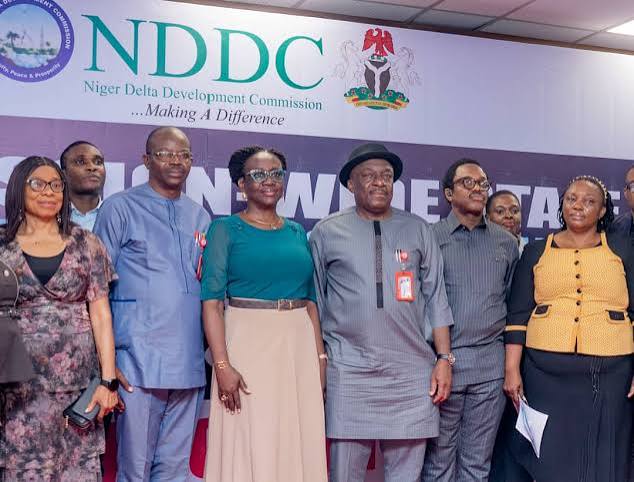
The Niger Delta Development Commission (NDDC) has urged its staff to take retirement planning seriously by maximising pension schemes and other financial instruments that can guarantee financial security after their years of active service.
The Director of Administration and Human Resources, Sir Kelechi Nwelue, gave the advice during a commission-wide staff interactive session with Pension Fund Administrators (PFAs) and insurance companies at the NDDC headquarters in Port Harcourt, Rivers State.
In a statement signed and issued by Seledi Thompson-Wakama
Director, Corporate Affairs, Nwelue said the programme, approved by the Managing Director of the commission, Dr. Samuel Ogbuku, was organised to sensitise staff on pension schemes and provide them with the knowledge required to make informed decisions about their retirement savings.
He particularly urged newly recruited employees to acquaint themselves with the operations and responsibilities of various PFAs before choosing an administrator to manage their pension contributions.
According to him, pension contributions deducted from employees’ salaries, alongside employers’ contributions, constitute long-term savings designed to provide financial support after retirement.
He urged staff to carefully assess the information provided by the participating pension administrators and choose the option best suited to their long-term financial interests.
Nwelue stressed that employees were at liberty to select their preferred pension administrator, noting that the interactive session provided an opportunity for the various companies to explain their products, services and benefits.
Also speaking, a Director in the Directorate of Administration and Human Resources, Mr. James Fole, said the programme was aimed at deepening employees’ understanding of pension, insurance and other financial instruments that could improve their financial wellbeing during and after active service.
Fole warned that inadequate preparation for retirement could expose employees to financial hardship in their post-service years.
He said: “That is not what the Managing Director, Executive Management and the entire management want for our staff. We want to see a situation where retirees enjoy a reasonable level of comfort, knowing that the Commission has contributed to their future.”
He added that equipping employees with appropriate financial knowledge while they were still in active service remained critical to achieving a financially secure retirement.
Several pension and insurance companies participated in the interactive session.
-

 News3 days ago
RSG Targets Nine Million Residents in Mosquito Net Distribution Campaign
-

 Oil & Energy3 days ago
Aiyedatiwa Signs New Electricity Bill
-

 Oil & Energy3 days ago
NLNG Commissions Research And Innovation Centre In RSU
-

 Maritime3 days ago
Marine Minister Commends President Tinubu On NPERA Bill Assent
-

 News3 days ago
KenPoly Holds Eight Convocations, August 29
-

 News3 days ago
RSG Begins Another Phase of Projects Commissioning Today
-

 News3 days ago
RMAFC Completes Revenue Sharing Review, Proposes New Pay
-

 Maritime3 days ago
NAGAFF Petitions IGP Over Alleged Maritime Police Harassment