
Nation
THE STATES

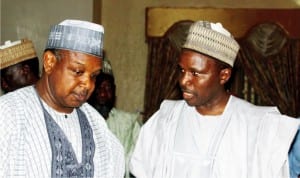
Governor Atiku Bagudu of Kebbi State (left) with the Editor-In-Chief of the Media Trust Ltd, Mr Mannir Dan-Ali, during his visit to the Governor in Birinin Kebbi on Tuesday.
Borno
The Theatre Commander of Operation Lafiya Dole, Maj.-
Gen. Lucky Irabor, has attributed his troop’s recent successes in the anti-Boko Haram war in the North-East to improved welfare by the Nigerian Army Headquarters.
Irabor disclosed this when he spoke with newsmen in Maiduguri.
“When you see a troop that is fighting and making the kind of progress we have made from January to date, it means that the troop is motivated.
“If the troop is not motivated it will not give you that type of result,’’ he said.
Irabor was reacting to speculations about delayed payment of allowances to some soldiers working in the theatre.
“In January when my predecessor Maj.-Gen. Hassan Umaru took over the command, his maiden briefing was on the delay in payment of allowances to soldiers.
FCT
Stakeholders under the auspices of Project Harmony, a
non-governmental organisation, have urged Nigerians to support the Federal Government’s fight against corruption and mismanagement of the nation’s economy.
This is contained in a communiqué issued at the end of a two-day National Conference on New Blueprint for Prevention, Resolution and Management of Conflicts.
The communiqué was signed by Mr Hassan Anka of Trade Union Congress (TUC) and Mr Nneka Ikelionwu of the Institute of Peace and Conflict Resolution, among others.
It stressed the need for encouragement of grassroots trade union leaders by their apex unions to avoid abuse of trade union immunity.
Kaduna
The Kaduna State Government said it would partner
with the Federal Ministry of Solid Minerals and other company to exploit the state solid minerals.
Governor Nasiru El-Rufai disclosed this in an interview with newsmen in Kaduna.
“We are working with several companies and the Federal ministry of solid minerals to exploit some of our solid minerals in Kaduna.
“For instance, we have a lot of gold in the Birnin Gwari axis and we have gone far in discussions with several companies to come and do that,’’ he said.
He said the state government was also looking at other precious stones in Southern Kaduna and granite and marbles in other parts of the state.
The governor said discussions were ongoing and that the state government would also meet other prospective investors at the economic summit.
Kebbi
The Waziri Umaru Federal Polytechnic, Birnin Kebbi,
said it had sponsored 40 academic staff for post graduate studies within and outside the country in the last five years.
Its Rector, Alhaji Sani Aliyu, stated this in an interview with newsmen in Birnin Kebbi ,.
He said that 32 of the beneficiaries, including 12 doctorate and 20 master’s degree holders, had since completed their studies while the remaining eight were still pursuing their programmes at the various universities.
Aliyu said four of the beneficiaries had been “outstanding and worthy of celebration’’.
Kano
The Department of Petroleum Resources (DPR) said it
had sanctioned 15 filling stations in Jigawa and Kano States for various offences in the dispensing of petrol.
The department’s Controller in charge of both states, Alhaji Isa Tafida, made this known to newsmen in Kano after monitoring some filling station in the city.
He said that one of the erring stations was charged for breaking the seal of the department, in addition to the offence of selling above approved pump price.
Tafida said that the station paid fines of N1 million for breaking the seal in addition to N300, 000 for selling above approved price.
Lagos
The Iron and Steel Senior Staff Association of Nigeria
(ISSSAN) has advised the Federal Government to ensure that all legal issues that would affect the proposed revival of the Ajaokuta Steel Plant were settled amicably .
ISSAN President, Mr Otori Maliki, told newsmen in Lagos that the Federal Government should ensure that it settled any court case involving the company before restructuring it.
Maliki said that the steel plant stopped functioning since 2005 when it was sold to Global Steel, an Indian Company, during former President Olusegun Obasanjo- led administration.
He said that there were transnational irregularities at the rolling mill when it was privatised and those issues needed to be rectified before rebuilding it.
“Since 2007, the government has been in arbitration with Global Steel and Global Infrastructure Limited at the International Chamber of Commerce, (ICC) London.’’
Nasarawa
The Nasarawa State Government has revoked the con
tract for the construction of the new Orange Market bridge in Mararaba.
Governor Tanko Al-Makura made this known during the inauguration of TA’AL Community New Orange Market in Mararaba, Karu local government area of the state.
He said that the state government decided to revoke the contract following the inability of the contractor to meet the required specification and alleviate the suffering of traders and people plying the road.
Al-Makura said that the inauguration of the market would help to fight poverty, unemployment, youth restiveness as well as boost the socio-economic development of the state.
“Because of the slow pace of work and the inability of the contractor to meet required specification, the state government has no option than to revoke the contract,” he said.
Ogun
The Deputy Speaker, Ogun House of Assembly, Mr
Olakunle Oluomo, on Saturday, said the proposed Local Council Development Areas (LCDA) in the state would engender rapid socio-economic development.
Oluomo told journalists in Abeokuta that the bill was currently before the assembly, adding that when passed, would also promote efficiency and widen the revenue base of the state.
According to him, the LCDAs will bring efficiency in service delivery through redistribution of workers and enhanced revenue generation initiatives.
“The bill for a law to amend The Local Government Law of Ogun State, 2002, is currently before the house and we will do our bit to scrutinise it before passage,” he said.
Oyo
The Oyo State Government said that the 10-month old
agreement it had with organised labour in the state over unpaid salaries subsisted, warning them to refrain from confrontation.
This is contained in a statement signed by Alhaji Ismael Alli, a former Secretary to the State Government and leader of the government delegation which was made available to newsmen in Ibadan.
“We urge labour leaders to embrace dialogue and consultation instead of issuing threats and ultimatum of strike.
“As stakeholders they should brainstorm on how to bail the state out of its financial predicament,” it said.
Plateau
The Commandant, Police Staff College, Jos, Mr. Jo
seph Mbu, has called on Federal Government to rehabilitate police colleges ahead of the coming massive recruitment in the force.
Mbu, an Assistant Inspector-General, told newsmen that the recruitment would be worthless without better facilities in training schools.
It would be recalled that President Muhammadu Buhari recently approved the recruitment of 10,000 policemen in the country.
Mbu described the state of police colleges as “in utter decay’’, saying hostels, lecture halls and other necessary facilities in the colleges were in very poor conditions.
Sokoto
A member of Sokoto State House of Assembly, Alhaji
Ibrahim Kabiru (APC), has advised President Muhammadu Buhari not to relent in his fight against corruption.
Kabiru, who gave the advice in Sokoto in an interview with newsmen urged Buhari to ensure that all those found guilty of embezzling the national treasury were prosecuted.
He said that the insecurity challenges facing the country were as a result of corruption by public officers in the last administration.
The legislator urged the government to ensure that looted funds were recovered, adding that such funds should be used in rehabilitating ailing industries in the country.
Yobe
The Executive Secretary of the Yobe State Emergency
Management Agency, Alhaji Musa Jidawa, has advised response groups to work as partners rather than competitors to avoid duplication and wastes.
Musa told newsmen in Damaturu that the emergency response actors had constituted a forum to coordinate areas of intervention to avoid over- lapping and duplication.
Musa, who is also the chairman of the forum, listed the actors as the National Emergency Management Agency (NEMA), the Red Cross, the World Health Organisation (WHO), UN Population Fund (UNFPA), World Food Programme (WFP), the UNICEF and Action against Hunger, among others.



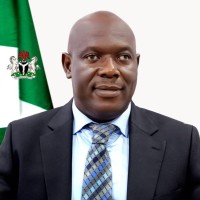
The Hydrocarbon Pollution Remediation Project (HYPREP) has commemorated the 15th anniversary of the release of the United Nations Environment Programme (UNEP) Environmental Assessment Report on Ogoniland, reaffirming its commitment to restoring the environment and improving the livelihoods of affected communities.
In a statement signed by the Project Coordinator, Prof Nenibarini Zabbey, to commemorate the anniversary, HYPREP described the anniversary as a significant milestone in Nigeria’s environmental restoration efforts, noting that the project has made remarkable progress in implementing the recommendations of the landmark UNEP report released on August 4, 2011.
The UNEP report had revealed extensive oil pollution across Ogoniland, severe environmental degradation, and serious public health risks resulting from decades of petroleum operations. It also recommended an initial $1 billion fund to commence the cleanup of the affected communities.
According to HYPREP, the Federal Government formally launched the Ogoni clean-up in 2016, while the Project Coordination Office was established in 2017 to drive the implementation of UNEP’s recommendations.
Zabbey said the current administration has continued to prioritise the project under the Renewed Hope Agenda.
Providing an update on the cleanup, the Project Coordinator disclosed that 30 of the 65 contaminated sites identified by UNEP have been fully remediated, while work is ongoing at several medium- and high-risk locations. It also stated that more than 1.5 million mangrove seedlings have been planted as part of what it described as the world’s largest restoration of oil-degraded mangroves, with over 1,000 hectares of shoreline already rehabilitated.
Zabbey further revealed that 49 Ogoni communities have been connected to potable water schemes through multiple water projects and booster stations aimed at providing safe drinking water across the region.
In the health sector, he said the 100-bed Ogoni Specialist Hospital in Kpite and the 43-bed Cottage Hospital in Buan are nearing completion, adding that several existing health facilities have been upgraded with modern medical equipment, while five ambulances have been donated to improve emergency healthcare services. The Project Coordinator also disclosed that a three-year human health biomonitoring study is being conducted in collaboration with the World Health Organization’s International Agency for Research on Cancer (IARC).
On economic empowerment, Zabbey stated that the Project has created more than 8,000 direct jobs and trained thousands of Ogoni youths and women in various vocational and technical skills, including software development, cybersecurity, aviation, commercial diving, seafaring, mechatronics, and creative arts. The project also reported awarding scholarships to more than 1,000 students, providing grants to small businesses, and supporting persons living with special needs through skills acquisition programmes.
The statement further highlighted ongoing legacy projects, including the Ogoni Power Project and the Centre of Excellence for Environmental Restoration, which it said is about 96 per cent complete. HYPREP also welcomed the recent designation of the Ogoni Wetland as a Ramsar Site of International Importance and pledged to continue promoting biodiversity conservation and sustainable management of the ecosystem.
Marking the anniversary, Zabbey said the progress achieved over the past 15 years demonstrates the collective commitment of government, development partners, stakeholders, and local communities to restoring Ogoniland. He called for renewed collaboration to sustain the cleanup effort, promote environmental sustainability, and support the long-term development of the region. 3
-

 News2 days ago
RSG Targets Nine Million Residents in Mosquito Net Distribution Campaign
-

 Oil & Energy2 days ago
Aiyedatiwa Signs New Electricity Bill
-

 Oil & Energy2 days ago
NLNG Commissions Research And Innovation Centre In RSU
-

 Maritime2 days ago
Marine Minister Commends President Tinubu On NPERA Bill Assent
-

 News2 days ago
KenPoly Holds Eight Convocations, August 29
-

 News2 days ago
RSG Begins Another Phase of Projects Commissioning Today
-

 News2 days ago
RMAFC Completes Revenue Sharing Review, Proposes New Pay
-

 Maritime2 days ago
NAGAFF Petitions IGP Over Alleged Maritime Police Harassment