
Nation
THE STATES

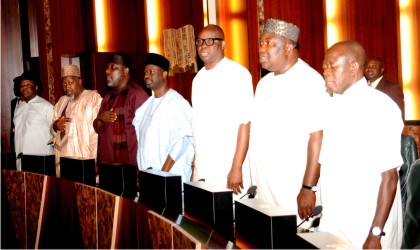
Governors of States, during a meeting with President Muhammadu Buhari at the Presidential Villa in Abuja, yesterday
Benue
Governor Samuel Ortom of Benue State, says that God
has given the people of Nigeria everything a nation needs to be successful.
Ortom, who made the remark at Igbor in Gwer East Local Government Area of the state, however said the country had failed to harness its resources to become a successful nation.
The governor was at Igbor to inspect the Benue Burnt Bricks Company and Ikwe Wildlife Resort.
He noted that the state was blessed with abundant human and natural resources which needed to be properly tapped for the good of all.
According to him, the failure to transform existing industries in the state and across the country is part of what is retarding the nation’s development and the attendant hardships faced by people.
FCT
The Nigerian military says it has the constitutional and
moral responsibility to protect Nigerians and could not suddenly engage in mass murder as portrayed in the allegations by Amnesty International.
Chief of Administration of the Nigerian Army, Maj.-Gen. Adamu Abubakar, said this while briefing newsmen on the recent allegations of war crimes against some senior military officers by the Amnesty International.
Abubakar said following the Amnesty International report released on June 3, the Nigerian military as a responsible corporate organisation was bound to respond to the allegations in order to put the records in proper perspective.
He recalled that upon the written request from Amnesty International to the military to comment on the allegations, the military promptly commenced investigations into the allegations.
He said consequently, several investigations on the allegations were ongoing.
Gombe
The Governorship Election Petition Tribunal, Gombe
State, has ordered Independent National Electoral Commission (INEC) to expedite action on the reproduction of necessary documents requested by lawyers to prosecute their petitions before it.
Justice Mathew Adewara, Chairman of the tribunal, being assisted by Justice Abba Mohammed and Justice Hafsat Abdulrahaman gave the order at the pre-hearing season in Gombe on Saturday.
The chairman gave the order following the complaints by Adeniyi Akintola (SAN), who is the counsel of the petitioner, Alhaji Inuwa Yahaya and APC, who also petitioned the victory of Gov. Ibrahim Dankwambo, joining the PDP and INEC.
He said they had made several efforts for the INEC to serve them with some of the viral documents to be use before the tribunal.
According to him, they were served with some and denied other documents as requested.
Jigawa
Governor Muhammad Badaru of Jigawa State, has re-
appointed Alhaji Sani Alhassan, as the Executive Secretary, Jigawa State Pilgrims Welfare Board.
A statement by the Secretary to the State Government, Alhaji Adamu Abdulkadir, in Dutse, said Alhassan was reappointed based on his “excellent performance in the past.”
It said that the appointment was with immediate effect, and urged the executive secretary to continue rendering selfless service to the state.
“While we commend you for the excellent performances you recorded in the previous Hajj operations, we also urge you to continue with that in future operations,” the statement further said.
Kaduna
The Anglican Bishop of Wusasa Diocese in Zaria, Kaduna
State, Rt. Rev. Ali Buba-Lamido, on Saturday advocated death penalty for corrupt public office holders.
He made the call at the Sixth Synod of the Wusasa Diocese of the Anglican Communion, held in Zaria, Kaduna State.
According to him, the death penalty option is the only way to put public officers in Nigeria in check.
Buba-Lamido said the call became imperative in view of the fact that corruption could kill more people than a conventional weapon.
“If our leaders know that they would be prosecuted if found corrupt they would be on their toes to avoid corrupt practices,” he said.
Katsina
President Muhammadu Buhari has urged Nigerians to
be patient and accept democracy not as a system of government but as a lifestyle in order to ensure development of the country.
The president said this when he paid homage to the Emir of Daura, Alhaji Umar Faruk Umar, after attending the Juma’at prayer at the Lowcost Mosque, in Daura, Katsina State.
The President, who delivered his speech in Hausa, urged those who were aggrieved after the 2015 elections to seek redress through democratic means and institutions.
Buhari noted that Nigeria was adopting democracy from the western nations and learning fast by avoiding mistakes made when studying the weaknesses and strengths of those nations.
According to him, if Nigerians decide to be hasty, some avoidable mistakes can be made.
Kwara
Nigeria has the largest population of people with sickle
cell disease in the world, with over 150,000 babies born with the serious condition every year, researches have shown.
A pharmacist with the University of Ilorin Teaching Hospital, Mr Lanre Alege, said this in a lecture delivered during June edition of the keep fit exercise for staff of the hospital at the Kwara stadium on Saturday.
He said it was estimated that only five per cent of the children with Sickle Cell Disease live past the age of 10 in Nigeria, compared to over 96 per cent surviving into adulthood in the United Kingdom and the United States.
Alege, who is the Coordinator of the programme, also disclosed that the recurrent pain and complications of the disease can interfere with many aspects of patients life, including education, employment and psychological development.
He said that Sickle Cell Disease is a genetic disorder due to the presence of an abnormal form of haemoglobin in the red blood cells, called haemoglobin S (Hb S) instead of haemoglobin A (Hb A).
Lagos
Primary school authorities in the country have been ad
vised to encourage their pupils to make use of libraries to improve their reading culture.
A management staff in the Office of the Registrar of the Ekiti State University, Ado-Ekiti, Dr Ayoola Olatunde, gave the advice in an interview with newsmen in Lagos.
He said it was necessary to expose pupils to use of library facilities at tender ages.
The don described the primary school level as “ a crucial stage of development and a foundation, which the rest of the educational system is built on”.
Olatunde said that reading was one of the most effective processes of conscious learning, which must be inculcated in children.
Nasarawa
Chairman, General Private Nursing Practitioners of Ni
geria, Nasarawa State branch, Chief Stephen Angbas, has appealed to the state’s Ministry of Health to reduce the cost of renewing licence by practitioners.
Angbas made the appeal in an interview with newsmen in Lafia on Saturday.
The chairman, who is also the proprietor of Angbas Medical Centre, Lafia, expressed concern over the increase in charges of renewing licence fees by private nursing practitioners in the state.
“We are appealing to them to look at the issue of renewing licence fees and make it reasonable to allow the private sector participate in health care delivery services.
“In those days, it was N13, 000, but now it had gone up beyond our reach,” he said.
Plateau
The price of tomatoes has soared in markets in Jos and
its environs.
A survey carried out in some markets also revealed that the price of pepper has also gone up.
Our correspondent learnt at the Farin-Gada tomatoes market, that a basket of fresh tomatoes which sold for N800 two weeks is now N6, 000.
The paint bucket which sold for N300 two weeks ago, now sells for N800.
A basket of pepper that was sold for N600, now sells for N4, 000, while the paint bucket of pepper now attracts N700 up from N200 which it sold two weeks ago.
Taraba
The Chairman, Muslim Council in Taraba State, Alhaji
Inuwa Manu, has urged Muslim faithful to use the Ramadan to demonstrate love and peaceful coexistence among different religious adherents in the state.
Manu made this known in an interview with newsmen in Jalingo on Saturday.
He said the call became imperative following activities of miscreants who were bent on causing public disturbances in the name of religion in the state.
According to him, criminals have infiltrated religious bodies with the sole aim of causing confusion so as to benefit from it.
He urged the people to embrace peace and respect each other’s religion so as not to create room for the miscreants to capitalise on it to cause problem in the state.
Yobe
Governor Ibrahim Gaidam of Yobe State has assured
security personnel involved in the war against Boko Haram insurgents in the state of prompt payment of allowances.
Gaidam made the pledge on Saturday during a special parade by troops of 27 Task Force Brigade, Operation Zaman Lafiya, in Damaturu.
The parade was to decorate deserving personnel who had spent a minimum of six months in the ongoing operation against the insurgents in the North East.
The governor also pledged to provide more logistic support to the brigade, to assist with its operations.



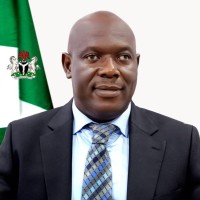
The Hydrocarbon Pollution Remediation Project (HYPREP) has commemorated the 15th anniversary of the release of the United Nations Environment Programme (UNEP) Environmental Assessment Report on Ogoniland, reaffirming its commitment to restoring the environment and improving the livelihoods of affected communities.
In a statement signed by the Project Coordinator, Prof Nenibarini Zabbey, to commemorate the anniversary, HYPREP described the anniversary as a significant milestone in Nigeria’s environmental restoration efforts, noting that the project has made remarkable progress in implementing the recommendations of the landmark UNEP report released on August 4, 2011.
The UNEP report had revealed extensive oil pollution across Ogoniland, severe environmental degradation, and serious public health risks resulting from decades of petroleum operations. It also recommended an initial $1 billion fund to commence the cleanup of the affected communities.
According to HYPREP, the Federal Government formally launched the Ogoni clean-up in 2016, while the Project Coordination Office was established in 2017 to drive the implementation of UNEP’s recommendations.
Zabbey said the current administration has continued to prioritise the project under the Renewed Hope Agenda.
Providing an update on the cleanup, the Project Coordinator disclosed that 30 of the 65 contaminated sites identified by UNEP have been fully remediated, while work is ongoing at several medium- and high-risk locations. It also stated that more than 1.5 million mangrove seedlings have been planted as part of what it described as the world’s largest restoration of oil-degraded mangroves, with over 1,000 hectares of shoreline already rehabilitated.
Zabbey further revealed that 49 Ogoni communities have been connected to potable water schemes through multiple water projects and booster stations aimed at providing safe drinking water across the region.
In the health sector, he said the 100-bed Ogoni Specialist Hospital in Kpite and the 43-bed Cottage Hospital in Buan are nearing completion, adding that several existing health facilities have been upgraded with modern medical equipment, while five ambulances have been donated to improve emergency healthcare services. The Project Coordinator also disclosed that a three-year human health biomonitoring study is being conducted in collaboration with the World Health Organization’s International Agency for Research on Cancer (IARC).
On economic empowerment, Zabbey stated that the Project has created more than 8,000 direct jobs and trained thousands of Ogoni youths and women in various vocational and technical skills, including software development, cybersecurity, aviation, commercial diving, seafaring, mechatronics, and creative arts. The project also reported awarding scholarships to more than 1,000 students, providing grants to small businesses, and supporting persons living with special needs through skills acquisition programmes.
The statement further highlighted ongoing legacy projects, including the Ogoni Power Project and the Centre of Excellence for Environmental Restoration, which it said is about 96 per cent complete. HYPREP also welcomed the recent designation of the Ogoni Wetland as a Ramsar Site of International Importance and pledged to continue promoting biodiversity conservation and sustainable management of the ecosystem.
Marking the anniversary, Zabbey said the progress achieved over the past 15 years demonstrates the collective commitment of government, development partners, stakeholders, and local communities to restoring Ogoniland. He called for renewed collaboration to sustain the cleanup effort, promote environmental sustainability, and support the long-term development of the region. 3
-

 News2 days ago
RSG Targets Nine Million Residents in Mosquito Net Distribution Campaign
-

 Oil & Energy2 days ago
Aiyedatiwa Signs New Electricity Bill
-

 Oil & Energy2 days ago
NLNG Commissions Research And Innovation Centre In RSU
-

 Maritime2 days ago
Marine Minister Commends President Tinubu On NPERA Bill Assent
-

 News2 days ago
KenPoly Holds Eight Convocations, August 29
-

 News2 days ago
RSG Begins Another Phase of Projects Commissioning Today
-

 News2 days ago
RMAFC Completes Revenue Sharing Review, Proposes New Pay
-

 Maritime2 days ago
NAGAFF Petitions IGP Over Alleged Maritime Police Harassment