
Nation
THE STATES

Adamawa
The presidential candidate of the All Progressives Con
gress (APC ), Maj.-Gen. Muhammadu Buhari (rtd), has promised enabling environment for Nigerian youths to excel, if elected president on February 14
Buhari gave the assurance at the APC Presidential campaign rally held in Yola last Monday.
He said a World Bank statistic indicated that 60 per cent of Nigerian citizens were under thirty three years and were jobless.
“Sixty per cent of Nigerian citizens are youths who have no job opportunity,” Buhari said.
According to him, the top priority of his government, if elected, was to ensure security of lives and property and to create job opportunities for the youth through agriculture and mineral resources potentials.
Buhari said that APC government would bring positive development to the people of Nigeria.
He sympathised with the internally displaced persons in the state and assured them that they would go back to their respective places of abode if the APC formed the government in February.
FCT
The police yesterday arraigned a driver, Ameobi Ndukwe
before a Wuse Zone 2 Senior Magistrates’ Court, Abuja for allegedly receiving a stolen property.
Ndukwe, 25, who resides at Sabon Lugbe Abuja, was alleged to have bought some clothing materials alleged to have been stolen.
He was arraigned on a one-count charge of receiving stolen property.
The prosecutor, Inspector Usman Owuna told the court that on November 8, 2014 at about 6.25 a.m, one Ms Juremi Shekwoyemi of Sabon Lugbe, Abuja, reported the matter at the Iddo Police Station.
Owuna said that on July 19, 2014 some unknown persons broke into the complainant’s shop and made away with some items which he listed as wrappers, earrings, necklaces among others.
He informed the court that during police investigation, some of the stolen materials were discovered in a tailoring shop owned by one Mohammed Kekere.
Kano
The Kano State Government last Monday said it had
approved N62 million for full take-off of the State Informatics Institute in Kura.
The Commissioner for Justice, Mr Maliki Umar, disclosed this while briefing newsmen on the outcome of the state’s Executive Council meeting in Kano.
“The council approved N10 million for the continuation of enforcement of law on the streets, as well as decongestion and illegal motor parks in the metropolis.
“The Council also approved N14.9 million for replenishment of operational funds for task force on drugs abuse and illicit trafficking committee.”
The commissioner reiterated the state government’s determination to develop infrastructure in the state as part of initiatives to improve the welfare of the people.
Kebbi
Some traditional leaders of border communities in Kebbi
State, last Monday pledged to promote peaceful coexistence with their neighbours in Benin Republic.
The district heads of Illo, Alhaji Muhammadu Wankoi and that of Kasati, Alhaji Muhammadu Dobvi gave the assurance when Gov. Saidu Dakingari visited Bagudo Local Government area.
The governor was in the area to inspect some projects being undertaken by the state government.
The district heads in their separate remarks said they would encourage their subjects to always portray Nigeria in positive manner and shun anything that would create conflict.
They commended Dakingari for the projects sited in their areas and further urged him to construct new official residence for them and allocate official vehicles to them to enhance their status.
Earlier, the governor said the state government had constructed a new road to link the community with their neighbours in Benin Republic to promote social and economic relations.
Kwara
The Hausa community in Kwara State has accused the
state government of marginalisation in the implementation of policies and programmes.
The head of the community, Alhaji Mukhtar Tawakalitu, told newsmen last Monday in Ilorin that majority of the members of the community were born in the state and deserved to be recognised as indigenes.
“We see Kwara as our state because majority of us were born here, grew up here, do our businesses here and married here,” Tawakalitu said.
He said members of the community had not benefitted from the administration of Gov. Abdulfatah Ahmed.
Lagos
National Leader of the All Progressives Congress (APC),
Chief Bola Tinubu, on Monday described the party’s governorship candidate in Lagos State, Mr Akinwunmi Ambode, as one of the most brilliant minds in financial accountancy.
Tinubu spoke at the APC governorship campaign rally in Ojo area of the state, urging the people to give Ambode their votes in the Feb. 28 governorship election.
He said that Ambode was a credible candidate who should be given the chance to continue with the excellence for which Lagos was noted.
“Today we present one of the most brilliant minds in financial accountancy; one of the most intelligent in financial management.
“He is tested, trusted, capable, visionary and an achiever,” he said.
Tinubu said that Ambode performed well when he was the state’s Accountant-General.
“Lagos State progressed when Ambode was the state’s Accountant-General.
“You need creative, great, visionary leaders and an intelligent government to manage the economy.
“That is why a disciplined Buhari and a visionary Ambode will want to create a better economy for Nigeria,” Tinubu said.
Nasarawa
Most Rev. Mathew Audu, the Catholic Bishop of Lafia
Diocese in Nasarawa State, has condemned the alarming rate of divorce in Nigeria.
The clergyman voiced his displeasure in an interview with newsmen last Monday in Lafia.
He said that he was shocked to learn that the rate of divorce in Nigeria had risen to above 30 per cent yearly.
He expressed concern why couples quickly resorted to divorce.
He said that instead of preaching against divorce, some clerics were preoccupied with counselling new and old couples on ways of sustaining their love.
He said that the high rate of divorce was not a good development as the church does not permit divorce since it is forbidden by God.
Ogun
The Independent National Electoral Commission (INEC)
yesterday said it had distributed over 672,000 Permanent Voter Cards (PVCs) in Ogun State.
The Resident Electoral Commissioner in the state, Mr Timothy Ibitoye, said this in Ijebu-Ode, Ogun State, during a visit to Oba Sikiru Adetona, the Awujale of Ijebuland.
Ibitoye said the figure represented 50 per cent of the 1.22 million cards received for the registered voters in the state.
He said eligible voters yet to obtain their cards should be patient as the commission would distribute the outstanding cards before February 14.
Ibitoye, however, warned that the commission would insist on its policy of “no PVC, no voting.”
He said smartcard readers would be used at the general elections for accreditation of voters, adding that no one should be seen with more than one card.
Ondo
The Ondo State Board of Internal Revenue said it gen
erated N13.2 billion from various internal sources in 2014.
Its Chairman, Mr Akinlolu Akinsehinwa. said this yesterday in Akure in an interview with newsmen.
Akinsehinwa said the board recorded success in 2014 because of its repositioning, dynamism and sensitisation.
“We made people see reason on tax payments and the infrastructure provided through tax.”
The chairman re-iterated the board’s commitment to generate more money through tax this year.
“We are looking into all remote areas for coverage and we will come up with some strategies and widen our scope to get more tax.
“At the end, we will get a lot of money and make the collection easy and convenient because tax payment is not meant to make life more difficult but better,” Akinsehinwa said.
Sokoto
The APC gubernatorial candidate in Sokoto State, Aminu
Tambuwal last Monday received 2400 supporters of the Peoples Democratic Party ( PDP) who defected to APC in Kebbi Local Government Area of the state.
Tambuwal received the defectors at the party’s gubernatorial campaign rally held in Kebbi town, headquaters of Kebbi Local Government Area of the state.
He called on the defectors to work towards promoting the lofty ideals of the party in the rural areas.
Tambuwal also called on the youths in the area to shun all kinds of violence by ensuring peaceful conduct of the forthcoming elections.
He said that the youths were a global catalyst for political development of any society, adding that they should be properly groomed to enable them contribute towards the socio economic and political growth of the country.
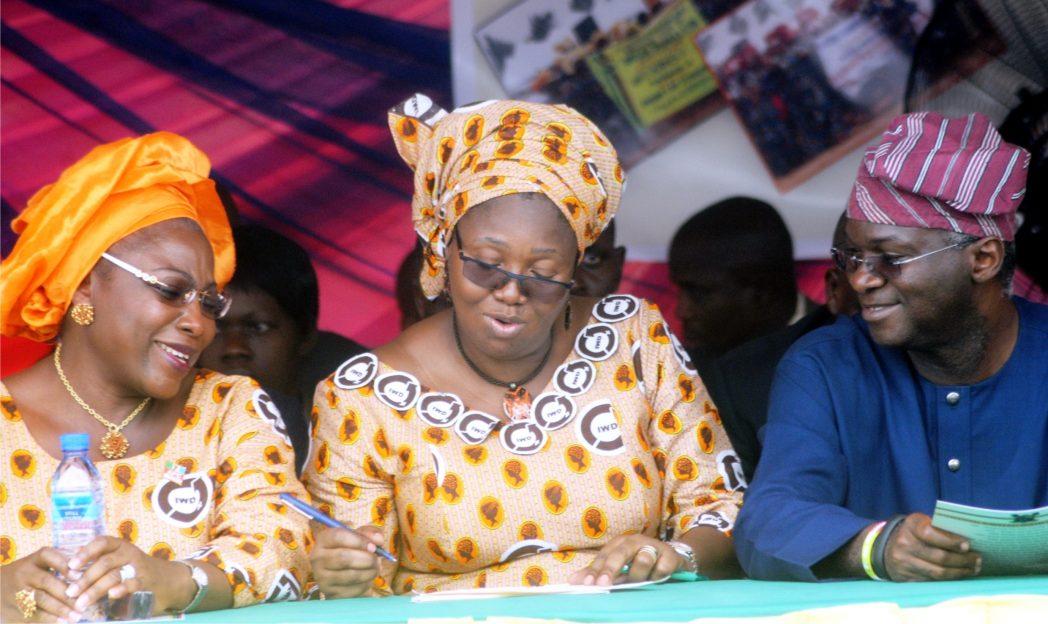
L-R: Former Lagos Deputy Governor, Mrs Adebisi Sosan, wife of Lagos State Governor, Mrs Abimbola Fashola and Governor Babatunde Fashola of Lagos State at the International Women’s Day in Lagos, recently.




The Hydrocarbon Pollution Remediation Project (HYPREP) has commemorated the 15th anniversary of the release of the United Nations Environment Programme (UNEP) Environmental Assessment Report on Ogoniland, reaffirming its commitment to restoring the environment and improving the livelihoods of affected communities.
In a statement signed by the Project Coordinator, Prof Nenibarini Zabbey, to commemorate the anniversary, HYPREP described the anniversary as a significant milestone in Nigeria’s environmental restoration efforts, noting that the project has made remarkable progress in implementing the recommendations of the landmark UNEP report released on August 4, 2011.
The UNEP report had revealed extensive oil pollution across Ogoniland, severe environmental degradation, and serious public health risks resulting from decades of petroleum operations. It also recommended an initial $1 billion fund to commence the cleanup of the affected communities.
According to HYPREP, the Federal Government formally launched the Ogoni clean-up in 2016, while the Project Coordination Office was established in 2017 to drive the implementation of UNEP’s recommendations.
Zabbey said the current administration has continued to prioritise the project under the Renewed Hope Agenda.
Providing an update on the cleanup, the Project Coordinator disclosed that 30 of the 65 contaminated sites identified by UNEP have been fully remediated, while work is ongoing at several medium- and high-risk locations. It also stated that more than 1.5 million mangrove seedlings have been planted as part of what it described as the world’s largest restoration of oil-degraded mangroves, with over 1,000 hectares of shoreline already rehabilitated.
Zabbey further revealed that 49 Ogoni communities have been connected to potable water schemes through multiple water projects and booster stations aimed at providing safe drinking water across the region.
In the health sector, he said the 100-bed Ogoni Specialist Hospital in Kpite and the 43-bed Cottage Hospital in Buan are nearing completion, adding that several existing health facilities have been upgraded with modern medical equipment, while five ambulances have been donated to improve emergency healthcare services. The Project Coordinator also disclosed that a three-year human health biomonitoring study is being conducted in collaboration with the World Health Organization’s International Agency for Research on Cancer (IARC).
On economic empowerment, Zabbey stated that the Project has created more than 8,000 direct jobs and trained thousands of Ogoni youths and women in various vocational and technical skills, including software development, cybersecurity, aviation, commercial diving, seafaring, mechatronics, and creative arts. The project also reported awarding scholarships to more than 1,000 students, providing grants to small businesses, and supporting persons living with special needs through skills acquisition programmes.
The statement further highlighted ongoing legacy projects, including the Ogoni Power Project and the Centre of Excellence for Environmental Restoration, which it said is about 96 per cent complete. HYPREP also welcomed the recent designation of the Ogoni Wetland as a Ramsar Site of International Importance and pledged to continue promoting biodiversity conservation and sustainable management of the ecosystem.
Marking the anniversary, Zabbey said the progress achieved over the past 15 years demonstrates the collective commitment of government, development partners, stakeholders, and local communities to restoring Ogoniland. He called for renewed collaboration to sustain the cleanup effort, promote environmental sustainability, and support the long-term development of the region. 3
-

 News2 days ago
RSG Targets Nine Million Residents in Mosquito Net Distribution Campaign
-

 Oil & Energy2 days ago
Aiyedatiwa Signs New Electricity Bill
-

 Maritime2 days ago
Marine Minister Commends President Tinubu On NPERA Bill Assent
-

 Oil & Energy2 days ago
NLNG Commissions Research And Innovation Centre In RSU
-

 News2 days ago
KenPoly Holds Eight Convocations, August 29
-

 News2 days ago
RMAFC Completes Revenue Sharing Review, Proposes New Pay
-

 News2 days ago
RSG Begins Another Phase of Projects Commissioning Today
-

 Maritime2 days ago
NAGAFF Petitions IGP Over Alleged Maritime Police Harassment