
Business
Africa Needs Stable Electricity For Successful e-Governance

A South Korean ICT
Expert, Mr Kuk Jeong, has said “Africa needs adequate and stable electricity supply to successfully develop and implement e-Government and to fight corruption.”
Jeong, a Senior Research Fellow with the Korea Information Society Development Institute (KISDI), stated this at a Stakeholders’ Workshop and Instructors Training on capacity development of e-government for Nigerian civil servants, in South Korea, recently.
A total of 30 Nigerian civil servants are currently undergoing a three-week capacity training in e-government in South Korea.
He said Africa needed to have ‘electric government’ before it could truly build electronic government, adding that the major challenge facing developing countries was inadequate supply of electricity.
“Internet technology to be preceded by electricity. Economic growth depends on continued reform in developing countries. Corruption has cost developing countries’ to loss tens of billion dollars annually.
“It is now acknowledged that e-government has great potential for government reforms in Africa. It needs this because it alleviates an administrative burden and helps to deal with fraud and corruption.
“It is a quick way for governments with limited infrastructure to catch up with the rest of the world in deployment of services.’’
Jeong said with e-government, there would be efficiency, transparency and the potential for easier interaction between governments and citizens, as well as essential for economic growth.
He said “once African countries have constant power supply like the developed nations, it will bring about good governance, boost economy and free societies on the continent.
“People focus on doing business the way they know, with lots of requirements and paperwork, but e-government is about convenience and doing business as fast as possible.’’
The expert said African governments required to push e-government and to streamline processes for its development and implementation in their various countries.
“The use of ICT and the support of new ways of thinking and working in public administration with the enhanced provision of information and interactive services accessible over different channels is the foundation of e-government.’’
He said “e-government brings about greater government accountability, easy to access information, convenient services, quick response to requests, fast delivery of services, as well as data security and confidentiality.’’
Jeong also urged African leaders to prioritise capacity building programme for ICT to bring about information revolution in Africa.



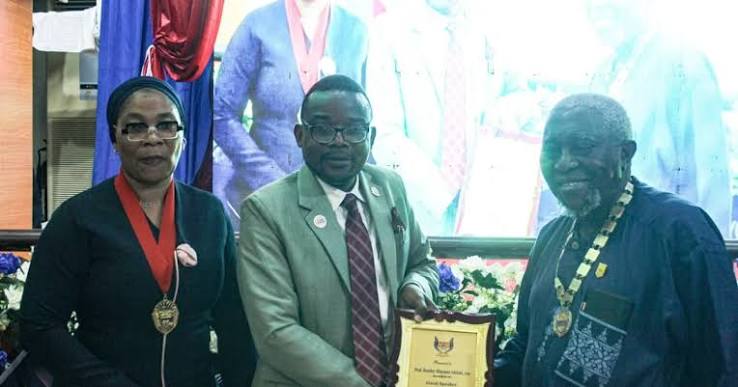
The NIM president also identified integrity, accountability, probity, honesty and efficiency as essential principles that needed to be strengthened in Nigeria’s workplaces and economy.
He argued that management failures extended beyond businesses to households and the wider society, making the promotion of sound management practices increasingly important.
Mustapha also renewed the institute’s call on the Federal Government to recognise 19 November as National Management Day, saying such recognition could strengthen its campaign for the United Nations to declare the date International Management Day.
The institute adopted 19 November for its annual celebration in 2016 to coincide with the birthday of Peter Drucker, widely regarded as the father of modern management.
Mustapha said the institute believed that official recognition by the Federal Government would strengthen its appeal to the United Nations to establish an international observance dedicated to the management profession.
The lecture featured Executive Director of the University of Lagos Business School, Prof. Sunday Adebisi, as guest speaker.
Other attendees included the Registrar and Chief Executive of NIM, Taiwo Olusesi, and a former president of the institute, Akinbayo Adenubi.

The Chief Executive Officer (CEO) of Moniepoint Microfinance Bank Babatunde Olofin, says transaction volume of the bank has hit one trillion naira daily.
Olofin said this at the unveiling of the bank’s North Central office in Abuja on Friday.
He said the bank also served a customer base of about 21 million and provided more than one million jobs in the country.
”Moniepoint is proudly Nigerian, owned by a Nigerian and managed by Nigerians.
?”With ?????????????????????our solid technologies and tailored-made products for businesses in Nigeria and retail customers as well, we are the bank to reckon with,” he said.
The CEO said the bank might be considering upgrade to a full-fledged commercial bank if the business required so.
According to him, this is a strategic decision which if the business requires it, we will communicate.
Fielding questions from newsmen, Edidiong Uwemakpan, the Vice-President Corporate Affairs of the bank, said the bank had been supporting agricultural activities to impact households.
”Moniepoint has always been hyper local and if you look at how we scaled our business, we understood how much Nigerians wanted to be able to interact with humans.
”From the very beginning, we built this distribution network of people that can be trusted, I think this is just an extension of our hyper-local strategy, getting closer to people,” she said.

-
News3 days ago
Bayelsa Boat Mishap: Tinubu Donates N250m As Death Toll Hits 29
-
News3 days ago
Odu Pays Tribute To Late Chinwah, Describes Him As Courageous, Selfless Academic
-
 Maritime3 days ago
Nigeria, Russia Customs Sign MOU To Trade Facilitations
-

 Sports3 days ago
World marathon champion gets three-year doping ban
-
 Maritime3 days ago
South-South Governors Urges To Shake Off Collective Lethargic To Embrace Blue Economy
-
 Maritime3 days ago
Oyetola Woos Investors With Nigeria’s Seabed Resources, Marine Biotechnology
-

 Business3 days ago
Moniepoint MfB transaction volume hits 1trn daily — CEO
-

 Oil & Energy3 days ago
Global Oil Market May Witness Supply Surplus Before The End Of 2026 …… Report