Sports
Nnadozie, Osimhen Lead Highest-Rated Nigerian Players

Super Falcons goalkeeper, Chiamaka Nnadozie, and Super Eagles striker, Victor Osimhen, have emerged as Nigeria’s highest-rated players in EA Sports FC 27, both handed an identical 85 overall rating in the game’s official list.
According to the ratings, ten Nigerian players are rated 78 overall or higher, reflecting a strong mix of attacking talent, midfield quality, defensive strength and goalkeeping experience across both the men’s and women’s national teams.
Nnadozie, who has built a strong reputation in European football and established herself as one of Africa’s leading goalkeepers, shares the top rating with Osimhen, whose spells in France, Germany, Italy and Turkey, including a Serie A title and the 2022/2023 Serie A Golden Boot with Napoli, have made him one of the continent’s most feared forwards.
Ademola Lookman, rated 83 overall, whose hat-trick for Atalanta in the 2024 Europa League final against Bayer Leverkusen made him the first player to score three goals in a Europa League final, also features prominently among the leading names, just behind the two top-rated players, alongside Super Falcons stars Rasheedat Ajibade, Jennifer Echegini and Gift Monday, and Super Eagles midfielder Alex Iwobi.
Ajibade, rated 81 overall, has built a strong reputation as an attacking midfielder in Europe and leads that group, while Iwobi, Echegini and Monday sit level on 80 overall.
Other Nigeria internationals recognised in the ratings include Ola Aina, on 79 overall, and Calvin Bassey, Raphael Onyedika, Samuel Chukwueze and Nathan Tella, who are all rated 78 overall.


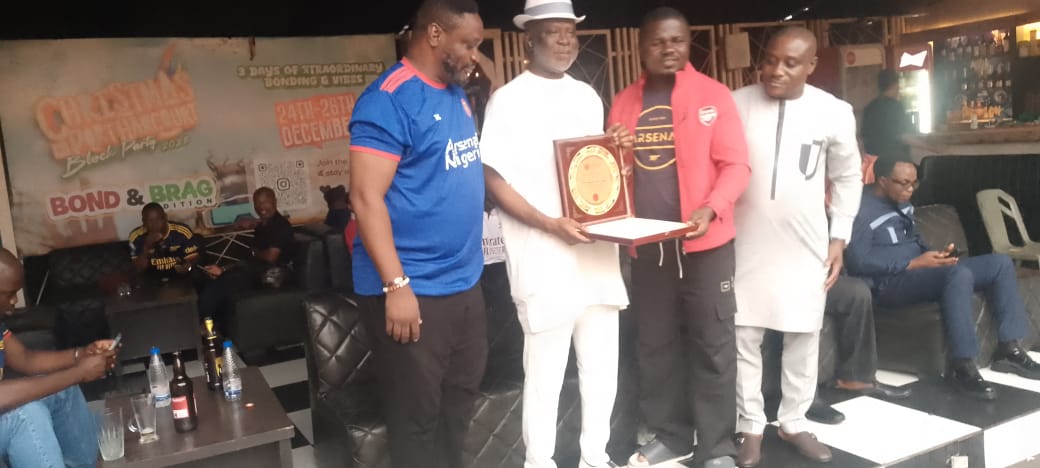
The Vice Chancellor of Rivers State University (RSU), Professor Isaac Zeb-Obipi, has congratulated the Port Harcourt Arsenal community for the successful hosting of the Nigeria Arsenal Converge 2026 in Port Harcourt, Rivers State.
Prof. Zeb-Obipi gave the commendation on Sunday, shortly after he received an award for “Outstanding Supporter of the Port Harcourt Arsenal Community” at Ediz Wine Bar in Port Harcourt, Rivers State.
He expressed satisfaction with the turnout for the program, which included a sanitation exercise at One Market, fun games at RSU, and a Community Shield watch party.
“The anniversary will run from Friday to Saturday, and Sunday, of course, we won the Community Shield,” he said.
“I am very grateful. I want to congratulate all of us for winning the Community Shield today.
“Today’s victory speaks to our supremacy over other clubs in the Premier League for winning the Community Shield,” Zeb-Obipi said.
He thanked the leadership of the Port Harcourt Arsenal Community for finding him worthy of the award.
He explained that he will continue to identify with the Arsenal community, adding that the community provides an opportunity for members to interact regardless of their status.
“That is the beauty of sports, the ability for us to network, to share joy, and of course, to derive the benefit and peace that football brings,” he said.
“I am very proud to be an Arsenal fan,” he stated.
By Kiadum Edookor
The Director General of the National Sports Commission (NSC), Hon. Bukola Olopade, has announced that Nigeria’s Women’s Beach Volleyball team will be immediately integrated into the training grant programme of the Elite and Podium Board following their historic qualification for the Los Angeles 2028 Olympic Games.
Hon. Olopade made this known while congratulating the team for securing Africa’s sole qualification ticket to the 2028 Olympic Games after a dominant performance at the African Beach Volleyball Championship in Alexandria, Egypt.
Esther Onyinye Mbah and Pamela Miyoum Bawa made history by defeating Morocco 2-0 in the final to claim the continental title and book Nigeria’s place at the Olympic Games.
The qualification represents another major milestone for Nigerian sports and, according to Hon. Olopade, further demonstrates the impact of the country’s growing sports ecosystem and the ongoing reforms aimed at ensuring that every sport has the opportunity to thrive and compete at the highest level.
“On behalf of the Chairman of the NSC, Mallam Shehu Dikko, I want to commend the progressive impact the board of the Nigeria Volleyball Federation has been making, both with the domestic league and the national teams,” Hon. Olopade said.
“The Nigeria Women’s Beach Volleyball team has been making giant strides in recent times, and the NSC is determined to ensure the team receives the highest level of high-performance preparation ahead of the Olympic Games.”
“This is why we are immediately integrating the team into our Elite and Podium Board programme so that the players can begin to benefit from the athletes’ training grants that we instituted last year.”
The Nigerian pair produced an impressive run through the championship, overcoming host Egypt in the Round of 16 before defeating Morocco twice, first in the quarterfinals and again in the final, to emerge African champions.
The achievement marks Nigeria’s return to the Olympic Beach Volleyball competition and provides the team with a significant runway to prepare for Los Angeles 2028 under the support structure of the National Sports Commission’s high-performance programme.
The NSC said the immediate integration of the athletes into the Elite and Podium Board training grant programme is part of its commitment to identifying, supporting and rewarding athletes and teams demonstrating the potential to deliver success for Nigeria on the global stage.
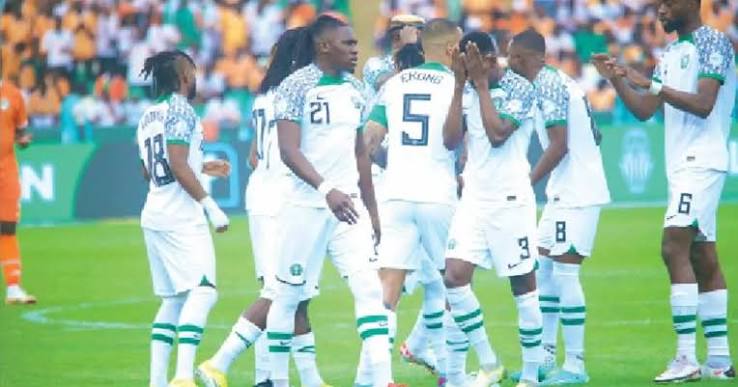
Nigerian football fans and former internationals may have finally joined the call on President Bola Ahmed Tinubu to save Nigerian football from the grip of the Nigeria Football Federation (NFF), demanding a complete overhaul and the resignation of the board following a series of national-team heartbreaks, including the Super Eagles’ failure to qualify for the 2026 FIFA World Cup, their second consecutive absence and the Super Falcons’ recent loss of an automatic qualification spot for the 2027 FIFA Women’s World Cup in Brazil.
Until now, football legend Segun Odegbami has been a lone voice in the vanguard of those calling on the Ibrahim Gusau-led NFF board to step aside. However, many ex-internationals, angered that the national embarrassment has now spilled over to the women’s team, have joined the call to “save our football.”
“We are demanding a total systemic clear-out and consequences at every tier of Nigerian football,” one of the former players said yesterday, pleading to remain anonymous to avoid “arrows” from what he described as desperate officials holding Nigerian football by the jugular.
Ahead of the September 27, 2026 elective congress of the NFF, scheduled to hold in Lafia, Nasarawa State, Chairman of the Advocacy for Nigeria Football Reforms Initiative, Prince Harrison Jalla, has also painted a gloomy picture of the future of Nigerian football.
Jalla’s position is in tandem with that of some aspirants who are also crying blue murder, alleging that the electoral procedure is skewed in favour of incumbent NFF President Ibrahim Musa Gusau to secure a smooth passage to a second term unopposed.
Jalla insisted that “all indicators are pointing to a gloomy picture for the future of Nigerian football, mainly due to administrative ineptitude, while the gladiators remain engrossed and fixated on the election.”
“The major crux of the election is the guidelines, which make it very difficult for other candidates to secure endorsements from across the six geopolitical zones to challenge Gusau.
“The NFF elective congress creates a skewed voting structure because [certain blocs] hold an overwhelming majority of the voting power, which critics argue marginalises key football stakeholders such as club owners, players, coaches, referees and sports writers.
“Out of the total delegates and voting structure, the 37 State FA chairmen form the primary voting bloc, making it difficult for independent candidates to win.
“This is so because of the marriage between the FA chairmen and the NFF. Most FA chairmen depend solely on the Federation for favours. Over time, during national and international engagements, the NFF uses such opportunities to reward the FA chairmen with trips and estacodes.
“They have been so compromised that no Jupiter would make them see reasons for a change. The system, therefore, heavily favours the incumbent leadership seeking re-election. That explains why they were in a hurry to pass a vote of confidence in the NFF leadership even when Nigerian football became topsy-turvy.
“As desperation has beclouded their reasoning, they have forgotten how low they have dragged Nigerian football.”
A cursory look at the catalogue of failures by Nigeria’s national teams will reveal this;
Super Eagles (Senior Men): Failed to qualify for the 2026 FIFA World Cup. Their campaign ended in agonising fashion in November 2025 during the CAF playoff final, when they lost 4–3 on penalties to DR Congo. This marked the second consecutive World Cup missed by the senior national team. Earlier, in January 2026, they were also eliminated from the 2025 AFCON via a penalty shootout.
Super Falcons (Senior Women): Suffered an early continental exit by losing 1–0 to Cameroon in the 2026 WAFCON quarter-finals. The defeat stripped them of an automatic ticket to the 2027 FIFA Women’s World Cup in Brazil, forcing them into an inter-confederation playoff route. Worse still, Banyana Banyana of South Africa stopped the Super Falcons with a 2-1 defeat in Morocco, marking Nigeria’s worst outing in the history of WAFCON.
Golden Eaglets (Men’s U-17): Failed to qualify for the U-17 AFCON and subsequently missed out on three consecutive FIFA U-17 World Cups — 2023, 2025 and 2026.
Flying Eagles (Men’s U-20): Missed both the 2026 U-20 AFCON and the FIFA U-20 World Cup.
Olympic Team (Men’s U-23): Failed to qualify for the 2023 U-23 AFCON, which directly resulted in their failure to qualify for the 2024 Paris Olympic Games.
An official NFF apology to the government and Nigerians was met with backlash, with fans dismissing it as “too little, too late” and “one apology too many”, while demanding actual resignations.
The current frustration among fans stems from what they regard as an unprecedented catalogue of systemic failures across all tiers of Nigeria’s national teams.
Segun Odegbami said the failures had become one too many.
“If you fail to take your team to the World Cup, you find out that more often than not, they vote you out or sack you.
“That’s the measure. If you have a coach who doesn’t do well, they sack him. If you have a player who is doing badly, you remove him.”
“These guys have not succeeded. They’re our friends; that’s the painful thing. We know ourselves. We are all in the business and, when we champion the fact that they should go, they make you an enemy.
“It’s not a personalised thing. They have failed and, if we go back to that route, we are going to fail as we have failed before,” he said.
The financial damage from missing recent major tournaments is equally devastating, with total losses estimated at between ?150 billion and ?300 billion in direct payouts and broader economic partnerships.
This continuous string of qualification failures has effectively choked off the federation’s primary revenue pipelines and left its local development initiatives starved of funds.
The economic wreckage breaks down across several critical areas. By failing to reach the expanded World Cup, the NFF forfeited a guaranteed baseline participation fee of $10.5 million, reportedly worth roughly ?15.5 billion.
This single tournament loss wiped out an amount equivalent to roughly 87 per cent of the NFF’s projected annual operational budget. Had the Super Eagles advanced beyond the group stage, the rewards would have risen above $12 million, while reaching the quarter-finals could have yielded up to $20 million in performance-related payments.
Early exits by the Super Falcons and the qualification failures of the youth teams, U-17, U-20 and U-23, mean the NFF has also missed out on vital developmental subsidies and travel grants normally provided by continental governing bodies.
Corporate organisations and major sports betting companies are scaling back their sponsorship valuations. Without global television exposure, the NFF cannot command premium rates for brand placement.
The federation also misses out on potential revenue from global jersey sales, training gear and licensed supporter memorabilia that normally spike around major tournaments.
By missing out on tournament participation, Nigeria also loses leverage to draw heavily from FIFA’s financial programmes aimed at upgrading domestic training academies and pitches.
Consecutive missed World Cups have further lowered the market value of the national team brand, making future broadcast and marketing rights significantly harder to sell at a premium.