
Editorial
Addressing Unruly Behaviours At The Airports

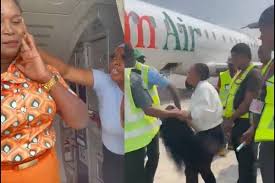
It began as a seemingly minor in- flight disagreement. Comfort Emmason, a passenger on an Ibom Air flight from Uyo to Lagos, reportedly failed to switch off her mobile phone when instructed by the cabin crew. What should have been a routine enforcement of safety regulations spiralled into a physical confrontation, sparking a national debate on the limits of airline authority and the rights of passengers.
The Nigerian Bar Association (NBA) wasted no time in condemning the treatment meted out to Emmason. In a strongly worded statement, the body described the incident as “a flagrant violation of her fundamental human rights” and called for a thorough investigation into the conduct of the airline staff. The NBA stressed that while passengers must adhere to safety rules, such compliance should never be extracted through intimidation, violence, or humiliation.
Following the altercation, Emmason found herself arraigned before a Magistrate’s Court and remanded at Kirikiri Maximum Security Prison, a location more commonly associated with hardened criminals than with errant passengers. In a surprising turn of events, the Federal Government later dropped all charges against her, citing “overriding public interest” and concerns about due process.
Compounding her woes, Ibom Air initially imposed a lifetime ban preventing her from boarding its aircraft. That ban has now been lifted, following mounting public pressure and calls from rights groups for a more measured approach. The reversal has been welcomed by many as a step towards restoring fairness and proportionality in handling such disputes.
While her refusal to comply with crew instructions was undeniably inappropriate, questions linger about whether the punishment fit the offence. Was the swift escalation from verbal reminder to physical ejection a proportionate response, or an abuse of authority? The incident has reignited debate over how airlines balance safety enforcement with respect for passenger rights.
The Tide unequivocally condemns the brutal and degrading treatment the young Nigerian woman received from the airline’s staff. No regulation, however vital, justifies the use of physical force or the public shaming of a passenger. Such behaviour is antithetical to the principles of customer service, human dignity, and the rule of law.
Emmason’s own defiance warrants reproach. Cabin crew instructions, especially during boarding or take-off preparations, are not mere suggestions; they are safety mandates. Reports suggest she may have been unable to comply because of a malfunctioning power button on her device, but even so, she could have communicated this clearly to the crew. Rules exist to safeguard everyone on board, and passengers must treat them with due seriousness.
Nigerians, whether flying domestically or abroad, would do well to internalise the importance of orderliness in public spaces. Adherence to instructions, patience in queues, and courteous engagement with officials are hallmarks of civilised society. Disregard for these norms not only undermines safety but also projects a damaging image of the nation to the wider world.
The Emmason affair is not an isolated case. Former Edo State Governor and current Senator, Adams Oshiomhole, once found himself grounded after arriving late for an Air Peace flight. Witnesses alleged that he assaulted airline staff and ordered the closure of the terminal’s main entrance. This is hardly the conduct expected of a statesman.
More recently, a Nollywood-worthy episode unfolded at Abuja’s Nnamdi Azikiwe International Airport, involving Fuji icon “King”, Wasiu Ayinde Marshal, popularly known as KWAM1. In a viral video, he was seen exchanging heated words with officials after being prevented from boarding an aircraft.
Events took a dangerous turn when the aircraft, moving at near take-off speed, nearly clipped the 68-year-old musician’s head with its wing. Such an occurrence points to a serious breach of airport safety protocols, raising uncomfortable questions about operational discipline at Nigeria’s gateways.
According to accounts circulating online, Wasiu had attempted to board an aircraft while he was carrying an alcoholic drink and refused to relinquish it when challenged. His refusal led to de-boarding, after which the Aviation Minister, Festus Keyamo, imposed a six-month “no-fly” ban, citing “unacceptable” conduct.
It is deeply concerning that individuals of such prominence, including Emmason’s pilot adversary, whose careers have exposed them to some of the most disciplined aviation environments in the world, should exhibit conduct that diminishes the nation’s reputation. True leadership, whether in politics, culture, or professional life, calls for restraint and decorum, all the more when exercised under public scrutiny.
Most egregiously, in Emmason’s case, reports that she was forcibly stripped in public and filmed for online circulation are deeply disturbing. This was an act of humiliation and a gross invasion of privacy, violating her right to dignity and falling short of the standards expected in modern aviation. No person, regardless of the circumstances, should be subjected to such degrading treatment.
Ibom Air must ensure its staff are trained to treat passengers with proper decorum at all times. If Emmason had broken the law, security personnel could have been called in to handle the matter lawfully. Instead, her ordeal turned into a public spectacle. Those responsible for assaulting her should face prosecution, and the airline should be compelled to compensate her. Emmason, for her part, should pursue legal redress to reinforce the principle that justice and civility must prevail in Nigeria’s skies.



There are moments in the life of a legislature when plain speaking becomes a public service. Senator Adams Oshiomhole provided such a moment on the floor of the Senate when he accused the Minister of Works, Senator David Umahi, of manifestly neglecting critical federal arteries in Edo and Delta States, and implored his colleagues to prevail on the Minister to adopt a more equitable and genuinely national approach to road infrastructure delivery. It was blunt, it was uncomfortable, and it was necessary.
The specifics of his complaint deserve restating. Drawing attention to the recent approval of some 20 new road projects despite the parlous state of existing ones, the former Edo State governor lamented that Nigerians cannot travel from Benin to Warri, Benin to Asaba, Benin to Auchi, or Auchi to Okene without encountering severe distress. He alleged a deliberate omission of these corridors from the national budget in the last three years, save for palliative interventions directed by President Bola Tinubu through tax credit arrangements. His question — “What have we done wrong?” — resonates far beyond the chambers of the National Assembly.
We lend our full and unequivocal support to that call. The Auchi-Benin Road, for instance, has been in a deplorable and near-impassable condition for several years, turning what should be a two-hour journey into an all-day ordeal of broken axles, extortionate fares, and despondent commuters. The media have, on multiple occasions, chronicled the suffering of motorists, traders, and students who ply that route. To describe it as a federal road today is to stretch the meaning of the term beyond recognition.
This pattern of sidelining is not confined to Edo or Delta. Even here in Rivers State, the disposition of the Federal Ministry of Works has left much to be desired, particularly along the Eleme axis of the East-West Road. That road, which ought to be a flagship of federal presence in the Niger Delta, has remained in a wretched state for long. Those who use it daily — workers at the Eleme Petrochemical Complex, the two refineries, Onne Port, and the countless ancillary industries — can attest to its deterioration. Work has proceeded in fits and starts without the sustained urgency such a strategic road demands.
The Eleme stretch is not a mere intra-state byway. It is the gateway to the nation’s economic jugular. According to the Federal Ministry of Works and Housing’s 2023 Highway Condition Survey, only about 35 per cent of the country’s 36,000 kilometres of federal roads are rated as being in good or fair condition, with the remainder classified as poor or very poor. The East-West Road, conceived in the 1970s to bind the entire Niger Delta, remains unfinished in critical sections more than four decades after. If it had been treated as a priority, the perennial gridlock, carnage, and economic loss on the Eleme-Refinery junction would have long been consigned to history.
The irony is as painful as it is glaring. The Niger Delta remains the goose that lays the golden eggs. Data from the Nigeria Extractive Industries Transparency Initiative [NEITI 2023 Oil and Gas Audit] show that the region still accounts for over 78 per cent of Nigeria’s federally collected export earnings and about 65 per cent of total government revenue. The National Bureau of Statistics [NBS Foreign Trade Report Q4 2024] similarly confirms that crude oil continues to dominate export receipts. By every metric of equity and economic logic, a region that sustains the national purse deserves first-rate consideration in the allocation of infrastructure, not afterthoughts and tokenism.
Road infrastructure is not largesse to be dispensed by favour; it is the skeleton upon which commerce, cohesion, and citizenship hang. When contracts are concentrated in one geopolitical zone while other zones are left to contend with craters, it erodes trust in the federation itself. The World Bank’s Nigeria Development Update [June 2023] estimated that poor transport connectivity inflates the cost of moving goods by up to 40 per cent and costs the Nigerian economy an estimated $1.5 billion annually in lost man-hours and vehicle maintenance. If we profess to be one country, then equity must be the compass that guides key institutions before any project is executed. Development must spread round, not pool in one place as though other regions do not matter.
There is also a grave security dimension that can no longer be ignored. The deplorable condition of federal roads has become a veritable enabler of criminality. The NBS Crime Experience and Security Perception Survey reported over 2.5 million incidents of kidnapping-related occurrences nationally, with transport workers identifying bad road spots as prime ambush points. When vehicles are forced to crawl at 10 kilometres per hour through failed sections at Auchi, Sapele Road, or Eleme, they become sitting ducks for armed gangs. Fixing bad roads, therefore, is not merely about convenience; it is about safeguarding lives.
By his intervention, Senator Oshiomhole has hit the nail on the head and reminded Minister Umahi of a fundamental constitutional truth: public office is held in trust. The Ministry of Works is not a personal estate where contracts are awarded according to whim or political convenience. It is a national institution funded by the collective resources of Nigerians, including the oil and gas rents from the very communities whose roads are now neglected. The Minister must demonstrate balance, transparency, and a pan-Nigerian outlook in the distribution of projects that impact the daily existence of citizens. Selective neglect breeds suspicion, and suspicion is corrosive at a time when the nation is preaching unity, oneness, equity, and justice.
Consequently, the National Assembly must go beyond rhetoric and assert its oversight powers with vigour. Sections 88 and 89 of the 1999 Constitution [as amended] empower the legislature to investigate and expose any maladministration in the execution of federal projects. If an office holder is not acting rightly, it is the duty of the Senate and the House of Representatives to call him to order. Oversight must not be reduced to budget approval ceremonies; it must translate to field verification, public hearings, and insistence that the Federal Character principle, as enshrined in Section 14(3) of the Constitution, reflects in road awards.
Let the Auchi-Okene, Benin-Warri, Benin-Asaba, and Eleme East-West gangways be restored to motorable dignity. Let priority be given to completing existing, economically vital roads before embarking on new ones. If those who, through their resources, sustain the federation are sidelined in the distribution of tangible dividends, it tells poorly of our nationhood. Bad roads must be fixed, and they must be fixed now, with fairness as the guiding standard.
-

 News2 days ago
RSG Targets Nine Million Residents in Mosquito Net Distribution Campaign
-

 Oil & Energy2 days ago
Aiyedatiwa Signs New Electricity Bill
-

 Oil & Energy2 days ago
NLNG Commissions Research And Innovation Centre In RSU
-

 Maritime2 days ago
Marine Minister Commends President Tinubu On NPERA Bill Assent
-

 News2 days ago
KenPoly Holds Eight Convocations, August 29
-

 News2 days ago
RSG Begins Another Phase of Projects Commissioning Today
-

 News2 days ago
RMAFC Completes Revenue Sharing Review, Proposes New Pay
-

 Maritime2 days ago
NAGAFF Petitions IGP Over Alleged Maritime Police Harassment