Connect with us

Business

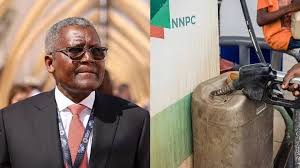
Refiners, Dangote Officials Oppose PMS Importation

Published

on

Domestic crude oil refiners and officials at the Dangote Petroleum Refinery have kicked against the commencement of the importation of Premium Motor Spirit (PMS), popularly called petrol, by major oil marketers in Nigeria.
The oil refiners alleged that some imported fuels were of low quality when compared with the ones produced by the Dangote refinery, a position that was reiterated by officials of the $20billion Lekki-based plant.
The Tide’s source had on Wednesday reportwd that three major oil marketers were expecting vessels of imported petrol this week, barring any unforeseen circumstances.
Dealers said about 141 million litres of PMS are being conveyed to Nigeria by oil vessels following the full deregulation of the downstream oil sector by the Federal Government.
They also noted that the recent hike in the pump prices of petrol produced by the Dangote refinery and released by the Nigerian National Petroleum Company Limited on Monday had allowed room for PMS imports.
Reacting to this on Thursday, officials at the Dangote refinery and the Crude Oil Refiners Association of Nigeria tackled the marketers, stressing that aside from the fact that the situation would increase the demand for United States dollars, the imported fuels were of low quality.
“These people (marketers) are importing dirty fuels that are toxic”, an impeccable source at the Dangote refinery who spoke to one of our correspondents in confidence, declared.
The source added. “They are importing substandard fuels and if allowed they will not stop importing such. We have more than enough, but these guys don’t want it. They want the game to continue, but the game will not continue”.
Another official at the plant stated that Nigerians should be concerned about the importation of substandard petroleum products into the country.
“You have to be concerned about the quality of the products they import. These are toxic fuels when you consider their blending process. All this is just to maximise profit”, the official stated.
Their positions were corroborated by the Publicity Secretary of CORAN, Eche Idoko, who alleged that some of the substandard fuels were blended in Malta or Togo.
He called for backward integration, saying some were afraid that Dangote would become a monopoly.
“The fear marketers are having is that Dangote will become a monopoly, but that has been taken care of by Dangote subscribing to our association. With the Petroleum Industry Act in place and all the agencies in play, there is no way that Dangote can become a monopoly.
“But for people who are used to a particular way, the fear of what the unknown holds keeps them back. I think that’s where a lot of marketers are now. They don’t know what to expect in this new regime and they are trying to struggle.
“So I would assure you this regime will pay them way better than the regime of importing petroleum products, where they sell to us, substandard products blended in Malta or Togo and imported into our country”, Idoko stated.
The domestic refiners’ association spokesperson condemned the continuous importation of fuel by marketers despite the coming on board of the Dangote refinery.
He said the focus at this time should be on how to export refined products instead of bringing substandard fuel into the country.
Idoko, however, recalled that some marketers who tried to import petroleum products could not do so after the removal of subsidies due to the foreign exchange crisis.
“For some people who are doing this import, at the end of the day, you import, and then you go back to CBN to give you ‘Form M’ to be able to access dollars.
“So, by importing, you are still not solving the problem because you still have to rely on dollars within Nigeria or use your naira to buy dollars from anywhere. And it will reduce the value of the naira. So you have not solved the problem.
“What enables the power of the currency is the level of its demand by other corresponding currencies. So, if you have dollars, francs, cefa, and other currencies chasing the naira because you want to buy a refined product of Nigeria, invariably, the value of the naira will appreciate”, he stated.
Responding to concerns about the quality of imported fuels, the Nigerian Midstream and Downstream Petroleum Regulatory Authority declared that all imported PMS would be subjected to at least three major tests by the agency before being allowed for sale across the country.
Its spokesperson, George Ene-Ita, earlier said marketers with approved import licenses were free to import PMS, but stressed that the products must be subjected to three major tests by the agency.
“The products must be subjected to our testing protocols at the ports. The products must conform to stipulated standards before we authorise them to move the fuels to their terminals.
“Also, before the smaller vessels bring it further inland to Nigeria our people will fly to the place to see the product and carry out some tests to ensure the right specification is upheld.
“Tests are also done at the products’ origins. And when the products come in, before they are released to the market, further tests would be conducted to ensure that they meet the specifications”, he said.


Continue Reading

Business

Association Woos Govt, Coys On  Boat Operators  Employments

Published

on

The leadership of Bonny Maritime Boat Association has called on Rivers state Government and oil companies operating in the state to provide sustainable employment to unemployed boat Operators.
The Association also want the government, companies and other relevant employers of labour to provide trainings for boat Operators to enhance their skills
Safety Officer of the Association, Comrade Kingdom Kingsley made this known in  a  telephone interview with  The Tide.
He noted that most of the boat Operators and owners plying Bonny route lacks jobs due to the fleets of boats introduced by Bonny Road Transport that had taken over the passengers to the Island
He noted that passengers are no longer patronizing boats owned by the Association, thereby rendering the operators redundant
“Most of our operators can not afford to feed their families due to no jobs, we don’t want to indulge in crime, government should fix our members with  sustainable jobs to take care of their immediate needs”
He called on oil companies operating in the state to engage their skilled boat Operators in their companies to reduce the sufferings faced by the Association.
The Safety Officer called on the state government  to made funds available to unemployed youths in the state to start up business than roam the streets.
He noted that provision of funds to youths would reduce crime rates and reposition their mindsets for a better life
“The  youths of Rivers state are suffering, have no job to feed their families, thereby indulging in criminality daily”
“The youths need empowerment,  jobs,  recreational facilities and better things of life as citizens of this Nation”, Kingsley said.
CHINEDU WOSU
Continue Reading

Business

FG Approves $1 Bn AFCFTA Credit Facility For Nigerian Exporters

Published

on

The Federal Government has approved a whooping $1bn credit facility to support Nigerian exporters and small scale businesses to take advantage of the African Continental Free Trade Area (AfCFTA) in order to boost production, competitiveness and intra-African trade.
The $1bn AfCFTA Adjustment Fund Credit Facility is also expected to address some of the financing gap being faced by Nigerian exporters and enhance the competitiveness of African businesses within the continental market.
The Minister of Industry, Trade and Investment, Jumoke Oduwole, disclosed this  during the second quarter 2026 meeting of the AfCFTA Central Coordination Committee held in Abuja.
According to a statement issued by the ministry’s Head of Press and Public Relations, Obilor-Duru Okechi, Oduwole said the financing facility represented a major opportunity for Nigerian businesses seeking to expand operations, modernise production processes and increase exports to African markets.
The statement partly read, “?The Federal Government has reaffirmed its commitment to accelerating Nigeria’s export-led growth agenda under the African Continental Free Trade Area, unveiling opportunities for businesses to access a US$1 billion AfCFTA Adjustment Fund Credit Facility aimed at boosting production, competitiveness, and intra-African trade.”
She noted that despite the progress Nigeria had made in implementing the continental trade agreement, many local businesses continued to face obstacles that limited their ability to take advantage of the single African market.
?
“Many businesses still face challenges relating to export documentation, certification, standards compliance and market access,” the minister said.
She explained that the Federal Government was addressing these bottlenecks through enhanced trade facilitation measures, simplified AfCFTA guidance tools, stakeholder engagement programmes and stronger collaboration with institutions such as the Nigeria Customs Service and the Nigerian Export Promotion Council.
Oduwole stressed the need to strengthen Nigeria’s legal and regulatory framework by domesticating key AfCFTA protocols, particularly the Digital Trade Protocol, to position the country as a major player in Africa’s growing digital economy.
The minister also highlighted some of the gains recorded in Nigeria’s AfCFTA implementation efforts.
According to her, the expansion of Nigeria’s Air Cargo Corridor Initiative to Rwanda, increased collaboration with development partners and private sector players, as well as sustained engagement with state governments, were helping to deepen awareness and participation in the continental market.
In her welcome address and first-quarter update, the National Coordinator and Chief Executive Officer of the Nigeria AfCFTA Coordination Office, Mrs Patience Okala, provided details of the financing initiative.
Okala said the $1bn AfCFTA Adjustment Fund Credit Facility was targeted at large African businesses with a minimum financing capacity of $10m.
She revealed that the National AfCFTA Coordination Office was working closely with fund managers to facilitate access for eligible Nigerian companies and had begun assembling a pilot group of businesses to ensure that Nigeria maximised the opportunities provided by the facility.
Nkpemenyie Mcdominic, Lagos
Continue Reading

Business

NIWA Harps On  Avoidance Of Leaking Boats

Published

on

The National Inland Waterways Authority (NIWA) has advised Nigerians against boarding boats that require constant bailing of water in the interest of their safety.
 NIWA Area Manager for Cross River and Ebonyi, Mr Stanley Onuoha gave this warning in an interview with Newsmen in Calabar.
Onuoha who spoke on waterway
safety, said that passengers should take responsibility for their safety by inspecting boats before embarking on any journey.
According to him, repeated scooping of water from a boat is a clear indication that the vessel may be leaking.
“If you are entering a boat and see people using a bailer to remove water, it is the first signal that the boat is leaking,” he said.
He urged passengers to check the integrity of boats, including seating arrangements and other visible safety features.
The Manager restated the importance of using safety jackets, saying that damaged jackets may fail during emergencies.
He further said that passengers should ensure that safety jackets were appropriate for their body sizes in order to guarantee effective flotation.
 Onuoha reiterated the need for passengers to fill manifests before departure to aid accountability during emergencies.
The NIWA official further advised travellers to monitor weather conditions and avoid boarding boats when the weather is unfavourable.
According to him, poor weather conditions can trigger strong tidal waves capable of affecting small boats commonly used on inland waterways.
He said that waterway journeys should be embarked upon between 6.00a.m and 6.00p.m for clearer visibility.
Onuoha said  the Authority had continued to sensitise riverine communities to the need for safety precautions during waterway journeys.
He stated that sustained awareness campaigns and enforcement measures had contributed to safety waterway safety in Cross River.
CHINEDU WOSU
Continue Reading

Trending