
Maritime
FG Launches National Single Window Steering Committee

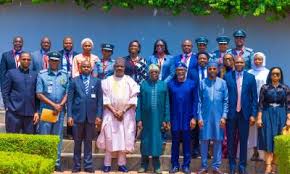
President Bola Ahmed Tinubu has said the decision of his administration to embark on a National Single Window (NSW) platform is to boost the country’s Ease of Doing Business Index as rated by the World Bank.
The NSW is an electronic portal that links all agencies and operators within the country’s supply chain to an integrated platform, which is to be domiciled at the Federal Inland Revenue Service (FIRS).
Membership of the steering committee is drawn from the Nigerian Ports Authority (NPA), Nigeria Customs Service (NCS), Federal Airports Authority of Nigeria, (FAAN), Federal Inland Revenue Service, (FIRS), National Agency for Food and Drug Administration and Control, (NAFDAC), Nigerian Maritime Administration and Safety Agency, (NIMASA), Central Bank of Nigeria (CBN), Standards Organisation of Nigeria (SON), and some key private sector operators, which include importers, exporters, shipping lines, freight agents and banks.
Speaking while inaugurating the steering committee for the project at the Presidential Villa, Abuja, the President also said the platform is aimed at eliminating all forms of encumbrances to trade and commerce with a view to optimising revenue generation and ultimately boost the inflow of both local and foreign direct investment into the country.
The President, who decried the bottlenecks that characterise the country’s import, export and other supply chain activities, noted that the project is another milestone by his administration, saying the project would boost investment inflow by removing all forms of trade barriers in the import and export value chain.
“Nigeria’s import and export processes are bureaucratic, which lead to delays at the seaports. Such inefficiencies have adverse impacts on local businesses in the country and serve as potential impediment for foreign direct investments.
“To eliminate these challenges, today, we are launching the National Single Window project.
“The National Single Window Project is intended to enhance revenue generation through imports and exports and accelerate economic activities in the country.
“This project is a bold initiative to simplify and streamline our import and export clearance processes by eliminating bottlenecks, and harnessing best-in-class technology. This will result in reduced costs of doing business and position us to attract more foreign investment.
“The National Single Window Project will consist of four key pillars, namely: Single Window for Imports, Single Window for Exports, Port Community System and Scanning Services across our sea, air and land borders.
“The Project is not merely a technological advancement, but a strategic initiative to increase revenue generation by consolidating import and export related procedures into a unified electronic platform.
“The platform will serve as a single portal for the submission and approval of all import and export related documents, as well as a centralised payment system. It will be integrated with the various systems in the Ministries, Departments and Agencies (MDAs) involved in the import and export processes.
“The National Single Window project is a top priority for this Administration. As a result, I am directing all relevant Ministries, Departments and Agencies working on similar systems or information technology implementation projects to stop doing so in silos but align and consolidate such projects under the National Single Window Project’s scope.
“Today, I am also inaugurating the National Single Window project steering committee. The primary objectives of the Steering Committee are to provide support, oversight, strategic direction, and guidance to ensure the effective implementation of the project.
“You are entrusted with the responsibility of aligning this project with this government’s revenue enhancement objectives, setting the stage for a more efficient and responsive economy.
“I expect nothing short of excellence from this committee. You are the driving force behind the success of this crucial project, and your commitment and dedication will determine its outcome.
“Our collective effort will shape this project and play a key role in shaping the future of trade and commerce in Nigeria. I urge you to approach this task with a sense of purpose, unity, and a shared commitment for the betterment of our nation”, the President said.
Meanwhile, Chairman of FIRS, Zacch Adedeji, who also spoke at the event, thanked President Tinubu for the project and approving FIRS and the Nigeria Sovereign Investment Authority (NSIA) as the project’s implementing agencies and financial managers.
Adedeji said the project aligns with the President’s commitment to stimulating Nigeria’s economy through enhanced trade facilitation and a bold step towards realising the country’s immense economic potential.
“As we strive towards achieving sustainable economic growth, we must embrace high-impact projects such as the National Single Window. By simplifying the government trade compliance process through a cutting-edge digital platform, we will unlock a myriad of economic benefits.
“This initiative will serve as a catalyst for achieving an average Gross Domestic Project (GDP) growth rate of seven per cent annually, propelling Nigeria to new heights of prosperity. The National Single Window is not just a technological advancement; it is the gateway to a more connected, efficient, and transparent system.
“By integrating our seaports, government agencies, and key stakeholders, we will create a seamless ecosystem that facilitates trade, saves time for businesses, and opens up a world of opportunities.
“From providing access to education and healthcare to enabling small businesses to reach global markets, digital connectivity is the key to unlocking Nigeria’s true potential.
“The heavy costs, delays, and inefficiencies at our ports has been a constant burden. It is estimated that a staggering $4 billion annually is lost due to these inefficiencies.
“By addressing revenue leakage prevention and facilitating effective trade, we will reclaim these lost resources and channel them towards the betterment of our society.
“Steering Committee, National Single Window 2 Paperless trade alone is projected to bring an annual economic benefit of around $2.7 billion; a testament to the transformative power of this initiative.
“The success stories of countries that have embraced Single Window systems are evident. Singapore, Korea, Kenya and Saudi Arabia have all witnessed significant improvements in trade efficiency after implementing similar initiatives. It is now Nigeria’s turn to join the ranks of these progressive nations and reap the rewards of a streamlined, digitised trade environment.
“The National Single Window is not just about facilitating trade, it is also a powerful tool for expanding our tax base and capturing the informal e-Commerce sector. By providing a unified, modern digital platform for expeditious paperless cargo clearance and logistics, we will bring more businesses into the formal economy, ensuring that everyone contributes their fair share to our nation’s development.
“Moreover, by linking the Nigerian National Single Window with other African nations, we will expedite cargo movement and optimise intra-Africa trade.
“This will position Nigeria as a leader in regional trade facilitation, fostering stronger economic ties with our neighbors and creating new opportunities for growth and collaboration.
“The current international trade environment is complex, involving disparate systems and requiring an average of 40 documents per transaction. Nigeria’s lack of a comprehensive trade facilitation system has led to bottlenecks, corruption, port delays, decreased revenue, and a negative business environment. The National Single Window is a decisive response to these challenges.
“By improving trade facilitation, revenue generation, economic growth, transparency, security, and streamlined processes, we will transform Nigeria into a global trade powerhouse”, the FIRS boss explained.





-

 News2 days ago
RSG Targets Nine Million Residents in Mosquito Net Distribution Campaign
-

 Oil & Energy2 days ago
Aiyedatiwa Signs New Electricity Bill
-

 Maritime2 days ago
Marine Minister Commends President Tinubu On NPERA Bill Assent
-

 Oil & Energy2 days ago
NLNG Commissions Research And Innovation Centre In RSU
-

 News2 days ago
KenPoly Holds Eight Convocations, August 29
-

 News2 days ago
RSG Begins Another Phase of Projects Commissioning Today
-

 News2 days ago
RMAFC Completes Revenue Sharing Review, Proposes New Pay
-

 Maritime2 days ago
NAGAFF Petitions IGP Over Alleged Maritime Police Harassment