
Politics
Impeachment: Edo CJ Raises Panel To Investigate Allegations Against Dep Gov

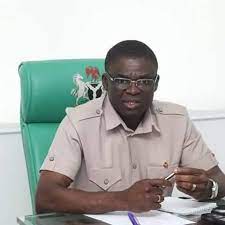
The Chief Judge of Edo State, Justice Daniel Okungbowa, has set up a seven-man committee to investigate alleged constitutional infractions leveled against the Deputy Governor of the state, Philip Shaibu.
Registrar of the Edo State Judiciary, Benson Osagie Osawaru, in a statement dated March 22, 2024, with reference number CR/4837/Vol. II/131, said the panel of seven is chaired by Justice S.A. Omonua (rtd).
It added that other members are Professor Violet Aigbokhaevbo, Professor Boniface Onomion Edegbai, Professor Theresa Akpoghome, Mr Oghogho Ayodele Oviasu, Dr Andrew Oliha and Mr Idris Abdulkareen.
The statement read: “This is to bring to the notice of the general public that in line with Section 188(5) of the 1999 Constitution of the Federal Republic of Nigeria (as amended), the Chief Judge of Edo State, Justice D.I. Okungbowa, has constituted the panel of seven persons to investigate the allegations contained in the impeachment notice against the deputy governor of Edo State, Philip Shaibu.”
Edo State House of Assembly had, on March 19, 2024, through a resolution passed by 19 out of the 24 members, directed the CJ to constitute a seven-man panel to investigate Mr Shaibu.
Mr Shaibu, however, approached an Abuja Federal High Court the same day asking the court, through an ex-parte motion, to restrain the assembly, the CJ and his principal, Governor Godwin Obaseki, from taking further action on the impeachment process pending the determination of the substantive matter before the court.
In the motion dated and filed on March 18, the deputy governor, through his lawyer, Professor Oladoyin Awoyale, also joined the Edo State Government, the Speaker of the House of Assembly, Clerk of the Assembly, the Director General of the Department of State Security, DSS, and the Inspector General of Police
Though the court, presided over by Justice James Omotoso, did not grant Shaibu’s request, it directed all parties to be put on notice.
While adjourning the matter to April 15, 2024, the court granted the request that the parties be served by substituted means.



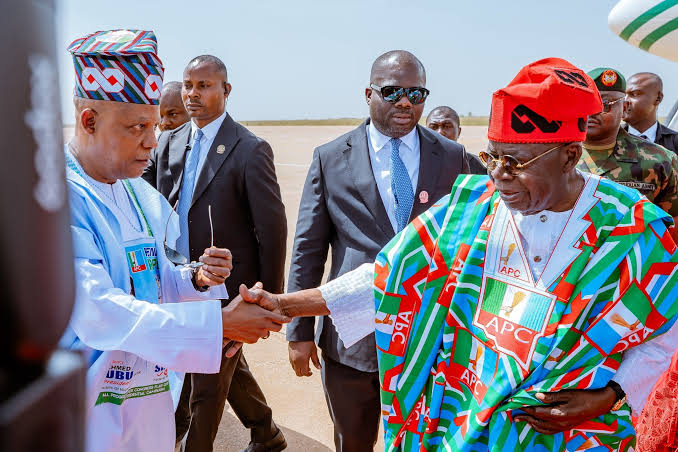
The campaign rally, held at the Kaduna Township Stadium, attracted Vice-President Kashim Shettima, APC governors, party leaders, federal and state lawmakers, political stakeholders and supporters from across the country.
The flag-off marks the beginning of the APC’s drive to secure a second presidential term for President Tinubu, with the party expected to promote its achievements, defend its economic reforms and outline its policy priorities under the proposed Renewed Hope 2.0 agenda.
Kaduna’s selection for the campaign launch underscores the strategic importance of the North-West, a region with a substantial voting population and considerable influence on presidential election outcomes.
The APC faces a significant challenge in Kaduna, where the Peoples Democratic Party’s presidential candidate, Alhaji Atiku Abubakar, defeated President Tinubu in the 2023 election. The rally therefore provides the ruling party an opportunity to strengthen its grassroots structures and regain electoral support in the state.
Addressing supporters, Vice-President Shettima appealed to Northern voters, highlighting President Tinubu’s political relationships with prominent Northern leaders, including Alhaji Abubakar, Mallam Nuhu Ribadu and the late President Muhammadu Buhari.
The Vice-President’s appeal reflects the APC’s determination to consolidate its support in the North as the party intensifies preparations for the presidential contest.
The Renewed Hope 2.0 agenda is expected to feature prominently in the campaign, providing a platform for President Tinubu to explain his administration’s economic policies and outline plans for another term.
However, the President’s record on economic reforms, rising living costs, petrol prices, employment, infrastructure and insecurity is expected to attract considerable scrutiny during the electioneering period.
-

 Education23 hours ago
FCE Yola Graduates 3,555 Teachers , Seeks Upgrade to University
-

 Niger Delta1 day ago
Diri Restates Stance On Lagos-Calabar Coastal Highway
-

 Sports22 hours ago
Nigerian Trio Target Titles At PFL Africa Finals
-

 Niger Delta1 day ago
C’River, NUJ Pay Tribute To Late Guardian Editor
-

 News1 day ago
NDLEA Recovers Tons Of Illicit Drug Consignments In Nine States
-

 Opinion1 day ago
Checking Voter Apathy In Nigeria’s Electoral Process
-

 Politics23 hours ago
2027: DICKSON’S EX-ALLY VOWS TO WORK AGAINST NDC INTEREST IN BAYELSA
-

 Politics23 hours ago
2027: GROUP PLEDGES 40,000 SUPPORTERS FOR COALITION CANDIDATES IN RIVERS