
Oil & Energy
Why Big Oil Isn’t To Blame For Rising Gas Prices

Good energy policy starts with a good understanding of energy issues. But both major political parties have glaring blind spots when it comes to understanding the energy sector.
Let me preface this column by noting that I am a registered Independent. I have major disagreements with both political parties, and I strive to approach issues from a completely objective viewpoint.
I think Republicans get it mostly wrong when it comes to climate change, and the importance of transitioning to alternative energy. But they seem to understand the current critical role of fossil fuels in the economy, and they mostly get it right when it comes to supporting nuclear power.
Democrats never seem to understand how the oil industry works. For example, look at the list of Democrats who signed onto the “Big Oil Windfall Profits Tax” introduced last year by Senator Sheldon Whitehouse (D-RI). In announcing the bill, Senator Whitehouse said it would “curb profiteering by oil companies and provide Americans relief at the gas pump”.
The bill was cosponsored by Senators Jeff Merkley (D-OR), Elizabeth Warren (D-MA), Bernie Sanders (I-VT), Richard Blumenthal (D-CT), Tammy Baldwin (D-WI), Sherrod Brown (D-OH), Jack Reed (D-RI), Ed Markey (D-MA), Cory Booker (D-NJ), Michael Bennet (D-CO), and Bob Casey (D-PA). Congressman Ro Khanna (D-CA-17) introduced the legislation in the U.S. House of Representatives.
In addition to claims of price gouging, this same cast of characters had sometimes blamed oil company profits for inflation. Here’s Senator Bernie Sanders doing that.
These politicians do not seem to understand that oil companies don’t control prices. Oil is the world’s most valuable commodity. Oil prices are set by buyers and sellers in global markets, based on supply and demand expectations.
Firms like ExxonMobil produce such a small share of the world’s oil they couldn’t move prices much if they wanted to. They benefit from high prices, but don’t set those prices. If they did, prices would never fall.
Saying profits cause inflation confuses cause and effect. It’s like saying hospitalizations cause car crashes. It is true that a car crash can result in hospitalization, but hospitalizations do not cause car crashes. If you believe the latter, and you try to address the problem by focusing on the hospital, you are working on the wrong problem.
Likewise, high profits in the oil industry and inflation are both caused by high oil prices. But high oil prices are caused by supply and demand factors.
Outside of rare circumstances, it’s impossible for oil companies to gouge you, because they don’t set the price.
An example of true price gouging would be if a local gas station that sets its own prices doubled them when supply is ample. But Chevron earning more from high global prices set by markets is normal capitalism. That’s how the entire global commodity markets work.
I can only imagine that in the minds of some politicians, executives of Big Oil are meeting in smoke-filled boardrooms, rubbing their greedy hands together, and deciding to raise prices because Russia invaded Ukraine. But that’s not how any of this works.
If politicians want to address oil prices, they need to address the supply side and the demand side. When politicians propose windfall profits taxes on oil companies, intending to give rebates to consumers, it might sound good, but it doesn’t address the core issue.
High prices should signal consumers to use less energy, but rebates would diminish the price signal, which wouldn’t alleviate pressure on demand.
On the supply side, punitive taxes on oil companies might sound appealing, but that’s less money that can be allocated to projects, which affects future supplies.
Former Venezuelan President, Hugo Chávez, learned this lesson the hard way, and Venezuela is still paying the price.
Some have expressed outrage that oil companies are using record profits to buy back shares or pay special dividends to shareholders. But it’s common for companies, not just in the oil industry, to buy back shares or pay dividends when profits are high. It’s a part of how our capitalist system works. If companies can issue shares, they should be able to buy them back.
For consumers worried about high oil prices, there are options. You can invest in an oil company. Thus, when oil prices rise, so do your shares. Or consider switching to an electric vehicle to reduce your reliance on fossil fuels.
In conclusion, understanding energy issues is crucial for effective policymaking, yet both major political parties often exhibit significant misunderstandings of the energy sector.
By understanding the complexities of the energy sector, policymakers and consumers alike can make informed decisions that contribute to a more sustainable and economically sound future.
By: Robert Rapier
Rapier writes for oilprice.com.



By Felicity Bradstock for Oilprice.com 16
The State Commissioner for Works (Rural Roads) and Public Information, Charles Aniagwu, disclosed this at a press conference in Asaba, weekend, noting that the initiative was part of wider reforms aimed at opening up the power sector to private investors.
Aniagwu, who was accompanied by the Executive Assistant to the Governor on New Media, Felix Ofou, said the state was exploring alternative sources of electricity to support businesses, households and communities while reducing pressure on the national grid.
He said the government was particularly interested in exploiting Delta’s abundant natural gas resources for power generation, pointing to the Kwale Free Trade Zone, which is part of the state’s special economic zone, as a major opportunity for investors.
According to him, prospective investors were taken to the zone during the state’s recent economic summit to enable them to assess the availability of gas as a key raw material for electricity generation. ComparePower Rates
The commissioner explained that generating more electricity locally would not only increase supply in Delta but also free up power on the national grid for use by other consumers.
Aniagwu cited the 8.5MW Independent Power Plant located behind the state secretariat in Asaba as an example of what could be achieved through alternative power sources.
He said the facility had enabled the secretariat complex to operate independently of the national grid, thereby making the electricity that would otherwise have been consumed there available to other users.
He added that the planned 120MW partnership with Supply Power would further strengthen the state’s electricity supply capacity and provide a more reliable power base for small and medium-sized enterprises.
Aniagwu said the state government was also intervening in areas traditionally regarded as the responsibility of electricity distribution companies because inadequate power supply could no longer be allowed to constrain economic development. LearnQuantum Physics
He identified the extension of the electricity grid from Abraka towards the Ndokwa axis as one of the interventions being undertaken to connect more communities to electricity.
The commissioner, however, raised concerns over the burden placed on communities that are often required to provide transformers and other electricity infrastructure, only for distribution companies to take over the facilities and subsequently collect electricity bills without adequately accounting for the investments made by the communities.
He said the state would continue to support efforts aimed at energising communities, noting that improved electricity supply would stimulate businesses, create jobs and help tackle social problems associated with unemployment and idleness.
On regulation, Aniagwu said the government was working with the Ministry of Energy and a committee set up to develop an appropriate regulatory framework for the state’s emerging power sector. SwitchEnergy Plans
He said the proposed energy commission would be responsible for regulating new electricity producers, determining appropriate tariffs and overseeing distribution networks.
The commissioner stressed that liberalising the sector required effective regulation to protect consumers and investors, adding that decisions on power distribution infrastructure, including the use of overhead or underground lines, must take into account the peculiarities and safety requirements of each location.
He warned that power expansion without adequate regulation could expose residents to electrocution and other hazards, stressing the need to protect electricity infrastructure while ensuring consumers were not subjected to unfair pricing.
Aniagwu said the state government’s broader objective was to build an efficient and sustainable electricity market driven by private investment and capable of powering businesses, households and communities across Delta State.
-
Opinion3 days ago
Ancestorial Worship: My Take (1)
-

 News3 days ago
FG Must Address Nigerians’ Concerns On Reforms -Shettima …Warns Against Misuse of AI, Social Media
-

 Featured3 days ago
Tinubu Jets To S’Arabia For Lesser Hajj …Unveils Free Healthcare For Pensioners
-
Niger Delta3 days ago
Police Rescue Woman, 24, From Online Dating Kidnappers … Arrest Five Suspects
-
News3 days ago
FG Approves King Amachree Airport In Rivers, Sets Conditions For Construction
-
 Featured3 days ago
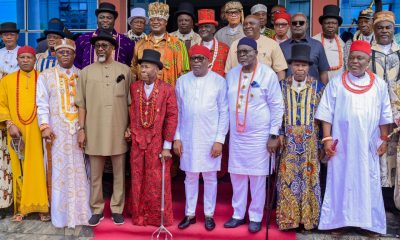
2027: Be Politically Neutral, Fubara Tasks Traditional Rulers
-
News3 days ago
Lawmaker Sets Sights On Assembly Return …As Mammoth Crowd Grace Flag Handover Rally
-
News3 days ago
RSG, Peter Odili Cardiovascular Hospital Move To Promote Early Breast Cancer Detection