
Politics
EU Recommits To Strengthening Nigeria’s Democratic Governance

The European Union (EU) has restated its commitment towards engendering and strengthening Nigeria’s democratic governance.
The EU stated this at the end of a two-day retreat for Support to Democratic Governance in Nigeria, EU-SDGN, partners in Lagos, pledging to further deepen its engagement with youngsters, women, and persons with disabilities, through its partners.
Remarking further, the EU noted that while there were some positives and good achievements in the just concluded general elections, there were also some issues that needed to be addressed henceforth.
The six EU-SDGN component areas include Support to INEC; Support to the National Assembly and the Judiciary; Support to Political Parties; Support to Media; Support to Women, Youth and Persons with Disabilities and Support to Civil Society Organisations.
In his remarks, the European Union’s Programme Manager for Democracy and Rule of Law, Laolu Olawumi, elucidated that the retreat considered the interventions of the partners in the last 12 months with a view to understanding what worked and what didn’t work, identified the challenges encountered, and charted better ways to address them.
Olawumi, while underlining the importance of introspection on the just concluded elections, also urged the EU-SDGN partners not to lose sight of states such as Kogi, Bayelsa and Imo who will be having elections in just over 100 days.
She stated that “Over the last 12 months, we have had an intense work plan where different members of the EU-SDGN cohort have been delivering several activities and technical support to critical stakeholders that we have jointly identified.
“The retreat, therefore, sought to see whether the interventions that we have planned for the next couple of months would help us address the challenges that we have seen in the period leading to the elections, and the immediate aftermath of the election.”
Elucidating further she pointed out that the retreat developed an opportunity for all the partners to discuss their intervention areas, the precise actions they undertook during the elections and what the cohort considers the critical issues that needed to be addressed moving forward.
“In terms of what we are doing around capacity building, one thing to really highlight is the fact that the EU-SDGN programme is Nigerian-led and is mainly implemented by civil society organizations. And that in itself, is our way of contributing and building the civil society space in Nigeria.
“How do we provide a platform with which civil society can better engage with the government and build capacity to ensure that they are focusing on the issues, and they are operating within an environment that helps them properly harness the voices of ordinary Nigerians, and better serve the needs and the will of Nigerian people?
“Within the government, we are working with the electoral management body, trying to provide technical assistance. We are also working with the judiciary through our training and our engagements with Judges, as well as other officers of the court.
“We are also working with the media to promote a conducive legal environment for media to operate and for the Broadcasting Commission to also efficiently promote pluralism in the media and civic space.
“Of course, I think it’s very important to stress here that we have Kogi, Bayelsa and Imo state elections in just over 100 days from now. And so, the priority is to build trust with the Nigerian public by ensuring that those elections are conducted in a way and manner that further instils confidence in the electoral process in Nigeria,” she added.



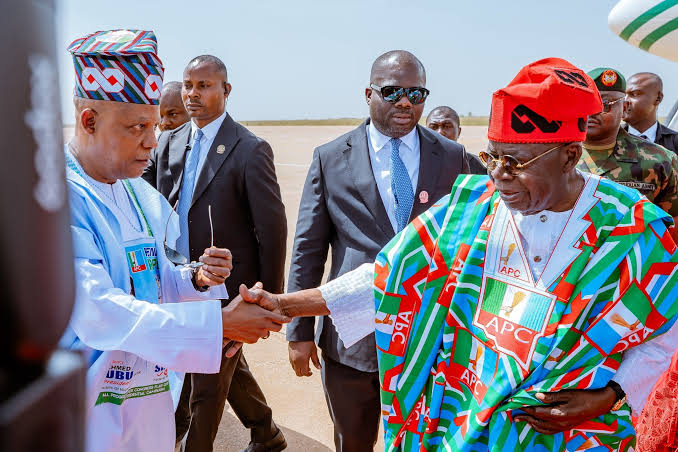
The campaign rally, held at the Kaduna Township Stadium, attracted Vice-President Kashim Shettima, APC governors, party leaders, federal and state lawmakers, political stakeholders and supporters from across the country.
The flag-off marks the beginning of the APC’s drive to secure a second presidential term for President Tinubu, with the party expected to promote its achievements, defend its economic reforms and outline its policy priorities under the proposed Renewed Hope 2.0 agenda.
Kaduna’s selection for the campaign launch underscores the strategic importance of the North-West, a region with a substantial voting population and considerable influence on presidential election outcomes.
The APC faces a significant challenge in Kaduna, where the Peoples Democratic Party’s presidential candidate, Alhaji Atiku Abubakar, defeated President Tinubu in the 2023 election. The rally therefore provides the ruling party an opportunity to strengthen its grassroots structures and regain electoral support in the state.
Addressing supporters, Vice-President Shettima appealed to Northern voters, highlighting President Tinubu’s political relationships with prominent Northern leaders, including Alhaji Abubakar, Mallam Nuhu Ribadu and the late President Muhammadu Buhari.
The Vice-President’s appeal reflects the APC’s determination to consolidate its support in the North as the party intensifies preparations for the presidential contest.
The Renewed Hope 2.0 agenda is expected to feature prominently in the campaign, providing a platform for President Tinubu to explain his administration’s economic policies and outline plans for another term.
However, the President’s record on economic reforms, rising living costs, petrol prices, employment, infrastructure and insecurity is expected to attract considerable scrutiny during the electioneering period.
-

 Education1 day ago
FCE Yola Graduates 3,555 Teachers , Seeks Upgrade to University
-

 Sports1 day ago
Nigerian Trio Target Titles At PFL Africa Finals
-

 Niger Delta1 day ago
Diri Restates Stance On Lagos-Calabar Coastal Highway
-

 Niger Delta1 day ago
C’River, NUJ Pay Tribute To Late Guardian Editor
-

 News1 day ago
NDLEA Recovers Tons Of Illicit Drug Consignments In Nine States
-

 Opinion1 day ago
Checking Voter Apathy In Nigeria’s Electoral Process
-

 Politics1 day ago
2027: DICKSON’S EX-ALLY VOWS TO WORK AGAINST NDC INTEREST IN BAYELSA
-

 Politics1 day ago
2027: GROUP PLEDGES 40,000 SUPPORTERS FOR COALITION CANDIDATES IN RIVERS