
Politics
INEC Says Tinubu Doesn’t Need 25% Of FCT Votes To Win Presidential Election

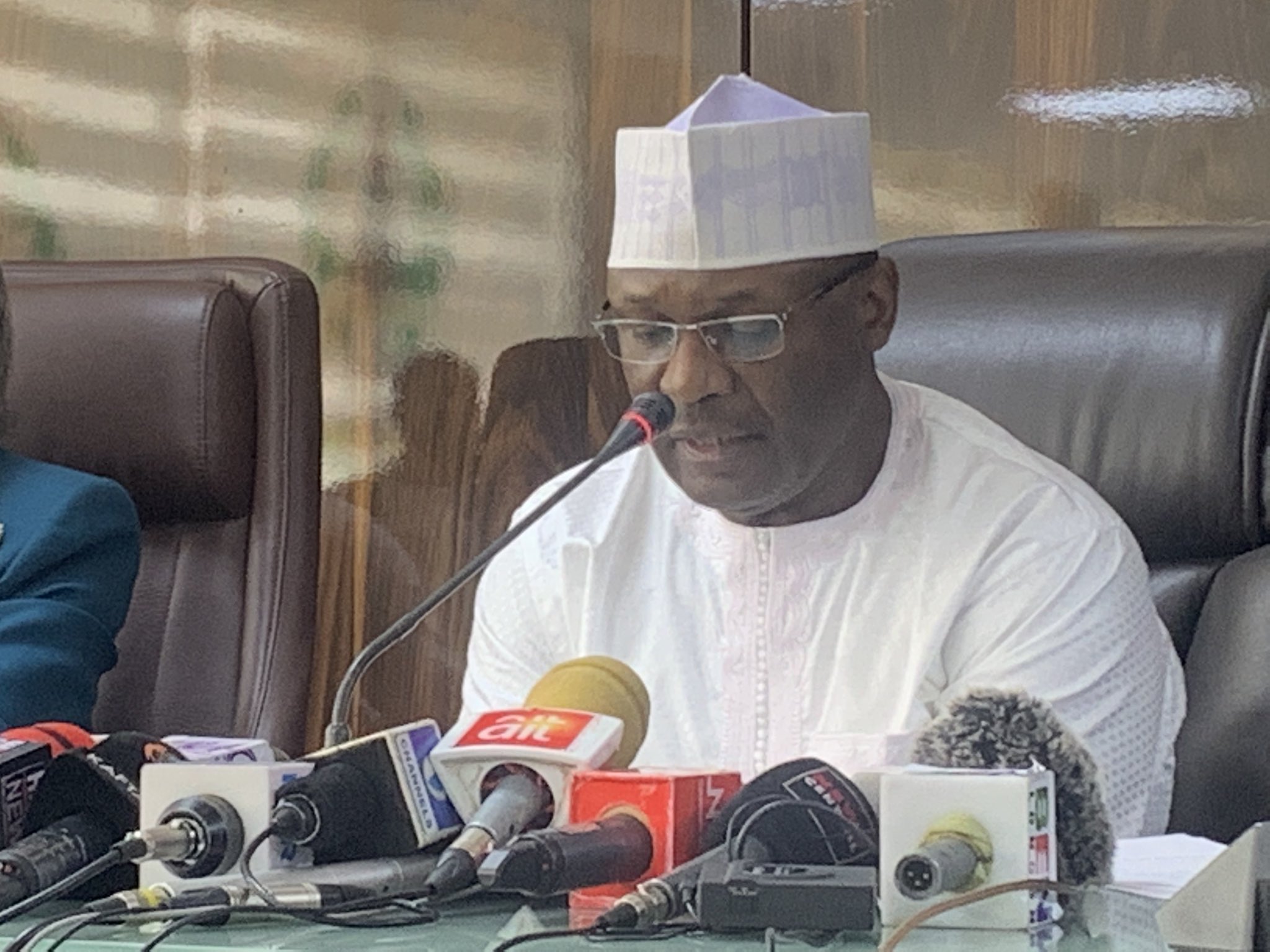
The Independent National Electoral Commission (INEC) has told the presidential election petitions tribunal that President-elect Bola Tinubu of the All Progressives Congress (APC) won the February 25 election and was validly returned as the winner without needing to get 25 per cent of the votes cast in the Federal Capital Territory (FCT).
INEC stated this in its reply by its lawyer, Abubakar Mahmoud, to the petition filed by the Peoples Democratic Party (PDP) and its presidential candidate, Atiku Abubakar, before the tribunal.
Nigeria’s electoral umpire said the APC candidate met all the legal requirements to be so announced as the winner of the election, arguing that a candidate must not secure 25 per cent votes in the FCT to be declared winner because the FCT was not accorded any special status in the constitution as being “erroneously” portrayed by some political parties and candidates who lost the election.
On why it returned Tinubu as the winner, INEC said the APC candidate scored 25 per cent of the valid votes cast in 29 states of the federation.
“Having scored at least one-quarter of the valid votes cast in 29 states, which is over and above the 2/3 states threshold required by the constitution, in addition to scoring the majority of the lawful votes cast at the election, the second respondent was properly declared winner and returned as the president-elect of the Federal Republic of Nigeria,” INEC explained, adding that Mr Tinubu, having scored 25 per cent of the valid votes cast in the 29 states, “has satisfied the requirement of the constitution to be declared winner of the presidential election, thus rendering the requirement of having 25 per cent of the valid votes cast in the Federal Capital Territory unnecessary.”
It also argued that the declaration and return of Mr Tinubu were not wrongful and were made in accordance with the provisions of section 134 (2) (b) of the Constitution, having scored one-quarter (25 per cent) of the valid votes cast in 29 states which is beyond the constitutional threshold for such declaration.
“The first respondent denies that scoring 25 per cent of the votes cast in the Federal Capital Territory is a condition precedent to the declaration and return of a candidate in the presidential election,” it said.
INEC added that by the margin of lead, it did not act hastily, as claimed by Mr Abubakar and the PDP in declaring Mr Tinubu, the winner of the election.
It stressed that Mr Tinubu scored 25 per cent of the valid votes cast in 29 states of the federation (Ekiti, Kwara, Osun, Ondo, Ogun, Oyo, Yobe, Lagos, Gombe, Adamawa, Katsina, Jigawa, Nasarawa, Niger, Benue, Akwa Ibom, Edo, Kogi, Bauchi, Plateau, Bayelsa, Kaduna, Kebbi, Kano, Zamfara, Sokoto, Taraba, Borno and Rivers).
While faulting Mr Abubakar and his party’s claim on the status of the FCT, INEC argued that “the provisions of the constitution apply to the FCT as if it were one of the states of the federation.”
The commission also argued that the use of the word “and” in section 134 (2) of the Constitution indicates nothing more than that in construing two-thirds of the states of the federation in which a candidate is required to score one-quarter of the votes cast in the Federal Capital Territory.”
It argued that by the constitution’s provision, the FCT “has the status of a state and ought to be recognised as if it was a state of the federation.”
It added that the FCT, beyond being the country’s capital, “has no special constitutional status over and above the other 36 states of the federation to require a candidate in the presidential election to obtain at least 25 per cent of the votes cast in the FCT before being declared winner of the presidential election.”
INEC pointed out that the Federal Capital Territory “is regarded as the 37 states of the federation, and as such, a candidate needs to score 25 per cent of the valid votes cast in at least two-thirds of 37 states ( to be declared as winner in the presidential election).”
The electoral body further stated that, as against the request by Mr Abubakar and PDP, he could not be declared the winner by the tribunal because he failed to fulfil the constitutional requirement, stressing that the former vice-president “failed to score, at least, one-quarter of the votes cast in at least two-thirds of the 36 states of the federation and the Federal Capital Territory and as such could not have been declared the winner of the Presidential Election held on the 25th day of February 2023.”
As against the claim by PDP and its presidential flag bearer, INEC stated that “the election was conducted in substantial compliance with the Electoral Act, 2022 and was not marred by any corrupt practices” and that Mr Tinubu “was duly elected by a majority of lawful votes cast in the election and his declaration and return as the winner of the presidential election” conducted on February 25, 2023 “is lawful, valid and in line with the Constitution of the Federal Republic of Nigeria and the Electoral Act, 2022.”
“Having satisfied the requirements of Section 134 (2) (b) of the Constitution of the Federal Republic of Nigeria, 1999, the return of the second respondent as the winner of the presidential election conducted on 25th February 2023 is lawful, valid and constitutional,” said INEC, Mr Tinubu “was at the time of the election qualified to contest the election.”
INEC told the tribunal that PDP and Mr Abubakar “neither scored the majority of the lawful votes cast at the election nor scored not less than one-quarter of the lawful votes cast in at least two-thirds of the 36 states of the Federation and the Federal Capital Territory and therefore the 1st petitioner (Atiku) is not entitled to be returned as the winner of the presidential election conducted on February 25.”
INEC, therefore, urged the court to dismiss the petition.
Mr Abubakar, the first petitioner, and PDP, the second petitioner, in the petition marked CA/PEPC/05/2023, had listed INEC, Mr Tinubu and APC as first to third respondents, respectively. They are seeking the nullification of the election victory of Tinubu in the February 25 presidential poll.
Mr Tinubu, who defeated 17 other candidates who took part in the election, scored 8,794,726 votes, the highest of all the candidates. Mr Abubakar came second with 6,984,520 votes in the poll; Obi came third with 6,101,533 votes.
PDP and Mr Abubakar are asking the tribunal to set aside Mr Tinubu’s victory and to declare the former vice-president winner of the election. They want an order mandating INEC to retrieve the certificate of return issued to the APC candidate or, in the alternative, conduct a fresh election.
Mr Abubakar and PDP are contending that Tinubu was not duly elected by the majority of the lawful votes cast during the poll and that INEC violated its own regulations and provisions of the Electoral Act, 2022 in the election conduct.



Minister of the Federal Capital Territory (FCT), Chief Nyesom Wike, has asked President Bola Tinubu to hand him two more states, Imo and Kwara, to mobilise for the President’s re-election in 2027, declaring that his work in Rivers State and the FCT was done.
He made the request on Wednesday at a Rainbow Coalition Town Hall meeting in Gokana Local Government Area of Rivers State.
“I was assigned to coordinate Rivers and the FCT. Frankly speaking, I am done with these states. All adequate political machineries have been set in motion to deliver Rivers State and the FCT for the President. So, I have no much work to do again,” Chief Wike said.
He addressed his plea to President Tinubu and to the Director General of the All Progressives Congress (APC) Presidential Campaign Council, Senator Abdul’aziz Yari.
“As I am going now, I will plead with the DG and Mr President to give two more states for me to deliver,” he said.
Chief Wike said his interest in Imo State stemmed from what he had heard about the state’s political situation.
“From what I am told, they are having some problems in Imo State. So, I will love to go there and deliver the State for Mr President,” he stated.
On Kwara State, he conceded that he had not verified the reports of division he was relying on.
“Secondly, I have not confirmed, but what I read on social media is that there are some divisions in Kwara. So I plead with the DG of the APC Presidential Council, Senator Yari, and Mr President to allow me take over Imo and Kwara States, because I am done with Rivers and FCT,” Chief Wike added.
The former Rivers State governor used the gathering to canvass a second term for the President, whom he described as a courageous leader willing to take difficult decisions in the interest of the country.
He listed the removal of fuel subsidy, increased financial allocations to state and local governments, and the establishment of the Federal University of Environment in Ogoniland among the interventions he said justified continued support for the administration.
Chief Wike urged the people of Gokana to sustain their relationship with President Tinubu, insisting that abandoning an existing political relationship for an uncertain alternative would be unwise.
He also commended stakeholders in the area for setting aside their differences to work together under the Rainbow Coalition, saying political unity was necessary to achieve common objectives.
The Coordinator of the Rainbow Coalition in Gokana and former Secretary to the Rivers State Government, Chief Kenneth Kobani, described the meeting as unprecedented, saying it brought together different segments of the community.
The APC National Vice Chairman for the South-South, Chief Victor Giadom, expressed confidence that the coalition would mobilise up to 90 per cent of the votes in Gokana in the 2027 elections.
Senator Magnus Abe also praised Chief Wike for reconciling previously divided political leaders, saying the people of Gokana were united in their expectations from the coalition.
The town hall meeting was attended by political leaders, traditional rulers, religious leaders, women, youths and other stakeholders from Gokana LGA and neighbouring communities.
The House of Representatives has urged President Bola Tinubu to closely monitor the security situation in Delta State and declare a state of emergency if necessary to address escalating political violence.
The lawmakers made the call following a motion moved by Hon. Benedict Etanabene, who raised concerns over recurring attacks and growing political tension in the state.
It also urged the Inspector-General of Police, Tunji Disu, to identify political violence flashpoints in the State and establish a special investigative team to track down the perpetrators and financiers of the attacks.
The resolution followed the deadly attack on a campaign convoy of the Nigeria Democratic Congress (NDC) in Uduere community, Ughelli North Local Government Area, which reportedly left six people dead and several others injured.
Former Deputy Senate President and NDC Delta Central Senatorial candidate, Ovie Omo-Agege, reportedly escaped unhurt in the attack.
Meanwhile, the Delta State Police Command has invited Senator Omo-Agege, Ughelli North Local Government Chairman, Mr Olorogun Jaro Egbo, and five others for questioning as part of investigations into the incident.
Police spokesperson, Bright Edafe, said the invitees had been directed to appear before the State Criminal Investigation Department (SCID) at the police headquarters in Asaba on specified dates.
Senator Omo-Agege and Mr Egbo were expected to appear yesterday at 11 a.m. and 2 p.m., respectively.
The other invitees are Mr Gowon Egoide, Mr Onoriode Oneya, Mr Edirin Wokode, Mr Ewhubare, Mr Erukaye Egoide and Mr Tony Gabon Mevowovo.
Detained former Governor of Kaduna State, Mallam Nasir El-Rufai on Wednesday, November 25, 2026, made a u-turn in his claim that he and some others tapped the telephone line of the National Security Adviser (NSA), Mallam Nuhu Ribadu, saying that it was a political rhetoric aimed at scaring the government.
Mallam El-Rufai, who stated this at a Federal High Court sitting in Abuja, said the claim was not factual, but a mere political rhetoric meant to make those in government uncomfortable.
Mallam El-Rufai, who claimed he knew that the government placed surveillance on leading opposition figures, past presidents, senior judges, among others, stated that he elected to claim that someone tapped Mallam Ribadu’s telephone line to create the impression that the opposition figures were equally monitoring those in government.
The ex-governor stated these while testifying as the first defence witness in his ongoing prosecution by the Department of State Services (DSS) on allegation that he intercepted the telephone conversations of the National Security Adviser, Mallam Nuhu Ribadu among other offences.
During his testimony, his legal counsel, Paul Erokoro, SAN, who led him in evidence, had part of the recording of the interview he granted Arise TV on February 13, where he made the claim, played in court.
After listening to the portion of the interview, Mr Erokoro asked Mallam El-Rufai to clarify what he actually meant by the statement, following which the former governor admitted claiming that they were listening to the NSA and others’ conversations and that someone tapped Mallam Ribadu’s telephone line and relayed his conversations to them.
Mallam El-Rufai, however, said he did not intend the statements to be taken in their literal sense, claiming that they were intended in “the context of literal flourish and in rhetorical form,” adding that it was political rhetoric that is allowed in political speaking.
In the words of Mallam El-Rufai, “What I wanted to say was that the government was monitoring opposition figures and that we knew what they were doing.
“I used the word ‘tap’ as political rhetoric to make them uncomfortable. It was rhetorical, not literal. It was linguistic flourish, just to make the government uncomfortable,” he said.
When reminded by his legal counsel that his interviewer told him that it was illegal to tap someone’s telephone line, Mallam El-Rufai said his intention was to make it public that the government was secretly listening to opposition figures conversations without lawful court orders.
According to him, “I was referring to the government violating the law and not someone else doing it”.
On who he referred to as “we” in his claim that “we are listening to their conversations…” Mallam El-Rufai said he meant himself and other leading opposition figures.
He specifically said that he and others did not tap Mallam Ribadu’s telephone line, but learnt about his plan to abduct him and have him detained through a mutual friend.
He, however, refused to disclose the identity of the said friends on the grounds that he would not want to jeopardize the interest of his source.
Mallam El-Rufai further said that when he got home after the interview, the said friend came to him and said he actually did not tap the NSA’s telephone line, and that he responded by telling the person that he knew, but only chose to make the claim to make those in government uncomfortable.
Earlier, Mallam El-Rufai told the court presided over by Justice Joyce Abdulmalik that he knew Mallam Ribadu since 2003 when he, as the Director General of the Bureau of Public Enterprises (BPE) assisted him to establish the EFCC by providing office space and funds.
Mallam El-Rufai explained that the break down in their relationship came when Mallam Ribadu ran for the presidency in 2011 and he felt that late Muhammadu Buhari was a better candidate, stressing that the Mallam Ribadu was against him because he is opposed to President Bola Tinubu’s re-election.
He particularly denied being involved in telephone line tapping, stressing that he neither had the knowledge or equipment to intercept telephone calls.
Under cross examination by prosecuting lawyer, Mr Oluwole Aladedoye, SAN, Mallam El-Rufai, who said that he has a degree in Law from the University of London, said he had chosen not to tell the court the names of those he referred to as “we” in his claim that they were listening to the conversations of those in government.
Mallam El-Rufai also declined to give the name of the person, who he claimed, told him that the NSA, Governor Uba Sani of Karuna State and the Chairman of the Independent Corrupt Practices and other related offences Commission (ICPC) held a meeting and agreed to ensure his arrest.
The ex-governor said he knew of the alleged plan to arrest him before he arrived from Cairo on February 12, adding that he resisted the attempt by operatives of the DSS to arrest him at the airport when he arrived from Cairo because they did not produce a valid arrest warrant.
Mallam El-Rufai said his claims, on Arise Television interview, that he has never stolen public funds and that he knew nothing about the disappearance of an activist, Dadiyatta while serving as governor of Kaduna State were factual and true.
According to hm; all other claims he made in the interview were true and factual except the one relating to the tapping of Mallam Ribadu’s telephone line.
Mallam El-Rufai, who said he filed fundamental rights suits over the alleged search of his house with defective warrant, however said that all the cases have been dismissed by the High Court of the Federal Capital Territory (FCT) and the Federal High Court.
While rounding off his cross-examination of the defendant, Mr Aladedoye told the court that Mr Eroko approached him before the commencement of proceedings for his assistance in the defence’s plan to invite Mallam Ribadu and the ICPC Chairman as its witnesses, saying however, that he told the defence lawyer that he could not assist in that regard because it was not within his control.
However, counsel to the defendant, Mr Erokoro, said he would make the necessary applications in that regard, following which Justice Abdulmalik adjourned till February 15 and 16 for Mallam El-Rufai to continue his defence.
-
Business2 days ago
PHICCIMA President Welcomes N60m BOI Micro, SMEs Initiatives
-
Politics2 days ago
Tinubu Hails Atiku For National Dev Efforts
-
Business2 days ago
FG Commences N1.45trn Port Upgrade, Targets 20,000 Jobs
-
Rivers2 days ago
Maritime Security: Expert Advocates Active Marine Surveillance, Coast Guard Agency Establishment …. Wants Presidential Endorsement for his group
-
Politics2 days ago
2027: 108 Rivers Groups Jostle To Work With Chinda’s Campaign
-
Politics2 days ago
Political Killings: Consider Emergency Rule In Delta, Reps Tell Tinubu
-
News2 days ago
IG Suspends Wanted Declaration Against Obaigbena, Eight Others
-
Politics2 days ago
Amupitan Tasks RECs On Flawless Mock Election, ’Morrow