
Rivers
FRSC Boss Tasks Special Marshals On Professionalism

The Acting Corps Marshal, Federal Road Safety Corps (FRSC), Dauda Biu, has urged officers of the Special Marshal to discharge their duties with diligence and professionalism to save lives on the roads.
Biu gave the advice during the 2022 Special Marshals Zonal Conference with the theme ‘Responsibility Of Special Marshals In The Face Of A New Administration In The Commission’, in Port Harcourt.
Represented by the Deputy Corps Marshal, Special Duties and External Relations, Susan Ajenge, Biu described the conference and itss theme as ‘prompt’, and stressed the need for the Marshals’ strict adherence to the fallout of the conference for a hitch free operations on duty.
Biu stated that the zone 6 Special Marshal conference which featured Rivers, Bayelsa, Cross River and Akwa Ibom states, was aimed at sensitizing the Special Marshals on their duties to reduce the rate of crashes and save lives and properties.
According to him, Special Marshals are volunteers supporting the regular Marshals to keep the roads safe, stating that since its inception in 1989, the Marshals have increased in their strength and guaranteeing safer roads for the country.
Biu urged the marshals to always be on their proper regalia while on duty and work with team spirit to end traffic accidents in the country.
While urging the Marshals to support the present administration, Biu advised Marshals who are politicians and vying for positions against using the FRSC platform for the advancement of their political careers.
“The corps is a non-partisan organisation and will continue to be impartial and available to assist the public in the free flow of traffic always. Moreso, as the yuletide season is here, we call on the public to imbibe safe road culture, drive carefully and obey road rules and regulations to arrive at their destinations safely”, he urged.
Earlier, the Acting Commanding Officer, Zone RS6, Jonathan Owoade, explained that the Special Marshals were to, among other things, carry out traffic control and rescue operations as a team squad in the case of emergencies, monitor road users with the view to providing constructive feedback to the commission, as well as participate in research activities relevant to road safety management .
Owoade called on the Marshals to study the guidelines as reviewed by the commission with strict adherence for the avoidance of disciplinary action upon infringement.
On his part, the Zonal Commanding Officer, Special Marshals, Ntefan Omori, expressed the marshals’ positive cooperation with any administration of the commission, and to continue upholding the FRSC’s mandate .
Omori said “we are happy to be part of the road safety family. Our role is to compliment you and work as a team to help achieve all the goals of the commission”.
By: Lady Godknows Ogbulu



A Professor of Industrial Technical Education (Mechanical Technology Option) at Ignatius Ajuru University of Education (IAUE), Rivers State, Professor John Ajike Uduma Uka, has called for the repositioning of Technical Education as a central pillar of national development.
Speaking on Thursday, at the University Auditorium, while delivering the 87th Inaugural Lecture titled, “Surgical Analysis of the Ills of Nigeria’s Technical Education Sector: Towards a Healing Process”, the Inaugural Lecturer noted that revitalizing Nigeria’s Technical Education system is not merely an educational priority but a national imperative.
He stated that a well-functioning Technical Education sector has the potential to bridge the skills gap, reduce unemployment, stimulate industrial growth and enhance the country’s global competitiveness.
Professor Uka emphasized that the healing process for Nigeria’s Technical Education sector requires coordinated reforms by the Federal Government, State Governments, educational institutions, industries, regulatory agencies, development partners and communities.
He explained that the sector stands at a critical crossroads, with its current state reflecting deep-seated structural inefficiencies and long-standing systemic neglect.
Despite its strategic importance in driving industrialization, employment generation and technological advancement, the sector continues to underperform due to a combination of policy inconsistency, inadequate funding, weak industry linkages and persistent negative societal perceptions.
The 87th Inaugural Lecturer said the challenges facing Technical Education in Nigeria are not isolated but deeply interconnected.
“As such, addressing them requires more than superficial interventions; it demands a holistic and sustained reform approach”, he said.
According to him, strengthening institutional capacity, modernizing curricula, enhancing industry collaboration and improving regulatory effectiveness through the National Board for Technical Education (NBTE) are essential steps towards restoring the credibility and functionality of the sector.
He highlighted the importance of shifting societal attitudes and recognising Technical Education as a viable and valuable pathway to economic empowerment, noting that without such reorientation, even the most well-designed policies may fail to achieve their intended impact.
He recommended, among others, increased and sustained funding for technical education, upgrading of technical facilities and learning environments, strengthening industry-institution collaboration, modernization of the TVET curriculum, promotion of competency-based assessment, strengthening of the NBTE, promotion of entrepreneurship and self-reliance, and improvement of students’ perception of technical education.
Uka also recommended strengthening quality assurance and institutional accountability, expansion of digital transformation, enhancement of research, innovation and technology development, addressing regional and gender disparities, and strengthening policy implementation.
He stressed that if these recommendations are implemented with political will, adequate funding, stakeholder collaboration and rigorous monitoring, technical education can become a powerful engine room for industrialization, employment creation, technological innovation, poverty reduction and sustainable national development.
He concluded that a healthy technical education system is indispensable to building the skilled workforce required for Nigeria to compete effectively in the 21st-century global economy.
Declaring the event open, the Acting Vice-Chancellor of IAUE, Professor Okechuku Onuchuku, who was represented by the Dean, Faculty of Vocational and Technical Education and Head, Ndele Campus, Professor Isaac Ogundu, lauded the 87th Inaugural Lecturer, who he described as a seasoned scholar, for exposing the ills of technical education.
He appealed to the Rivers State Government to establish a Ministry of Vocational and Technical Education to give TVET a wider range and reach.
On his part, the Registrar of IAUE, Professor Chinonye Abraham Ajie, expressed appreciation to the 87th Inaugural Lecturer for holding the audience spellbound with his presentation and expressed hope that the essence of the lecture would be internalized by all.
In a vote of thanks, Professor TamunodienyeNkechiMba expressed gratitude to all who found time to grace the occasion.
Obolo Lawyers Forum, an association of legal practitioners of Obolo extraction has frown at the inadequate representation of Obolo indigenes in the Rivers State legal structure.
Newly elected Chairman of the forum, Wilson Oke, who raised the concern shortly after his election in Port Harcourt, said with over 170 lawyers of Obolo extraction practicing in the state, Obolo lawyers are yet to gain sufficient recognition within the State legal structure.
He said out of approximately 50 judges in Rivers State, only one is from the Obolo extraction, while the nation currently has no magistrate in the State.
Oke pledged to work with relevant stakeholders to address the situation by ensuring that Obolo lawyers receive better representation and opportunities within the State’s legal system.
He also identified infrastructural gap as a major developmental challenge facing the Obolo nation, adding that the Obolo Nation remains backward in terms of infrastructural development.
The new chairman assured that he would utilise his three-year tenure to collaborate with politicians and other critical stakeholders to attract development to the area.
“We have discussed and we have agreed there is need for us to work in synergy to ensure that Obolo is developed”, he stated.
Oke, a legal practitioner from Ngo Town, headquarters of Andoni Local Government Area of Rivers state, was elected alongside nine other executive members, and will serve for three years.
The Obolo Lawyers Forum cuts across Rivers, Akwa Ibom, and Abia States.
The new Chairman, who pledged to promote unity, peace, legal representations and infrastructural development across the Obolo Nation, described his election as a call to service rather than a personal achievement, and promised to work with senior lawyers, colleagues and relevant stakeholders to advance the interests of the Obolo Nation.
“I’m quite glad because it is a call for service. I know that there is nothing personal there. The essence of it is a higher call for service to the Obolo Nation”, he said.
On his message to politicians and electorates ahead of the 2027 general elections, Oke emphasised the importance of maintaining peace, describing it as a necessary foundation for meaningful development.
“Peace is priceless”, he declared, urging political stakeholders, aspirants and electorates to shun violence and ensure peaceful conduct throughout the campaign and election periods.
He further called on all stakeholders to contribute towards sustaining the existing peace in Andoni and the wider Obolo Nation, stressing that development cannot be achieved in an atmosphere of violence and instability.
He reaffirmed his commitment to protecting the interests of the people, the Rule of Law, and ensuring that the Obolo Nation receives its fair share in the affairs of Rivers State.
By: John Bibor & Okezie Nnenna
The Eze Oha Apara IV of Apara Kingdom, Eze Chike AmadiWorlu-Wodo, has called on the Federal Government to assign more constitutional responsibilities to traditional rulers to enable them contribute more effectively to governance and grassroots development.
Eze Wodo, who made the call as Chairman of the Rivers State Council of Traditional Rulers (RSCTR), during the combined quarterly general meeting of the council held in Port Harcourt last Wednesday, said traditional rulers remained closer to the people than other arms of government, stressing that their involvement was essential to achieving sustainable development at the grassroots.
“We are closer to the people than any other arm of government. No development can be sustained without us”, he said.
The royal father also appealed to the government to improve the welfare of traditional rulers by providing a better working environment and reviewing their stipends in line with prevailing economic realities.
While commending the State Governor, Siminalayi Fubara, for promoting peace and good governance in Rivers State, Eze Wodo urged the Governor to fulfil his promises to council members, particularly in mobility and logistics.
Declaring the meeting open, Fubara charged traditional rulers across the state to take the lead in promoting peace and unity as political activities ahead of the 2027 general elections gather momentum.
The Governor cautioned royal fathers against allowing political differences to create divisions or threaten the peace in their respective communities.
He stressed that their conduct during the political season would be crucial to maintaining stability across the state.
“As we are entering into this political season, actively ensure that your conduct maintains peace in your place. Your action should not be what will lead to the division and multiple crises that we cannot manage as a government”, he said.
Fubara further urged traditional rulers to uphold justice and fairness in their domains, noting that these values were essential to peaceful communities and sustainable development.
Reaffirming his administration’s commitment to he people.
the traditional institution, the governor described royal fathers as custodians of the state’s cultural heritage and community leaders who maintained close relationships with the people.
He expressed appreciation for their prayers and contributions to peace and development, assuring them that his administration would continue to respect the institution and give due attention to their welfare.
Addressing concerns over statutory benefits due to traditional rulers from local government councils, Fubara explained that such matters were guided by established procedures.
He, however, assured the royal fathers that he would address issues within his authority and communicate further decisions through the Permanent Secretary of the Ministry of Chieftaincy and Community Affairs.
By: Kevin Nengia
-
Rivers2 days ago
Don Seeks Repositioning Of Tech Education For Dev
-

 Education2 days ago
PAMO MEDICAL UNIVERSITY -Nullifies Arrest warrant on VC
-
Niger Delta2 days ago
PANDEF Seeks 50% Oil Derivation Allocation Increase
-

 Education2 days ago
IAUE MOVES TO END GHOST WORKERS SYNDROME AS 400 NEW NON-TEACHING STAFF UNDERGO MANDATORY ETHICS TRAINING
-

 News2 days ago
Fresh Ebola Scare As NCDC Records Two Cases
-
News2 days ago
Customs Partners EFCC, NDLEA, Others To Tackle Money Laundering, Terrorism Financing
-
 Politics2 days ago
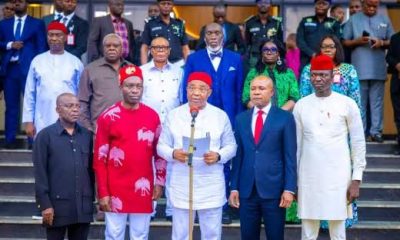
2027: South-East Govs Insist On Tinubu’s Re-election
-

 Politics2 days ago
2027: RIVERS GUBER CANDIDATES SIGN CHARTER TO PRIORITIZE CITIZENS’ DEMANDS