
Niger Delta
Flooding: Experts Blame Nigerians’ Attitude, Govt’s Neglect


Some environmentalists have blamed the attitude of some Nigerians who block drains with waste and build on water channels, resulting in aggravation of flooding in communities, towns and cities.
The experts in a survey conducted by The Tide’s source in the South-South region also blamed the situation on government’s poor waste management
They alleged that government neglected flood forecasts by the Nigerian Meteorological Agency (NiMeT) and the Nigeria Hydrological Services Agency.
The respondents further said the absence of active town planning laws and poor implementation of existing ones were part of the causes of flooding.
According to them, some states have obsolete laws while others cannot implement them due to corruption.
The experts added that these lapses had caused serious devastation in the country as many lives and properties had been lost and many rendered homeless.
They, however, urged government to immediately institute preventive measures both at the State and Federal levels to tackle the menace.
According to the Director General, Cross River State Emergency Management Agency, Mr Princewill Ayim, there was an early red alert from NiMeT that water would be discharged from the Lagdo Dam in Cameroon on September 13, 2022.
“Unfortunately, there was no proactive measures taken by the Federal and State Governments to prevent the water from causing havoc in Nigeria.
“The Lagdo Dam has contributed largely to the flooding being experienced in some states in the south,” he said.
An environmentalist in Calabar, Mr Osita Obi, said ensuring clean drainages at all times as well as effective waste control and management system would assist in abating flooding.
A town planner with the Cross River Town Planning Service, Mr Anthony Okon, said neglect of town planners in building projects contributed to blockage of waterways and submerging of buildings during flooding.
Similarly, the Chairman, Nigeria Institute of Town Planners, Edo State Chapter, Inanigie Audu, observed that the flood ravaging the country was a product of uncoordinated and unregulated human activities over the years.
Audu noted that cities and towns had been left to grow in an unregulated manner and services of the town planners were not employed for proper development.
According to him, builders even go as far as sand-filling swampy areas and building on waterways.
“There are natural drainage created by nature such that when town planners are designing a building layout, they recognise these natural drain areas.
“And when rain falls, water naturally drains into them as provided by nature.
“We need State Governments to domesticate the Urban and Regional Planning Decree of 1992 to empower and protect town planners to carry out their duties effectively,’’ he said.
He expressed regret that the neglect of meteorologists’ forecasts for hazardous weather and climate conditions by Nigerians and government had compounded the problem.
Audu said the issue of climate change made it imperative for government to act otherwise.
An environmentalist in Auchi, Mr Abass Ibrahim, urged the federal government to intensify efforts to reduce the impact of climate change in the country.
Ibrahim, a lecturer in the School of Environmental Studies, Auchi Polytechnic, said that the torrential rains being experienced at present impacted on the soil capacity to absorb the high volume of water.
“This means that the flowing water will have to find a channel for itself. In situations and where flood plains have been blocked by buildings, the implication is flooding,’’ he said.
The expert highlighted decaying drainage infrastructures, dumping of refuse in water channels and poor environmental governance as part of the causes of flooding.
Ibrahim, however, urged Nigerians living in flood-prone areas to adhere to NiMet’s weather predictions and take appropriate measures to prevent loss of lives and damage to property.
Meanwhile, churches, mosques, markets, schools, and houses in no fewer than 12 communities were submerged by flood recently in Etsako Central Local Government Area (LGA) of Edo.
The communities are Udaba-Ekphei, Anegbette, Ukpeko Orie, Ofukpo, Agbabu, Osomegbe, Udochi, Yelwa, Ake Island and Ifeku Islay.
Crops affected by the ravaging flood include rice, cassava, vegetables, potatoes and groundnut among others.
A victim from Udaba community, Mr Isaac Omoaka, said that since he was born, he had never seen such devastation by flood, adding, ‘’this year’s flooding is 10 times that of 2012.
The traditional ruler of Anegbette, Chief Geffrey Ugbodada, said that the flood had inflicted untold hardship on his people, rendering them homeless and helpless.
“Our people are very hardworking farmers who do not depend on government or support from anyone to earn a living,’’ he said.
He, however urged government and good spirited Nigerians to donate relief materials to the victims of flood disaster in Nigeria.
Also in Delta, Chief Sylvanus Ejezie, Chairman, Rice Farmers Association of Nigeria (RIFAN), urged government to support the victims, especially farmers with food and other relief materials to enable them to recover from the disaster.
Ejezie lamented his loss of over 70 hectares of rice farm, home and rice mill, adding that Oko communities including Omelugboma were all submerged.
“I have lost everything; over 36 hectares of rice farm in Omelugboma here in Oko, and another 40 hectares at Ngegwu, Ajaji, Illah to flood.
“Also, flood has taken my rice mill at Abraka in Asaba; there is nothing left for me.
“The situation is terrible and it will be difficult for me to start all over again without government support,’’ he lamented.
On his part, the Delta Commissioner for Agriculture and Natural Resources, Dr Godfrey Enita, decried the devastating effect of the flood, particularly on farmers and the nation’s economy.
“We visited some hectares of rice farms which have been taken over by flood. This is massive destruction running into millions on naira; these are all large scale farms,” he lamented.
Enita said that field officers had been directed to open desks for enumeration of victims, and expressed hope that the government would assist to mitigate the impact.
The Delta Chairman, Fishery Cooperative Federation of Nigeria, Chief Adim Nwokobia, lamented the challenges facing the nation’s economy including insecurity, high cost of farm inputs, rising inflation and flood.
He urged government to address food insecurity by giving soft and interest-free loans, grants, as well as implements to real farmers to enhance food production.
Nwokobia said that no nation could survive on crude oil without food needed for development, and predicted scarcity of food and starvation if the flood remained unabated.
“As we speak, my fish farm at Camp 5, Anwai, near Asaba which is running into millions of naira has been submerged.
“So, having lost everything, even if the flood stops today, I will find it difficult to start my business again without the assistance of government.
“If nothing is done quickly to arrest the yearly flooding in the next three years, there will be no food to eat even if you have money to buy.
Similarly, a farmer and victim of flood in Rivers, Mr Sodin Akiagba, said that Engenni Community was one of the worse flood-hit areas in Ahoada-West Local Government Area.
Akiagba, the spokesman for the Engenni Ethnic Nationality Forum (EENF), said that the huge loss of farmlands posed great danger to food security in 2023.
Contributing, Prof. Wai Gosi of the Faculty of Environmental Sciences, Rivers State University, Port Harcourt, accused the federal government of poor response to the NiMet’s flood predictions.
According to him, government has continued to neglect the construction of the Dansin Hausa Dam expected to accommodate water whenever there is an excess release from the Cameroon’s Lagdo dam.
Gosi urged the federal government to as a matter of urgency commence construction of the dam to save the country from further flood disaster.
A waste management expert in Port Harcourt, Mr Joseph Abu, said that apart from climate change, Nigeria had yet to implement environment-friendly policies aimed at flood prevention and control.
He noted that most populated cities in the country were faced with the challenge of managing non-bio degradable materials like plastic waste which also accumulated in drains, preventing free flow of water.
Abu said most residents were fond of dumping refuse in drains either due to inadequate dump sites across residential areas or habit, adding that this had contributed to perennial flooding over the years.
In the same vein, another environmentalist, Mr Fegalo Nsuke, said that government had greater role to play than the citizens who were regulated by government’s standards.
‘’If government is failing to set and enforce standards, citizens will naturally flout rules.
“Sadly, the flood has created security issues and emergencies with children, girls, women and young people becoming vulnerable to abuse and crime,” he said.
Nsuke also criticised inadequate synergy between government and town planners, adding that town planners lacked legislative powers to oversee buildings and constructions.
Collaborating him, a town planner in Akwa Ibom, Akpabio Ufot-Akpabio, opined that adequate and holistic physical planning, management and development must be put in place to mitigate flooding in the country.
Ufot-Akpabio, a representative of Akwa Ibom in the Town Planners Registration Council of Nigeria (TOPREC), told NAN that some states were still operating obsolete colonial town planning laws.
However, Dr Sunday Ntoiden, Controller, Federal Ministry of Environment in Akwa Ibom, maintained that even when town planning was perfect, attitudes of Nigerians must change to avoid the menace.
‘’You see people carrying bags of waste to dump inside drains. You see people build shops and block drains and water will not flow the way it should. So attitudinal change has to be addressed,’’ he said.
Ntoiden, however, urged government to sensitise residents on the best practice of waste disposal, advising residents to inculcate the habit of desilting drainages, especially during raining seasons to avoid flooding.
Similarly in Bayelsa, Prof. Dimie Miebi, of the Department of Geography and Environmental Management Sciences, Niger Delta University, Otuoke, said poor or non-existent drainage systems caused flooding in Nigeria
Miebi said Nigeria’s increasing urbanisation had contributed to the growing proportion of ground surface concrete, preventing percolation of water.
He said that the anthropogenic factors, including roadside dumping, dumping in canals, and dumping in drains worsened flooding problem in Nigeria.
Meanwhile, an economist in Yenagoa, Dr Hebron Oweifa, has called for active implementation of planning laws, eradication of political interference and checking of corruption to ensure effective town planning.




The Publisher and Editor-In-Chief of a Yenagoa-based tabloid, Niger Delta Herald, Mr. Francis Dufugha, has commended the Bayelsa State Governor, Senator Douye Diri, for the relative peace in the State.
Dufugha, however, expressed resentment over what he described as stringent measures against assessing the State’s Students Loan Scheme, especially for the common citizens.
He made the observations while briefing journalists at the Earliest Ikoli Press Centre, Ekeki, in Yenagoa, the State capital.
“I commend the Governor for the relative peace in the state owing to his approach to the security of lives and properties in the State.
“For now, the police in Bayelsa State is using drones to monitor red flag areas that can cause security breaches and that has really encouraged the peace in the State.
“The security situation has improved and we commend the government for that. We cannot deny the fact that there is relative peace in the State”, he said.
On the State’s students loan, the publisher accused the scheme of having elitist posture due to its accessibility process.
He argued that it would be difficult for the ordinary Bayelsan to provide a Level-17 civil servant as guarantor to be able to benefit from the scheme, describing it as a systemic denial of the less privileged.
He noted that the loan was supposed to be a succour to indigent Bayelsa parents and students who could not assess education easily, noting that such persons should not be made to face cumbersome situations before assessing the financial instrument.
On road infrastructure, the Niger Delta Herald Publisher and Editor-in-chief praised the Diri’s administration on the work done on the three senatorial district roads and tasked the government to do more.
Dufugha, who described Bayelsa State as a wealthy State, asserted that the oil rich state needed to see more developmental strides comparative to its current financial status.
“Bayelsa is not a poor state in terms of public revenue. We’re an oil producing state. We receive federal allocations. We receive derivation revenue. We have access to enormous public resources.
“We receive interventions. Yet, after all these years, the ordinary citizen is still asking, what exactly are we getting for our money? Where are the industries? Where are the jobs? Where are the functional health institutions? Where is the agricultural transformation? Where is the human capital development? Where is the economic diversification?,” he argued.
He enjoined the government to redouble effort in the education and health subsectors, adding that it would pay the state a lot if there were centres for the treatment of critical health cases such as cancer and others in order to save lives and avoid capital flight.
The Publisher urged the Senator Diri-led government and the public not to misunderstand his message as hatred or personal issues with the Governor, but see it as a constitutional and professional duty to hold government accountable.
By: Ariwera Ibibo-Howells, Yenagoa
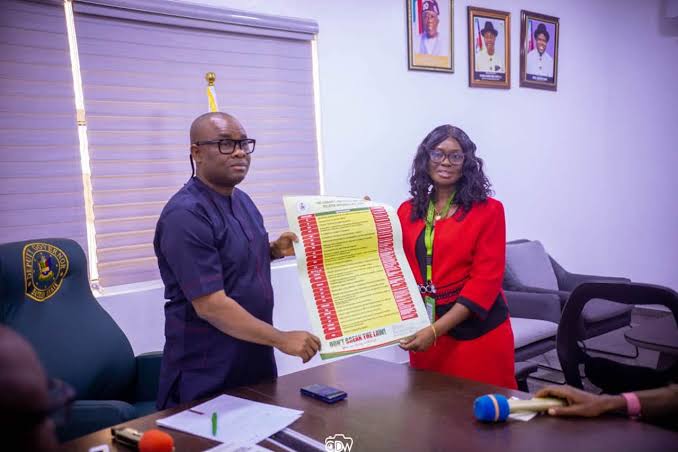
The Bayelsa State Government has stated its stance on zero tolerance for corruption in governance and cautioned residents against writing frivolous petitions to anti-graft agencies.
Deputy Governor of the State, Dr. Peter Akpe, stated this rexently when he received the Resident Anti-Corruption Commissioner of the Independent Corrupt Practices and Other Related Offences Commission (ICPC) in ernment House, Yenagoa.
charge of Bayelsa and Rivers States, during a courtesy visit to Government House, Yenagoa.
Akpe said the general perception of those in politics has always been that of corruption, but noted that the position of the Douye Diri-led Prosperity Administration is non-tolerance for corruption.
Akpe, who frowned at the habit of writing unfounded petitions against individuals and groups, said the heap of petition files from Bayelsa State at the ICPC was several times higher than that from any other state in the country.
He reminded residents that writing unjustifiable petitions to anti-graft agencies is not only a bad culture, but also attracts jail penalty, and assured the ICPC of the state government’s support to improve public enlightenment.
“Our government is a government that believes in zero tolerance for corruption; that is why we are always open to interact with you and other anti-graft agencies.
“Usually, there is this issue of negative perception of politics and politicians. But it is not true that every politician is corrupt. We have a good number of people in politics that are not corrupt, and we believe that a good percentage of them are in this government.
“The issue of petitions at the ICPC: What we observed was that the heap of files from Bayelsa were 10 times higher than the ones from even Lagos, and 15 more times than the ones from Sokoto and other states.
“That is quite disturbing. More so, most of those petitions were ion, our people should also know that such frivolous petitions can land them in jail”, he saidfrivolous.
From a personal experience, I can tell you that most of the petitions are extremely frivolous. While we will never tolerate corruption, our people should also know that such frivolous petitions can land them in jail”, he said.
Earlier in her remarks, the ICPC Resident Anti-Corruption Commissioner in charge of Rivers and Bayelsa States, Dr. Ekere Usiere, highlighted the statutory mandate of the ICPC, stressing that its mission was to carry out sensitisation on the ills of corruption in the Nigerian society.
Usiere, who expressed concern at the volume of petitions currently before the ICPC emanating from communities in Bayelsa over the management of the PIA funds, expressed the commission’s desire to partner the Bayelsa State Ministry of Information to carry out sensitisation programmes.
The ICPC Resident Anti-Corruption Commissioner was accompanied on the visit by Assistant Chief Superintendent, Mr. Evans Peters; Principal Superintendent, Mr. Emmanuel Akpor; Assistant Superintendent, Mrs. Tamaraudoubra Ebebi; and the Administrative Officer, Mr. Frank Yileaziba.
By: Ariwera Ibibo-Howells, Yenagoa
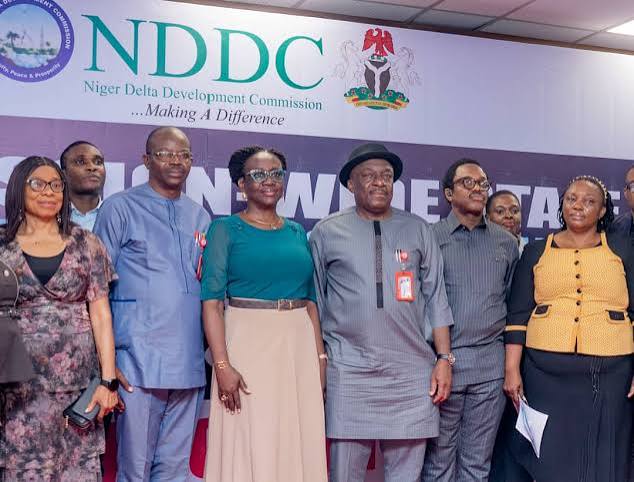
The Niger Delta Development Commission (NDDC) has urged its staff to take retirement planning seriously by maximising pension schemes and other financial instruments that can guarantee financial security after their years of active service.
The Director of Administration and Human Resources, Sir Kelechi Nwelue, gave the advice during a commission-wide staff interactive session with Pension Fund Administrators (PFAs) and insurance companies at the NDDC headquarters in Port Harcourt, Rivers State.
In a statement signed and issued by Seledi Thompson-Wakama
Director, Corporate Affairs, Nwelue said the programme, approved by the Managing Director of the commission, Dr. Samuel Ogbuku, was organised to sensitise staff on pension schemes and provide them with the knowledge required to make informed decisions about their retirement savings.
He particularly urged newly recruited employees to acquaint themselves with the operations and responsibilities of various PFAs before choosing an administrator to manage their pension contributions.
According to him, pension contributions deducted from employees’ salaries, alongside employers’ contributions, constitute long-term savings designed to provide financial support after retirement.
He urged staff to carefully assess the information provided by the participating pension administrators and choose the option best suited to their long-term financial interests.
Nwelue stressed that employees were at liberty to select their preferred pension administrator, noting that the interactive session provided an opportunity for the various companies to explain their products, services and benefits.
Also speaking, a Director in the Directorate of Administration and Human Resources, Mr. James Fole, said the programme was aimed at deepening employees’ understanding of pension, insurance and other financial instruments that could improve their financial wellbeing during and after active service.
Fole warned that inadequate preparation for retirement could expose employees to financial hardship in their post-service years.
He said: “That is not what the Managing Director, Executive Management and the entire management want for our staff. We want to see a situation where retirees enjoy a reasonable level of comfort, knowing that the Commission has contributed to their future.”
He added that equipping employees with appropriate financial knowledge while they were still in active service remained critical to achieving a financially secure retirement.
Several pension and insurance companies participated in the interactive session.
-

 News1 day ago
RSG Targets Nine Million Residents in Mosquito Net Distribution Campaign
-

 Oil & Energy1 day ago
Aiyedatiwa Signs New Electricity Bill
-

 Maritime1 day ago
Marine Minister Commends President Tinubu On NPERA Bill Assent
-

 Oil & Energy1 day ago
NLNG Commissions Research And Innovation Centre In RSU
-

 News1 day ago
KenPoly Holds Eight Convocations, August 29
-

 News1 day ago
RSG Begins Another Phase of Projects Commissioning Today
-

 News1 day ago
RMAFC Completes Revenue Sharing Review, Proposes New Pay
-

 Maritime1 day ago
NAGAFF Petitions IGP Over Alleged Maritime Police Harassment