
City Crime
Towards Hitch-Free Poll In Anambra

Barring unforeseen negative circumstances, the indigenes and residents of Anambra State will, tomorrow, November 6, turn out in their number from every nook and cranny of the state to elect a new governor that will take over from the incumbent, Willie Obiano, whose second tenure expires on March 17, 2022.
The off-season election has been generating so much anxiety among the people of the South-East following the wanton destruction of lives and property in that region by heartless and criminal elements in recent times. The Indigenous People of Biafra (IPOB) has been spasmodically named in connection with the orgy of violence, particularly because of its professed undertaking to make certain that the November 6 election does not hold.
In one of the most uncertain elections in Nigeria’s history, 18 candidates are lobbying the hearts and votes of the Anambra people. As a bargaining chip, IPOB has vowed that unless its leader, Mazi Nnamdi Kanu, is released from detention unconditionally, on or before November 4, the entire South-East will be on lockdown from November 5 (a day before the Anambra governorship election).
Kanu is being tried on an amended seven-count charge of alleged treason, secession and terrorism for which he had pleaded “not guilty”; and the trial at the Federal High Court in Abuja has been adjourned to November 10, 2021, when his lawyers will be expected to raise objections to the charges.
IPOB has also warned the people of Anambra to remain indoors throughout the sit-at-home order for their safety. It is pertinent to note that the organisation has been enforcing the Monday sit-at-home directive in the South-East with ferocious venom since it became public knowledge that Kanu had been arrested by the Federal Government.
Although the body has denied directing a boycott of the governorship election in a statement issued by its Media and Publicity Secretary, Emma Powerful, the proscribed group is too clever by half as it reiterated its warning on lockdown if Kanu was not released from custody. “For the sake of clarity, what we said was that the entire Biafraland would be locked down from November 5 to November 10, 2021, if the Federal Government failed to release our leader, Mazi Nnamdi Kanu, unconditionally”, he said.
INEC had expressed concerns about the Anambra gubernatorial election and warned against the constitutional crisis that might engulf the state if the situation persisted. Its chairman, Prof. Mahmood Yakubu, affirmed the fears during a meeting of the Inter-Agency Consultative Committee on Election Security (ICCES) in Abuja recently. Recall that last May, the INEC office in Awka was attacked wherein non-sensitive materials and vehicles were wrecked.
Both the voters and the candidates are in a panic. The buildup is so unseemly that even contestants cannot openly campaign or make “empty or substantive” promises to voters. Some candidates held election campaigns in faraway Lagos, hoping that the information would spread more than 407 kilometres to reach people in Akwa and other areas. This is the dark atmosphere in the most important political and economic capital of the South-East.
Regardless, INEC has restated its commitment to go on with the election as scheduled. The Inspector-General of Police, Usman Baba Alkali, has ordered a major overhaul of the security landscape in Anambra ahead of the election. Consequently, 34,587 police personnel, including two DIGs, five AIGs, 14 Commissioners of Police, 31 Deputy Commissioners of Police, 48 Assistant Commissioners of Police as well as three helicopters have been deployed to the state to ensure adequate security for the conduct of the poll.
It is worth noting that at this critical moment, the impact of IPOB cannot be quelled, because the group’s problem is pervasive in the South-East for the past few years, trying to discredit governance and authority in the whole area. This group of agitators, hastily proscribed as terrorists by the Federal Government, has consistently carried out violent protests in the entire region against Kanu’s incarceration. Hence, for peace to reign, the Federal Government should dialogue with the group to ensure a smooth election.
This ill wind will blow no one any good. A militarised Election Day by IPOB or the state is inharmonious with free and fair election and public interest. The tense atmosphere will only benefit dubious politicians, waiting to use the apathy of voters to seize the whole process and impose an unpopular candidate on the state. It has also set dangerous priorities for the entire region. IPOB and Anambra should not succumb to this hushed attempt to set the country back.
Contrary to the blanket iron-fit approach of the Biafran group and its probable effect on the election, the body should subject its campaign for a fair deal for the Igbo Nation and Nnamdi Kanu within the Nigerian corporate existence to the judicial process for peace sake. Bloodletting and crude aggression are neither in the interest of the group nor of the region at large.
Also, IPOB and its supporters should be more cautious and trust the judiciary, because it is the last hope of the ordinary person. The continued siege of the people they vowed to defend has been socially and economically counterproductive, and the political turn of events is waiting to destroy their beleaguered fortunes for the worst.
Without a doubt, the Anambra election is a test case for the 2023 general election. This should not be a matter of life and death. It must be free, fair and credible, and the results must reflect the will of the people. Therefore, every effort must be made to ensure its success. Citizens must ensure that they come out to vote or live with the consequences.
Voters must exercise their privileges freely and fearlessly without intimidation. Politicians, their agents and supporters must maintain order and peace during the election. We believe that if all parties concerned follow the rules, the election will be successful. Most importantly, let the INEC ensure that the votes count.



Akwaowo’s appointment follows the expiration of the second tenure of the former Registrar, Chemist Jwalshik Wilford.
According to a letter released from the office of the Minister of State for Health and Social Welfare dated August 5, 2026, the Minister of State for Health and Social Welfare, Dr. Iziaq Adekunle Salako, said the appointment was with immediate effect.
The minister had earlier announced Akwaowo’s appointment during a meeting with the Permanent Secretary, Heads of Departments, and Directors in June 10, 2026 in the Minister’s Conference Room.
He said the appointment was automatic and effective 1st June, 2026 following the satisfactory handover that followed the succession procedure.
The Minister nullified the earlier process put in place for a substantive appointment, citing it as a contravention of the provision of the ICCON Act.
He further directed that the appointment letter be issued without further delay.
The Minister admonished the new ICCON Chief Executive to take charge and ensure that the Institute is on the path of peace and progress to deliver her mandates.
In his response, Akwaowo thanked the the Federal Government for the appointment which, he said, has laid every uncertainty surrounding the leadership of the Institute to rest.
He pledged his unalloyed loyalty to the Federal Government and the Minister and promised to work with his Management Team to align with the policy directives of the Ministry as well as the renewed hope agenda of the Federal Government.
Akwaowo joined ICCON in 2005 as a pioneer staff, rose through the ranks and served in many capacities transcending virtually all the departments in the Institute including HOD, Administration/Accounts & Finance.
Most recently, he served as the pioneer Team Lead and the Registrar/CEO Representative in the National Chemical Personnel Audit excercise to Chemical companies and Chemistry Departments in Tertiary Institutions as part of the Institute’s regulatory mandates.
He has attended several courses and workshops and represented the Institute at various conferences and fora.
Akwaowo is a Chartered Chemist and also a member of a number of professional bodies.
He rose to the rank of Director, Scientific in 2025, and was until his appointment, the Coordinator, Zonal Offices of ICCON.
City Crime
Bayelsa Water Coys Raise Alarm Over Business Threats …Set To Resist Multiple Levies Amid High Production Cost

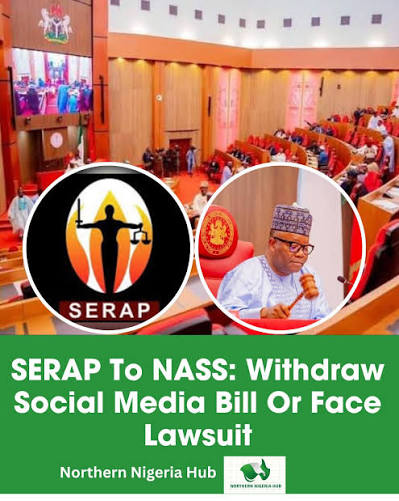
SERAP warned that it would institute legal action if the bill is passed in its current or substantially similar form.
The bill, sponsored by Senator Ned Nwoko (APC, Delta North), seeks to compel social media platforms, data controllers and data processors operating in Nigeria to establish physical offices in the country.
It also empowers the Nigeria Data Protection Commission to shut down or prohibit the operations of any entity that fails to comply within 30 days.
In a letter dated July 18, 2026, and addressed to Senate President Godswill Akpabio and Speaker of the House of Representatives Tajudeen Abbas, SERAP said the proposed amendment posed a threat to constitutionally guaranteed rights.
The letter, signed by SERAP Deputy Director Kolawole Oluwadare and issued on Sunday, read in part, “Requirements compelling technology companies to establish local offices would increase government leverage over platforms, facilitate political pressure, make censorship demands easier and expose local employees to retaliation.
“The Bill would create sweeping powers capable of shutting down or excluding social media platforms from the Nigerian market and expose millions of Nigerians to serious violations of their constitutionally and internationally guaranteed human rights.”
SERAP argued that the bill revives previous attempts to regulate social media that attracted widespread public opposition.
“The current Bill revives substantially similar proposals previously introduced by Senator Nwoko, raising renewed concerns that localisation requirements are being used as a vehicle for expanding governmental control over digital platforms and online expression,” it said.
The organisation warned that it would challenge the legislation in court if enacted.
“Should the Bill be enacted into law in its current or substantially similar form, SERAP shall promptly take all appropriate legal actions to challenge its legality in the public interest and to ensure that Nigerians’ fundamental rights are fully protected,” the letter stated.
According to SERAP, the proposed legislation would give the Nigeria Data Protection Commission excessive powers to block digital platforms without adequate procedural safeguards.
“The Bill constitutes a backdoor attempt to regulate social media and increase governmental control over online expression through corporate localisation requirements rather than through transparent and constitutionally permissible regulation,” it said.
The group argued that the bill lacks provisions for prior judicial authorisation, meaningful opportunities for compliance beyond the proposed 30-day period, and safeguards to protect the rights of millions of Nigerians who rely on digital platforms.
SERAP also cited the judgment of the ECOWAS Court of Justice on Nigeria’s suspension of Twitter, arguing that the proposed amendment could produce similar consequences by indirectly excluding social media platforms from operating in the country.
“The Bill also risks recreating the very dangers previously condemned by the ECOWAS Court of Justice. In SERAP and Others v. Federal Republic of Nigeria, the Court held that the suspension of Twitter violated the rights to freedom of expression, access to information and media freedom protected under the African Charter.
“Although the present Bill differs from the Twitter suspension in form, it creates the possibility of achieving the same result indirectly by empowering regulators to prohibit digital platforms from operating in Nigeria.
“The National Assembly should not enact legislation capable of producing, through indirect regulatory means, the very restrictions on fundamental rights that regional human rights law prohibits,” the organisation said.
It maintained that while governments have a legitimate interest in regulating digital platforms, such measures must comply with constitutional guarantees and international human rights standards.
The organisation further warned that mandatory localisation requirements would increase compliance costs for technology companies, startups, educational institutions and artificial intelligence developers.
“The proposed amendment conflicts directly with the objectives of the Nigeria Startup Act 2022 and the National Digital Economy Policy and Strategy.
“Mandatory localisation requirements substantially increase compliance costs, particularly for startups, open-source projects, educational institutions, research organisations, AI developers and smaller technology companies, while reducing Nigeria’s attractiveness as a destination for innovation and investment.
“No major democratic jurisdiction requires every social media platform to establish a physical office as a blanket precondition for providing services.”
SERAP added, “The National Assembly should immediately reject and withdraw the Bill, as it is manifestly incompatible with the Nigerian Constitution and Nigeria’s obligations under the African Charter on Human and Peoples’ Rights and the International Covenant on Civil and Political Rights.”
-

 News2 days ago
RSG Targets Nine Million Residents in Mosquito Net Distribution Campaign
-

 Oil & Energy2 days ago
Aiyedatiwa Signs New Electricity Bill
-

 Maritime2 days ago
Marine Minister Commends President Tinubu On NPERA Bill Assent
-

 Oil & Energy2 days ago
NLNG Commissions Research And Innovation Centre In RSU
-

 News2 days ago
KenPoly Holds Eight Convocations, August 29
-

 News2 days ago
RSG Begins Another Phase of Projects Commissioning Today
-

 News2 days ago
RMAFC Completes Revenue Sharing Review, Proposes New Pay
-

 Maritime2 days ago
NAGAFF Petitions IGP Over Alleged Maritime Police Harassment