
Editorial
That Desecration Of NDA

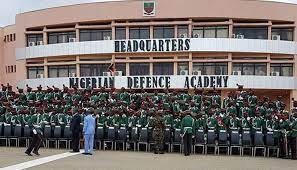
The contumelious assault on the headquarters of the Nigerian Defence Academy (NDA), Kaduna, by gunmen in the early hours of Tuesday, August 24, is possibly the most menacing sign that the Federal Government may have lost total control of the ungraceful security predicament faced by Nigerians. With this tragic incident and many others counting, obviously, the North-West may have increasingly evolved into the new terror epicentre, as the Boko Haram/ISWAP terrorism ostensibly dies down in the North-East.
According to media reports, the gunmen took advantage of a chasm in the NDA’s perimeter fencing and stormed the location along Airport Road, Afaka. They gained access to the residential area where two senior officers (Lieutenant Commander Awolor Wulah and Flight Lieutenant Chinecherem Okoronkwo) were shot dead. They also abducted another officer, Major Christopher Datong. The NDA is just steps away from the Federal Forestry Mechanization College, Afaka, where a gang of bandits kidnapped 39 students last March.
Indeed, the NDA, an institution that engenders young men and women to become gallant military personnel, should not come under an invasion of that dimension so easily. The onslaught was a rude reproach to the military, and by extension Nigeria. The Armed Forces ought to have carefully studied earlier raids and taken steps to safeguard their men and institutions. That this did not happen was indicative of imprudence on their part.
The inability to repel or capture the assailants highlights the shortcomings of our security system and demonstrates how daring terrorists or bandits are. Are there moles inside the Army? How would bandits attack a military institution without any effort or considerable resistance? We are asking because there has always been lingering suspicion that people are undermining the endeavours of our military, particularly in the ongoing anti-insurgency and banditry war.
While we vehemently denounce the incursion and call for the perpetrators to be apprehended and prosecuted, we urge that every effort be made to salvage the kidnapped major in the attack. The military must note that the continuous assaults on their men and formations are not only disconcerting, but hazardous as they erode the confidence of Nigerians in their ability to keep them safe. Something has to be done about that. These relentless attacks should be considered acts of terrorism and properly addressed.
In the aftermath of the NDA ambuscade, the Chief of Defence Staff (CDS), Lt-Gen Lucky Irabor, assured Nigerians of updates on the search and rescue of the abducted officer, and added that “the Armed Forces of Nigeria will continue operations to ensure that all those involved in the dastardly act are brought to justice”. Much as Irabor’s words may be soothing, we believe more can be done to reassure Nigerians that the military is in firm control.
It was reported that the Defence Headquarters (DHQ) was investigating the unfortunate attack. It is a step in the right direction. But characteristic of the government, it should not take eternity to conclude. We call for a thorough inquiry and all those found to have pitched in to the success of the onslaught either through their actions or inactions must face the law. Also, the findings should be released to the public to instil trust in the inquisition.
Nigerians have consistently been experiencing fear and anguish. Most people are afraid of the road these days. Anytime they have to travel, their hearts are always tucked in their mouths. It was no surprise that in 2020, our nation was considered the third most terrorized country in the world for the sixth year in a row. Sadly, and most ignominiously, the authorities have never been perturbed by such unenviable rankings.
Millions of scared Nigerians are wondering what truly is going on. What is happening to our once mighty Nigerian Armed Forces, which were able to keep the nation one during the Civil War between 1967 and 1970, and return peace to war-torn Liberia, Sierra Leone, Sudan, Mali and even Libya? Why can the once dominant military power in Africa no longer defend itself from ordinary armed thugs on motorbikes that have clearly become a new frontier for terrorism?
Could it be the insatiable greed of the leaders? Could it be that top military officers have been compromised or put in jeopardy and are politicking with issues as sensitive as security? Have our soldiers lost the will to fight gallantly? Or are their weapons obsolete and can no longer withstand the sophisticated projectiles of their enemy? Or could it be that the military is no more as potent as it used to be back in the day? Those critical questions deserve responses.
What is most perplexing is that the security of our country is degenerating vis-a-vis the ever-increasing military allocations. Official figures indicate that more than N5trillion of our annual budgets have been spent on the military for our defence in the past six years. Allocations to the police and other security agencies not inclusive. All seems to have gone down the drain without a corresponding output.
These bandits have to be regarded as terrorists and treated as such. Lately, they have become very unsparing and appear a step ahead of our security agents. Therefore, they should be handled ruthlessly. Those behind the attacks must be fished out. The criminals must be properly defined, chased after, and apprehended, including their patrons. This can be accomplished by the military intelligence.
There is no doubt that the NDA attack is a special message that the bandits are sending to Nigerians to prepare for more deadly onslaughts. So, the security agencies must brace up. This is to say the least, very hair-raising, and the Federal Government must sit up to protect, not only the military establishments, but the country in totality. Hence, there is a pressing need for a change in our security architecture.
All patriotic Nigerians should be troubled by the attacks on the NDA and other military establishments as they undermine the sovereignty of the country. As a result, security agencies are expected to grow with renewed fervour to tackle this failing condition in the nation. Insecurity is the biggest challenge every government has to deal with, and should not be treated lightly. Additional tactics must, therefore, be deployed to hammer away terror and banditry in the land.




Particularly troubling is the reported targeting of National Youth Service Corps (NYSC) members, who play a vital role in Nigeria’s electoral process. Many serve far from home and undertake sensitive assignments at polling units and other electoral locations. As civilians, they should not be exposed to intimidation, abduction or violence without adequate protection. If election workers are vulnerable, the safety of other officials, observers and voters cannot be guaranteed.
Nigeria’s electoral history offers painful lessons. Human Rights Watch reported in Nigeria’s Post-Election Violence, published in May 2011, that more than 800 people died in the violence following the 2011 general elections. NYSC members serving as electoral officials were among the victims. This tragedy underscores the deadly consequences of political tension, incitement and disputed outcomes. Nigeria must act on the latest warning before another preventable disaster occurs.
INEC deserves recognition for uncovering the alleged plot, while the DSS and other security agencies merit commendation for their reported assistance. However, arrests are only the beginning. Investigators must establish the suspects’ identities, motives, networks and intended targets, ensuring that evidence is admissible in court. The process must remain impartial and free from political interference. Credible public updates are also necessary, provided they do not compromise investigations or operational security.
The authorities must adopt a comprehensive, intelligence-led security strategy for 2027. INEC’s proposed security conference should produce practical measures developed in collaboration with the Inter-Agency Consultative Committee on Election Security (ICCES), the police, the DSS and other relevant agencies. Threat assessments should guide personnel deployment, secure transportation, emergency communications, evacuation procedures and rapid response. Protection must extend beyond polling day to the distribution of sensitive materials, collation centres and the safe return of ad hoc personnel.
Those who provide intelligence must also be protected from retaliation. Confidential reporting channels and appropriate safeguards should be established for informants and others assisting investigations. Equally, security deployments must not intimidate voters or facilitate political repression. Personnel should act professionally, impartially and proportionately, within the law. Clear mechanisms for reporting misconduct and investigating abuses are essential to maintaining public confidence.
The threat also highlights broader concerns about trust in the electoral system. The European Union Election Observation Mission’s June 2023 final report identified shortcomings in transparency and operational implementation during Nigeria’s 2023 general elections, alongside concerns about the legal framework and electoral dispute resolution. Credible elections require more than security; they depend on transparent procedures, accountable officials and consistent enforcement of electoral laws. INEC must demonstrate measurable progress in addressing previously identified weaknesses.
Voter apathy presents another challenge. INEC’s published figures indicate that approximately 25 million people voted in the 2023 presidential election, out of about 93.5 million registered voters, a turnout of roughly 26.7 per cent. Although insecurity is not the sole cause of low participation, threats against electoral personnel can heighten public anxiety and discourage voters from exercising their franchise. INEC should strengthen civic education, improve polling accessibility and communicate procedures clearly. Political parties, civil society and the media must promote peaceful participation and reject electoral intimidation.
Misinformation and manipulated digital content pose additional risks. False reports, fabricated announcements and deepfake videos can inflame tensions, impersonate officials and mislead voters. INEC should establish a well-resourced, rapid-response communication system supported by verified digital channels and timely public statements. Collaboration with credible media organisations and fact-checkers would help counter falsehoods without suppressing legitimate criticism. Clear, consistent communication is indispensable, as administrative confusion and delayed explanations often allow rumours to spread.
Electoral integrity must also begin within INEC itself. The chairman’s warning against partisanship, negligence, extortion and ethical misconduct deserves serious attention. Security measures cannot compensate for officials who abuse their positions or disregard established procedures. INEC should strengthen staff training, ensure transparent recruitment and deployment, provide secure channels for reporting misconduct and enforce disciplinary rules consistently. Allegations of bribery and political interference must be investigated regardless of rank, while ad hoc personnel should receive adequate briefing, support and prompt payment.
The legal framework also requires clarity and consistent enforcement. INEC should explain the precise provisions and applicability of Section 26 of the Electoral Act 2026, including the obligations of electoral officials and security personnel, and publish authoritative guidance on neutrality and professional conduct. Complaints by opposition parties that they have been prevented from campaigning in certain states must likewise be investigated impartially. Any established violations should attract appropriate corrective action. Electoral fairness requires not only impartial polling officials but also lawful campaigning, access to competing viewpoints and freedom from intimidation.
The alleged plot against INEC’s ad hoc personnel is a warning against complacency ahead of the 2027 general election. Governments, security agencies, INEC, political parties and civil society must work together to prevent violence, punish misconduct and protect citizens’ participation. The commission should communicate its security priorities, maintain accessible threat-reporting channels and provide periodic updates on preparedness. Nigeria’s democracy cannot be safeguarded by assurances alone; it requires demonstrable preparation, impartial law enforcement and an unwavering commitment to free, fair and credible elections.
-

 Politics3 days ago
LG CITY BOY COORDINATOR HAILS WIKE’S SUPPORT FOR ONYESOH, TINUBU
-
Politics3 days ago
DIRI INAUGURATES APC CAMPAIGN COUNCIL, SETS MILLION VOTES TARGET FOR TINUBU
-
 Politics3 days ago
NDC Candidate Urges Oborevwori To Probe Asaba Political Violence
-

 News4 days ago
Army Recovers X Account After Hack Attempt
-
 Business3 days ago
Nigeria Loses N17tr Yearly To Abandoned Projects
-
Politics3 days ago
2027: Oborevwori Tasks Media On Fair, Accurate Reporting
-
Politics3 days ago
2027: AKPABIO ENVISAGES TINUBU’S VICTORY IN SOUTH SOUTH REGION
-
Politics3 days ago
Asaba Political Violence: Police Confirm One Dead, Delta Govt Urges Probe