Connect with us

Education

Students Want STEM Introduced At Primary Level 

Published

on

Some students have underscored the need to introduce Science, Technology, Engineering and Mathematics (STEM) in their curriculum right from the primary level to stimulate their interest in the fields.
They stated this on Saturday at the STEM showcase organised by the Pan African University of Life and Earth Sciences Institute (PAULESI), University of Ibadan, in collaboration with Co-Creation Hub (CCH) to mark the African Union Day celebration.
It was gathered that the 110 students, mainly drawn from both secondary and primary schools in Ibadan were introduced to Robotics and Artificial Intelligence, 3D design and scientific-practical to solve real-life problems.
Anuoluwapo Okunneye, a JSS III student of UCH Staff School, Ibadan, said learning on how some scientific practical work and what he can do with it was exciting for him.
“I learnt about things like crafts and other robotics that can be made with scraps at home, thereby recycling what was initially considered as waste.
“I learnt in practical ways how mechanical energy turns to mechanical and the light energy that can be used to power appliances.
“This is an edge for me to start thinking of how to deploy all I have learnt to solve problems in my environment, especially the problem of waste management,” Okunneye said.
Another student, Inioluwa Ireniyi, a JSS II student said “the event has opened my mind to the fact that I can be an engineer, that STEM is not only for males, but that I can excel there too.
“That I can be an inventor also and I would like to solve the problem of light for Nigeria by inventing a machine from renewable sources that switches itself on whenever there is a power outage.
Isabella Akinyede, a Primary Four pupil of Richmab International School, said she was fascinated about how robotics and artificial intelligence were used to make things work.
“I would like to become a medical doctor in the future and use the knowledge I am gaining in STEM to make things better,” Akinyede said.
Also, Michael Oladunjoye, a Primary Six pupil of Rolis International School, Ibadan said he would like to become a physicist and the event has further stimulated his interest in STEM.
“I would like to develop more in this field and also build machines that will ease work when I grow up,” Oladunjoye said.
In her address, the Director, PAULESI, Prof. Titilayo Akinlabi, said as a professor of Mechanical Engineering, there was the need to encourage many more students, right from their tender age into STEM.
According to her, this would turn them into solutions providers and make them compete favorably with their counterparts worldwide, especially girls whose numbers are few in the STEM field.
“For the young girl-child here today, for you to know that it is possible to be a woman and excel in STEM fields and even be at the top of your career,” Akinlabi said.
In an interview, Mr Abraham Akpan, the Programme Manager, Co-Creation Hub, said that the company organised community engagement projects for communities and stakeholders to drive technology toward problem-solving in the country.
According to him, the programme focused on students from age 10 to 16 years old, to have firsthand knowledge of what STEM was all about.
“As technology and youths are taking over our world, students need to have hands-on knowledge and this is our way of contributing and impacting our world,” Akpan said.


Continue Reading

Education

IAUE Trains HODs, Deans Ahead of NUC Resource Verification

Published

on

The Academic Planning Unit of Ignatius Ajuru University of Education, IAUE, has organized a Pre-Resource Assessment Workshop for Heads of Department and Deans as part of preparations for the forthcoming NUC Resource Verification exercise.
The workshop held on Tuesday, August 4, 2026, at the Postgraduate Hall of the University. It drew professors, deans and HODs from across faculties.
Declaring the workshop open on behalf of the Vice-Chancellor, Prof. Okechukwu Onuchukwu, the University Librarian, Prof. Emmanuel Okwu, welcomed principal officers and other participants. He described the session as critical to ensuring the University’s readiness for the NUC assessment.
Prof. Okwu stressed that the exercise was not routine but a strategic step toward meeting national standards. He urged participants to take the presentations seriously and implement recommendations in their departments.
The Director of the Academic Planning Unit, in his welcome address, said the workshop was designed to assess the level of preparedness of departments ahead of the verification. He noted that the University had already invested significantly in facilities and staffing and was now awaiting the NUC team.
Three resource persons took participants through key aspects of the verification process. The Director of Academic Planning, Prof. Joseph Kinanee, spoke on “NUC Resource Verification and Their Requirements.”
Prof. Levi Doe Kalagbor, Director of Quality Assurance, addressed “The Role of Staff in Successful Resource Verification Exercise.” Prof. Isaac Ogundu, Dean of the Faculty of Vocational and Technical Education, presented on “NUC Scoring Format/Guide and Its Implication for Approval Status.”
The presentations were followed by an interactive question-and-answer session. Participants sought clarifications on documentation, facilities and staffing ratios, and received detailed responses from the facilitators.
In his closing remarks, Prof. Okwu thanked everyone for their active participation and engagement. He expressed optimism that IAUE would record a successful outcome in the upcoming NUC resource verification. The programme ended with a closing prayer and refreshments.
Continue Reading

Education

UNIPORT VC Hails Postgraduate School Over Planned International Conference

Published

on

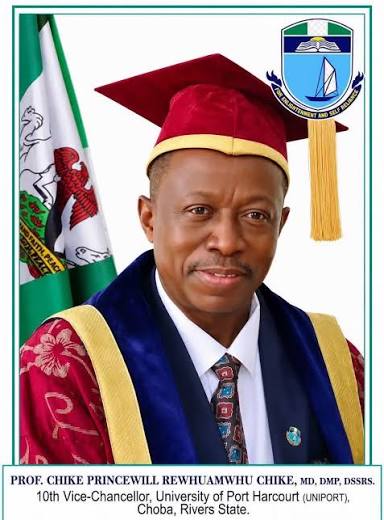
The Vice-Chancellor of the University of Port Harcourt, Prof. Chike Princewill, has commended the School of Graduate Studies for initiating an international conference, describing it as a timely move to boost research output, academic excellence and the University’s global visibility.
Prof. Princewill gave the commendation on Friday while receiving members of the conference planning committee set up by the School. The delegation was led by the Associate Dean of the School of Graduate Studies, Prof. Doris Adameh.
He applauded the committee for conceiving the project and urged members to pursue it with diligence and strategic planning. According to him, such academic gatherings are critical to positioning UNIPORT as a hub for cutting-edge research in the region and beyond.
The Vice-Chancellor specifically charged the committee to engage the University’s alumni as strategic partners in the execution of the conference. He noted that their networks, experience and resources would add significant value to the event.
Prof. Princewill further directed the team to reach out to former postgraduate students of the University to solicit their support and cooperation. He said their involvement would help ensure wider participation and a more successful hosting.
He stressed that alumni remain vital stakeholders in the University’s growth agenda. “Their contributions can significantly enhance the success of the event and strengthen our academic and research profile,” he stated.
Earlier in her remarks, Prof. Adameh said the committee was constituted by the School of Graduate Studies to plan and deliver an international conference that meets global standards. She noted that the process was already underway.
Prof. Adameh explained that the conference is designed to bring together scholars, researchers and professionals from across the world. The goal, she added, is to advance knowledge exchange and foster academic collaboration that will benefit both the University and the wider scholarly community.
By: Amadi Akujobi
Continue Reading

Education

Education Commissioner hails RSU’S  growth research as key to rivers development

Published

on

The Rivers State Commissioner for Education, Dr. Peters Nwagor, has commended Rivers State University, RSU, for its resilience, academic growth and research contributions, describing the institution as critical to the state’s socio-economic development.
Dr. Nwagor gave the commendation on Tuesday, August 11, 2026, during an official visit to the University in Nkpolu-Oroworukwo. He held talks with principal officers, provosts, campus heads, deans and directors at the Dr. Nyesom Ezenwo Wike Senate Building.
The Commissioner said the visit was to engage the University’s leadership on consolidating gains and strengthening capacity for quality teaching, cutting-edge research, innovation and community service. He noted that RSU occupies a strategic position in the state’s development agenda.
Reaffirming government’s commitment, Dr. Nwagor said education remains the bedrock of human capital development and economic transformation. He stressed that investments in infrastructure, staff development and digital learning must be matched with strong institutional systems, transparency and measurable outcomes.
He urged the University to prioritize key performance indicators such as accreditation performance, research output, internally generated revenue, student outcomes and graduate employability. According to him, these metrics should drive continuous improvement across faculties.
Dr. Nwagor also charged RSU to accelerate its digital transformation, establish research and innovation hubs to solve real societal problems, and maintain existing infrastructure. He advised management to explore sustainable funding through grants, endowments, alumni engagement and strategic industry partnerships.
The Commissioner emphasized that government and the University must play complementary roles. While government meets its statutory funding obligations, he said, the institution must strengthen internal efficiency and pursue legitimate private-sector collaborations.
The Vice-Chancellor, Prof. Isaac Zeb-Obipi, appreciated the State Government for its sustained support. He highlighted last year’s budgetary intervention for accreditation, approval of funds for the Faculty of Communication and Media Studies Film Festival slated for November 2026, and the implementation of the new minimum wage for RSU staff.
Prof. Zeb-Obipi, however, drew attention to pressing challenges. He cited shortages of teaching and non-teaching staff ahead of accreditation exercises, inadequate classrooms, libraries, equipment and office spaces, and acute accommodation deficits for staff and students.
The Vice-Chancellor appealed for support to recruit more personnel, retain retired academics on contract, and engage sabbatical and adjunct lecturers. He also requested funding for NUC and professional accreditation scheduled for October, stressing that successful outcomes are vital to RSU’s competitiveness. He reaffirmed management’s commitment to work with government to position RSU as a leading centre of knowledge, research and innovation.
By Amadi Akujobi
Continue Reading

Trending