
Politics
Perspective On NASS 2% Budget Spending

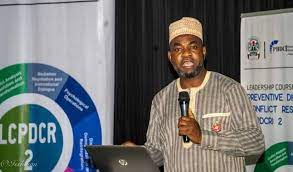
The theme of the symposium was “Saving A Nation From The Precipice: Between Re-Federation And Secessionalism”. The occasion was the 10th annual symposium of the Muslim Students Society of Nigeria, B-Zone. The event which took place last week held in the Ogun State Capital, Abeokuta.
Vice Chancellor of Ahman Pategi University, Patigi, Kwara State, Professor Mahfouz Adedimeji, was the guest lecturer. Top among the dignitaries that graced the talkshop was the Deputy Chairman of Nigeria’s National Assembly and Speaker of the House of Representatives, Rt. Hon. Femi Gbajabiamila by proxy.
Of course, the crux of the discussion was how best to pull back Nigeria that many believe is lingering precariously on the brink of national suicide. And this was where the second in command of the national legislature squared up with the erudite academic as the professor dared to point at the National Assembly as part of the areas that need adjustment in order to save the life of the nation.
In his presentation, Prof. Adedimeji chided the country for running the most expensive legislative arm in the world and expressed the view that a leaner and more concise National Assembly would reduce cost and conserve funds for other critical sectors of the economy that would be of more direct benefit to the generality of Nigerians.
He said, “With due respect to the Speaker of the House of Representatives, Nigeria spends the highest amount of money on legislators in the world and the National Assembly consumes more money than any other parliament in the world”.
According to the university don, it is superfluous to keep two legislative chambers, adding that it is as well bogus and extravagant to maintain the number of lawmakers when a single chamber and a much less number of persons could deliver the same service at a more tolerable cost.
“A unicameral legislature with two representatives from each state is sufficient. The National Assembly should have less than 100 members, including Abuja,” he emphasised.
This inclusion of the National Assembly among the areas to be pruned for better national productivity was what the Speaker of the House, who was also the chairman of the occasion, represented by Hon. Ibrahim Isiaka, House member representing Ifo/Ewekoro Federal Constituency, could not let slide without an effort to put the records straight.
The speaker accused Nigerians of being seemly obsessed with the neglible portion of the national revenue spent on the federal lawmakers while closing their eyes to how the greater part is dispensed.
Gbajabiamila said, while only two per cent of the national budget is spent on the National Assembly, 98 per cent goes to service the rest of the country and wondered why the searchlight is scarcely turned on the greater part instead of beaming its rays always on the infinitesimal fraction.
“The money being spent on the National Assembly is less than two percent of the total budget of this country but nobody has ever looked at what is happening to the remaining 98 per cent”, he said, explaining that, “when you say National Assembly, you are not talking about legislators, who are the lawmakers only. You are also talking about the National Assembly Commission; you are talking about everything, all encompassing”.
While noting that Nigerians appear to lack adequate appreciation of the volume and value of the work of the lawmakers, he called for a change of perception that suggests that the country maintains the most expensive lawmaking arm in the world.
“No one, till today, has actually sat down to go into research and define the meaning of legislators,” he said.
The issue of the cost of maintenance of Nigeria’s legislature is always a touchy one, especially for the lawmakers. The total take home per month for federal lawmakers in the country is still largely a subject of speculation.
Senators and members of the House of Representatives are believed to be carting home double digit millions of Naira as monthly pay packets. While the lawmakers are usually edgy and dodgy whenever any discussion gets close to their emoluments, they also usually shy away from full disclosure.
However, the former Senator representing Kaduna Central Senatorial District, Professor Mahfouz Adedimeji,troubled the waters when he revealed in 2018 that he and his colleagues received N13.5 million as “running cost” in addition to N700,000 consolidated salary and allowances on a monthly basis.
According to the outspoken former lawmaker, the average legislator in the upper chamber of the National Assembly pocketed N162 million yearly in allowances and N9 million in salaries.
Until 2015, statutory budget allocation to the National Assembly was N150 billion annually. The figure was adjusted to N125 billion subsequently, until 2021 when it was moved up to N134 billion.
Without a doubt, two per cent of N13.58 trillion is more than N200 billion. So, going by Gbajabiamila’s submission, money that is expected to go into the running of the National Assembly in 2021 is more than has been made public under the subhead in the appropriation document.
Instead of speaking in percentages, therefore, Nigerians would have loved the speaker to speak in terms of the quantum of money that is being spent on the maintenance of the 469 lawmakers and a service commission whose staff strength may not be more than a thousand persons.
This, actually, is the point of divergence between Prof. Adedimeji’s argument and the Honourable Speaker’s perspective. The import of the proof’s discourse is that the nation can do without spending this huge amount on an arm of government that does not generate money.
Indeed, not just a few Nigerians share the view that something needs to be done, and urgently too, to reduce the size of not only the legislative arm, but that of the executive as well. The belief is that such a measure will automatically cut the overall cost of governance and free up funds needed to finance the productive sector of the economy, provide jobs for the teeming unemployed able youths and douse the rising tension in the land.
The lawmakers should be worried that Nigerians think that the country is wasting money on them (legislators) and that the citizens are not getting value for money spent on their (legislators’) upkeep. They should be concerned that the people are getting more angry that while their (citizens’) lives and material circumstances have continued to depreciate, devalued and endangered by opportunistic social and economic devourers, the legislators live in obscene luxury at the expense of their (citizens’) welfare.
Nigerians would probably not bother much about how much of their collective resources go into servicing their representatives and leaders, if by the work they (representatives and leaders) do, their (citizens’) lives are made better, secure and are assured of a certain future.
However, as long as unemployment, poverty, insecurity, hunger and hopelessness continue to be the lot of the mass of the Nigerian people, they would never see any justification for any percentage of their resources being spent on their leaders. For now, the feeling is that the people are paying leaders who are overseeing their misery and underdevelopment instead of working for their (citizens’) socio-economic advancement.
The lawmakers and indeed the federal government should be deeply disturbed that for all their (government) efforts, the reality of the situation in the country is that more than one-third of the population is languishing in extreme poverty, children are out of school for no fault of theirs’ or their parents’, cost of food is rising above the reach of the common man, freedom to move around in search of livelihood is being curtailed, there is no guarantee for safety of lives and property, children can neither go nor safely sit in school to learn and everyone appears to be living on the edge.
Something needs to be done swiftly to change the growing perception that the federal government can no longer embark on any meaningful project, without borrowing money. Somebody needs to reassure Nigerians very quickly that the national assembly is actively engaged in some other beneficial assignments than merely approving loans whose impact they seem not to feel.
Inevitably, the controversy over federal lawmakers’ take home pay in particular, and what some have described as the unsustainable cost of governance in general in Nigeria, is not likely to abate until a corresponding significant improvement in the living condition of the people is achieved.
By: Opaka Dokubo



The commission announced the extension in a statement issued on Saturday and signed by the National Commissioner and Chairman of its Information and Voter Education Committee, Mohammed Haruna.
According to INEC, the decision followed appeals by political parties for additional time to complete the submission process through the dedicated online portal.
“The submission window, which according to the revised Timetable and Schedule of Activities for the General Election was originally scheduled to close on Saturday, 8th August, 2026, has been extended to Tuesday, 11th August, 2026,” the commission said.
In a a related development, INEC announced the suspension of PVC collection in Osun State ahead of the August 15 governorship election.
The commission said voters who applied for replacement of lost, damaged or defaced Permanent Voter Cards would have until midnight on Sunday, August 9, to print downloadable copies of their cards.
The electoral body explained that the deadline was necessary to enable it compile data on downloaded PVCs and produce final statistics on the total number of cards collected ahead of the election.
INEC said PVC collection in Osun commenced at the Registration Area level from July 22 to 28, 2026, but was extended to July 31 following complaints about large crowds and difficulties experienced by voters at collection centres.
The exercise subsequently moved to the local government level and ran from August 1 to 7.
The commission also disclosed that replacement downloadable PVCs had been made available to voters in Odo-Otin and Ife Central Local Government Areas following the theft of cards during attacks on the two collection centres.
It stressed that the stolen cards could not be used to vote.
INEC reassured Osun residents of its preparedness for the August 15 governorship election.
“The commission reiterates that the stolen cards cannot be used to vote.
“INEC reassures the people of Osun State of its readiness to conduct a free, fair, credible and inclusive governorship election on 15th August, 2026,” the statement said.
The commission said the deadline, initially set for Saturday, 8 August, has been extended to Tuesday, 11 August 2026, following appeals from political parties for more time.
INEC also announced that the window for voters who applied to replace lost, damaged or defaced PVCs to download their replacement cards will close at midnight on Sunday, 9 August.
The move is to enable the commission compile final PVC collection figures ahead of the 15 August Osun governorship election.
INEC said replacement downloadable PVCs have also been provided to affected voters in Odo-Otin and Ife Central Local Government Areas after hoodlums carted away cards from two collection centres, stressing that the stolen cards cannot be used to vote.
The commission reaffirmed its readiness to conduct a free, fair, credible and inclusive election in Osun State.
Gov. Kefas made the remarks over the weekend at the Federal Medical Centre (FMC), Jalingo, during the flag-off of the second phase of the Renewed Hope Medical Outreach in Taraba State, organised as part of activities marking Prof. Yilwatda’s 58th birthday.
The governor commended Prof. Yilwatda for choosing to mark his birthday by providing medical care to people in need.
“What Professor Nentawe did is a powerful demonstration of what leadership should be,” Gov. Kefas said.
He assured that his administration would continue to support initiatives that complement government efforts to improve healthcare delivery and the wellbeing of residents.
Speaking at the event, Prof. Yilwatda called on Nigerian leaders to embrace the culture of giving and use their positions to touch the lives of the less privileged.
He said his decision to celebrate his 58th birthday in Taraba State was deliberate and informed by the needs of underserved communities, particularly people who face difficulties accessing healthcare because of distance and financial constraints.
According to him, the intervention followed a needs assessment and was extended across the three senatorial districts of the state.
He said the exercise commenced on August 3 at Takum General Hospital and covered the Federal University Teaching Hospital, Wukari; First Referral Hospital, Sunkani, Ardo-Kola Local Government Area; General Hospital, Bali; General Hospital, Gembu; and FMC Jalingo.
Prof. Yilwatda said the intervention provided medical services to thousands of beneficiaries, including people who required surgical procedures.
He said sustainable national development could only be achieved when strong institutions placed Nigerians at the centre of development.
“Leadership is about service,” he said, urging political and public leaders to make giving back to society an important part of their responsibilities.
He reaffirmed his commitment to serving Nigeria and its people, saying his personal vision was to make every day of his life useful to humanity.
“Every day that I live, the vision is: let it be useful to humanity,” he said.
The Taraba State Commissioner for Health, Dr. Bordiya Buma, commended the initiative, saying it was consistent with the Renewed Hope agenda and efforts to strengthen healthcare delivery in the state.
Dr Buma said the second phase followed the successful completion of the first phase, which was conducted simultaneously in six local government areas, with two LGAs selected from each of the three senatorial districts.
According to him, more than 10,000 patients were attended to during the first phase, including people with medical and surgical conditions.
He disclosed that 327 general surgeries, 71 eye surgeries and 575 dental procedures were carried out during the exercise.
The commissioner expressed appreciation to President Bola Tinubu for the Renewed Hope Medical Outreach and thanked Prof. Yilwatda for supporting the initiative and choosing Taraba State as a beneficiary.
The Minister of Health and Social Welfare, Prof. Muhammad Ali Pate, also commended Prof. Yilwatda for choosing Taraba State to mark his 58th birthday through a medical outreach.
Prof. Pate said making healthcare the centrepiece of the birthday celebration was significant because health affects everyone.
-

 News4 days ago
RSG Targets Nine Million Residents in Mosquito Net Distribution Campaign
-

 Oil & Energy4 days ago
Aiyedatiwa Signs New Electricity Bill
-

 Maritime4 days ago
Marine Minister Commends President Tinubu On NPERA Bill Assent
-

 Oil & Energy4 days ago
NLNG Commissions Research And Innovation Centre In RSU
-

 News4 days ago
KenPoly Holds Eight Convocations, August 29
-

 News4 days ago
RSG Begins Another Phase of Projects Commissioning Today
-

 News4 days ago
RMAFC Completes Revenue Sharing Review, Proposes New Pay
-

 Maritime4 days ago
NAGAFF Petitions IGP Over Alleged Maritime Police Harassment