
News
1, 868 Security Men Killed By B’Haram, Blair Institute Alleges

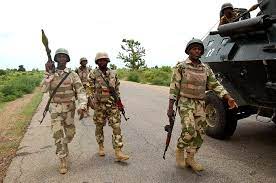
Amid what seems like an onslaught against law enforcement agents in Nigeria, it has emerged that no fewer than 1,868 members of security forces may have been killed in the North-East by Boko Haram between 2018 and 2020.
Also, the three years were said to be the deadliest for security agents on the frontline of the fight against terrorists.
The figure for the three years is said to be almost equal to the total number of people killed by the terrorist group in six years, 2011-2017.
These were contained in a report titled, ‘Violent Extremism in Sub-Saharan Africa: Lessons from the Rise of Boko Haram’, published by UK-based Tony Blair Institute for Global Change.
Tony Blair is a former British Prime Minister.
The report, dated July 23, 2021, is part of the institute’s Africa Frontiers Series.
Authored by Audu Bulama Bukarti, it, among other issues, extensively investigated the origin of Boko Haram, its founders, funding, internal battles, strengths, sustaining factors and capacity to carry out attacks.
Many misconceptions about the group were addressed just as likely solutions were proffered.
It drew from Hausa, Kanuri and Arabic-language evidence and eyewitness accounts, including the author’s extensive interviews with former classmates and associates of three of the four founders – Muhammed Yusuf, Muhammed Ali and Mamman Nur.
The report also warned that for Nigeria’s counter-terrorism campaign against Boko Haram to be successful, the sincerity of those prosecuting the battle on the frontlines is essential.
In addition, it warned that in the North-West, Ansaru is winning the hearts and minds of locals by using the al-Qaeda model.
North-West has, of late, been a hotbed of bandits who have been kidnapping people, including schoolchildren, for ransom.
According to the report, “factional splits led to more, not less, violence with Boko Haram’s ideology retained despite the divisions. Boko Haram’s splintering into the Ansaru faction in 2012 and then ISWAP in 2016 (the original faction JAS also remains present) did not diminish the terror threat – but enhanced it. All three splinter factions share operational and ideological histories, with networks built over many years. This divergence has only served to create additional modus operandi and growth strategies beyond the initial plans outlined by Muhammed Yusuf.
Between 2018 and 2020, for instance, 1,868 security personnel were killed – a number almost equal to the total casualties between 2011 and 2017. ISWAP, led by Muhammed Yusuf’s son Abu Musab al-Barnawi between 2016 and 2019, symbolically continues the Boko Haram legacy and is responsible for much of the violence in the Lake Chad Basin, while Abubakar Shekau’s rogue JAS faction has pivoted to a criminal-like operation that targets civilians and engages in systematic looting of property – despite its leader’s recent death.
‘’In the North West, meanwhile, Ansaru is engaged in a long and dangerous game of winning the hearts and minds of locals by mimicking al-Qaeda’s so-called civilian-friendly model. Yet each essentially remains driven by the same ideology of their founding fathers.
“Do not mistake factional disputes and changes in leadership as “operational crises” for terrorist groups. Global jihadi factions are now more prone to splintering and operational divergence than they were 20 years ago. Yet policymakers need only look to Boko Haram to see how it has grown stronger following its factional splits – an approach that can apply equally to jihadi actors emerging in the Sahel and parts of Syria. Efforts to tackle Boko Haram factions should be tailored to the individual entities that are operating but all bodies, including the UN and military forces involved in the fight against ISWAP, need to recognise that the group’s founding ideology; relationships and local influences still matter today.
Whatever incarnations the separate factions might take in the future, they will always carry their Boko Haram doctrines and heritage with them. Policymakers can therefore future proof their strategies by acknowledging that splinter factions will remain Boko Haram at their core.
“The threat from Boko Haram became more acute following its splintering into three distinct factions between 2012 and 2016, and the past three years have proved the deadliest ever for security forces battling the group. While international actors have long been driven by the view that Boko Haram and its constituent factions would be weakened by the defeat of the Islamic State (ISIS), this has not come to pass and efforts to defeat the group have fallen short. In fact, the ISIS-allied faction of Boko Haram became stronger after the territorial defeat of the Islamic State in Iraq and Syria in 2019. Boko Haram started as a local Islamic movement when a group of radical preachers infiltrated religious, social and political circles in northeastern Nigeria. Nearly 20 years later, the power that Boko Haram wields at the local level continues to sustain it.”
Tracing the group’s origin, the report said, “Boko Haram identified social vulnerabilities in and around the Nigerian city of Maiduguri, particularly among those communities lacking education or with low literacy to enable a sweeping radicalisation campaign across the North-East. These at-risk communities became integral to Boko Haram’s funding channels, with militants soliciting donations from locals including prominent and respected figures.
“For counterterrorism and counter-extremism policies to succeed in the long term, including prevention programmes, they must recognise the ways in which societies are manipulated into the extremist fold. Boko Haram was the first major terrorist group to emerge in Africa. Two decades on, it is one of the most dangerous in the world. Understanding the story of how its members got there and how they sustain their presence to this day is crucial if we are to defeat Boko Haram and jihadi groups elsewhere.
“Their main leader and teacher, Muhammed Yusuf, was a graduate-level student in Islamic studies, with weak Arabic language skills. Their interactions with the Salafi circle of northern Nigeria – which was led by graduates of Saudi Arabia’s Islamic University of Madinah, who advocated strict adherence to the early Muslim generations or ‘pious predecessors’ in all spheres of life – played a crucial role in cementing their understanding of Islamism as well as the importance of building a network of followers among the masses. But the future leaders were not grounded in the Salafi canon. None of them studied for an extended period in Nigeria or elsewhere.
“At the same time, they were taught to loathe Western values and principles from a young age even though they had limited understanding of the associated systems and institutions. Their Sufi upbringing, their active membership of the Muslim Brothers (a group inspired by Egypt’s Muslim Brotherhood) and their participation in the Nigerian Salafi circle all shaped Boko Haram’s ideology – essentially a conglomeration of elements derived from the various groups the leaders had come into contact with. These roots shaped the movement and eventually contributed to Boko Haram’s long-term objective of establishing an Islamic state in Nigeria and across the Lake Chad Basin.
“To comprehend the strategies of a terrorist group and undermine its appeal, governments and policymakers should study the early histories of leading members.
“Prioritise soft-power policy programmes that aim to equip communities with the basic skills to dispute and counter extremist narratives. While it is difficult to overhaul entire education systems and improve access rates in underdeveloped areas such as Borno and Yobe, more work could be done to equip individuals with the basic skills to consciously disrupt Boko Haram narratives. This could be in the form of existing development programmes run by organisations such as the Foreign, Commonwealth & Development Office (FCDO), which educates communities in Africa who are vulnerable and hard to reach. Building resilience through the teaching of ‘critical thinking skills’ could compensate for the high illiteracy rates seen in Borno, Yobe and other Nigerian states as well as across the Lake Chad Basin where Boko Haram is still attracting potential followers.
“For counterterrorism and counter-extremism policies to succeed in the long term, including prevention programmes, they must recognise the ways in which societies are manipulated into the extremist fold. Boko Haram was the first major terrorist group to emerge in Africa. Two decades on, it is one of the most dangerous in the world. Understanding the story of how its members got there and how they sustain their presence to this day is crucial if we are to defeat Boko Haram and jihadi groups elsewhere.
“Since linguistic assimilation has allowed Boko Haram’s founding leaders to target specific communities, counterterrorism and counter extremism efforts need to include anthropological evaluations as part of any planning of operations to combat Boko Haram in Nigeria and across the Lake Chad Basin. As Boko Haram recruits and infiltrates society by channelling its ethnic heritage and expertise, governments and international actors would benefit from an anthropological analysis of cultures and traditions to effectively prevent this exploitation and protect at-risk communities.
“The authenticity and legitimacy of those challenging Boko Haram on the front lines are essential to a successful counter-campaign. Counter-messaging programmes in the Kanuri language such as those on the USAID-backed radio station Dandal Kura should be upscaled and improved. Meanwhile, satellite television channels such as AREWA24 that promote peace building through dramas, movies, documentaries and sports in the Hausa language should integrate Kanuri as well.
“Donations fundamental to Boko Haram’s take-off came from local community members – including individuals not officially affiliated with the organisation. Boko Haram raised their initial funds by soliciting donations not only from their members but also from communities who sympathised with – and were manipulated by – the group’s causes.
“This grew into a sophisticated funding channel as Boko Haram became more influential in Maiduguri’s religious and social circles. In addition to regular financial contributions from members during Friday services and daily prayers, individuals from the community, including those who weren’t official Boko Haram affiliates, also donated to the organisation – driven by their desire to aid “the course of Allah”.
“A substantial part of this came from ‘Zakat’, an annual charitable payment made by wealthy Muslims, which Boko Haram then used to cultivate farms and properties as well as empower those who gave parts of their profits to the group.
“Boko Haram was able to expand its preaching activities using these funds, namely by building mosques, purchasing vehicles and audio equipment, and completing major property transactions. When the group started to transition to violence, it used donations and contributions to purchase weaponry in the early days of the insurgency, and this income eventually became a vital source of sustainability as the group diversified its operations and expanded its territorial footprint. While funds and supplies from 2011 onwards largely came from the vast land and water resources around Lake Chad, as well as raids or taxation on communities in the region, it is worth noting that the group also used members in disguise and middlemen to smuggle in items they could not produce themselves – including medicine and ammunition.
“The Financial Action Task Force (FATF) and similar bodies operating across the Lake Chad Basin need to acknowledge that a significant proportion of Boko Haram’s revenue is sourced from local channels, and not solely via transnational means nor global wire-transfer (such as Hawala networks). Therefore, financial task forces should be educated on the particular local dynamics of terrorist financing in addition to the international dimension.
“Furthermore, local authorities should vet and run due diligence on large transactions in their jurisdictions, and flag when unusually large payments are made or buyers raise suspicions. Security forces should step up efforts to block Boko Haram’s finance and supply routes because this is an integral part of any strategy to combat the group
“Boko Haram benefited from alliances with al-Qaeda and ISIS, but transnational support was – and is – not essential to its survival. Boko Haram’s alliances – first with al-Qaeda, and then with ISIS – produced material, logistical and financial support as well as capacity-building benefits that elevated the group’s operations and standing. Consequently, the success of Boko Haram factions especially the Islamic State West Africa Province (ISWAP) has in turn benefited ISIS and its bid for global territorial dominance. As such, ISIS regularly draws on the achievements of ISWAP to venerate its own global brand and make stronger appeals for fighters to join one of its insurgencies in other parts of the world. Yet it is an overstatement to portray Boko Haram as a mere puppet or representative of transnational jihadi organisations. ISIS does not essentially control Boko Haram.
“While al-Qaeda’s support between 2009 and 2010 was vital to the group’s transition to insurgency, ISIS’s support from around 2015 until today has not been instrumental to the survival of the group. Thus, defeating al-Qaeda or ISIS elsewhere will not automatically bring an end to or even weaken Boko Haram. Because of its inherent, home-grown attributes, Boko Haram will survive without such affiliations. The group’s influence via ethnic, religious, social and political channels means their influence around the Lake Chad Basin is more entrenched than ever, irrespective of any global jihadi association. Furthermore, Boko Haram’s major sources of funding remain local whether from farming, fishing and logging or raids on communities in order to secure cattle, food, medicine and taxation from resident
“Home-grown groups such as Boko Haram (and its most active faction) are standalone threats that should be considered beyond the transnational links they hold with ISIS. Policymakers need to make a distinction between Boko Haram (and its factions) and the Islamic State in counterterrorism and counter extremism programming. The present threat is from ISWAP, who are internationally recognised and supported by ISIS. But ISWAP’s home-grown and localised attributes are more lethal and destabilising than their transnational links with ISIS alone.
“With significant influence in rural parts of the Lake Chad Basin, ISWAP will remain immune to counterterrorism and counter extremism efforts that aim to defeat ISIS in other parts of the world. Therefore, the Multinational Joint Task Force, France, the UK and the US, all of which are actively engaged in the fight against ISWAP, should aim to target both the Boko Haram roots from which ISWAP grew and the supporting Islamic State elements. This could be the basis upon which to tackle other jihadi groups whose alliances with al-Qaeda and ISIS disguise their more hazardous home-grown and localised powers
“As our final recommendation, we call for all governments directly affected by Boko Haram activities, including those in Nigeria, Niger, Chad and Cameroon, to do more to synchronise their military, de-radicalisation and prevention programmes. Terrorism today extends its reach beyond the kinetic and physical – and governments suffering under the presence of home-grown Islamist organisations have much knowledge to share that illuminates how localised social, political, economic and religious channels are used to nurture jihadi movements. Through improved coordination and information-sharing, leading counterterrorism and counter extremism organisations will be better placed to prevent the emergence and, ultimately, work towards the defeat of jihadist groups such as Boko Haram.
“While Boko Haram effectively operates as the three distinct factions of ISWAP, JAS and Ansaru, they are still inherently the same. The goal of establishing an Islamic State in Nigeria, and across the Lake Chad Basin, is ideologically ingrained in each faction with the same fervour that drove Yusuf, Ali, Nur and Shekau as they first set foot in Maiduguri years ago. Despite differences that have since led to infighting and splintering, the factions remain united by the core, foundational message of their founders. ISWAP’s operational growth during the past four years has seen it expand its footprint beyond Nigeria into the Lake Chad Basin, with offensives prioritising security personnel and hard targets. Its violence in the region is complicating efforts to alleviate conflict in the Sahel and bring peace and security to West Africa.
“Conversely, JAS has reverted to a criminal-like operation mainly targeting civilians, with its leaders continuing to cite Islamic scripture to justify their violent acts and frame their group as a jihadist one. And just when JAS was able to boast of establishing a territorial presence complete with hundreds of members in northwestern Nigeria, it suffered its biggest setback yet with the recent death of Shekau, which occurred during a renewed factional struggle with ISWAP. Having received direct orders from ISIS to take out Shekau and consolidate the Lake Chad region, ISWAP commanders invaded Shekau’s stronghold in the Sambisa Forest. They cornered Shekau after killing many senior JAS members and demanded that he announce his loyalty to ISWAP, instructing all his followers to do the same. Shekau refused and blew himself up instead, throwing his faction’s future not only in Lake Chad, but across the North West, into uncertainty.
“Shekau’s death has since taken the ISWAP–JAS battle into uncharted territory with Shekau’s lieutenants launching revenge attacks and ISWAP vowing to eliminate them all.
“Finally, the more recent re-emergence of Ansaru highlights the proliferating jihadist threat in and around Nigeria, where groups born out of operational and ideological differences remain true to the same unified cause and violent ambitions set out by their founding members.’’
“AREWA24 that promote peacebuilding through dramas, movies, documentaries and sports in the Hausa language should integrate Kanuri as well.
“Donations fundamental to Boko Haram’s take-off came from local community members – including individuals not officially affiliated with the organisation. Boko Haram raised their initial funds by soliciting donations not only from their members but also from communities who sympathised with – and were manipulated by – the group’s causes.
“This grew into a sophisticated funding channel as Boko Haram became more influential in Maiduguri’s religious and social circles. In addition to regular financial contributions from members during Friday services and daily prayers, individuals from the community, including those who weren’t official Boko Haram affiliates, also donated to the organisation – driven by their desire to aid ‘the course of Allah’.
“A substantial part of this came from ‘Zakat’, an annual charitable payment made by wealthy Muslims, which Boko Haram then used to cultivate farms and properties as well as empower those who gave parts of their profits to the group. Boko Haram was able to expand its preaching activities using these funds, namely by building mosques, purchasing vehicles and audio equipment, and completing major property transactions.
“When the group started to transition to violence, it used donations and contributions to purchase weaponry in the early days of the insurgency, and this income eventually became a vital source of sustainability as the group diversified its operations and expanded its territorial footprint. While funds and supplies from 2011 onwards largely came from the vast land and water resources around Lake Chad, as well as raids or taxation on communities in the region, it is worth noting that the group also used members in disguise and middlemen to smuggle in items they could not produce themselves – including medicine and ammunition.
“The Financial Action Task Force (FATF) and similar bodies operating across the Lake Chad Basin need to acknowledge that a significant proportion of Boko Haram’s revenue is sourced from local channels, and not solely via transnational means nor global wire-transfer (such as Hawala networks). Therefore, financial task forces should be educated on the particular local dynamics of terrorist financing in addition to the international dimension. Furthermore, local authorities should vet and run due diligence on large transactions in their jurisdictions, and flag when unusually large payments are made or buyers raise suspicions. Security forces should step up efforts to block Boko Haram’s finance and supply routes because this is an integral part of any strategy to combat the group
“Boko Haram benefited from alliances with al-Qaeda and ISIS, but transnational support was – and is – not essential to its survival. Boko Haram’s alliances – first with al-Qaeda, and then with ISIS – produced material, logistical and financial support as well as capacity-building benefits that elevated the group’s operations and standing. Consequently, the success of Boko Haram factions especially the Islamic State West Africa Province (ISWAP) has in turn benefited ISIS and its bid for global territorial dominance. As such, ISIS regularly draws on the achievements of ISWAP to venerate its own global brand and make stronger appeals for fighters to join one of its insurgencies in other parts of the world. Yet it is an overstatement to portray Boko Haram as a mere puppet or representative of transnational jihadi organisations. ISIS does not essentially control Boko Haram.
“While al-Qaeda’s support between 2009 and 2010 was vital to the group’s transition to insurgency, ISIS’s support from around 2015 until today has not been instrumental to the survival of the group. Thus, defeating al-Qaeda or ISIS elsewhere will not automatically bring an end to or even weaken Boko Haram. Because of its inherent, home-grown attributes, Boko Haram will survive without such affiliations. The group’s influence via ethnic, religious, social and political channels means their influence around the Lake Chad Basin is more entrenched than ever, irrespective of any global jihadi association. Furthermore, Boko Haram’s major sources of funding remain local whether from farming, fishing and logging or raids on communities in order to secure cattle, food, medicine and taxation from resident
“Home-grown groups such as Boko Haram (and its most active faction) are standalone threats that should be considered beyond the transnational links they hold with ISIS. Policymakers need to make a distinction between Boko Haram (and its factions) and the Islamic State in counterterrorism and counter extremism programming. The present threat is from ISWAP, who are internationally recognised and supported by ISIS.
“But ISWAP’s home-grown and localised attributes are more lethal and destabilising than their transnational links with ISIS alone. With significant influence in rural parts of the Lake Chad Basin, ISWAP will remain immune to counterterrorism and counter extremism efforts that aim to defeat ISIS in other parts of the world. Therefore, the Multinational Joint Task Force, France, the UK and the US, all of which are actively engaged in the fight against ISWAP, should aim to target both the Boko Haram roots from which ISWAP grew and the supporting Islamic State elements. This could be the basis upon which to tackle other jihadi groups whose alliances with al-Qaeda and ISIS disguise their more hazardous home-grown and localised powers
‘’As our final recommendation, we call for all governments directly affected by Boko Haram activities, including those in Nigeria, Niger, Chad and Cameroon, to do more to synchronise their military, de-radicalisation and prevention programmes. Terrorism today extends its reach beyond the kinetic and physical – and governments suffering under the presence of home-grown Islamist organisations have much knowledge to share that illuminates how localised social, political, economic and religious channels are used to nurture jihadi movements. Through improved coordination and information-sharing, leading counterterrorism and counter extremism organisations will be better placed to prevent the emergence and, ultimately, work towards the defeat of jihadist groups such as Boko Haram.
“While Boko Haram effectively operates as the three distinct factions of ISWAP, JAS and Ansaru, they are still inherently the same. The goal of establishing an Islamic State in Nigeria, and across the Lake Chad Basin, is ideologically ingrained in each faction with the same fervour that drove Yusuf, Ali, Nur and Shekau as they first set foot in Maiduguri years ago. Despite differences that have since led to infighting and splintering, the factions remain united by the core, foundational message of their founders. ISWAP’s operational growth during the past four years has seen it expand its footprint beyond Nigeria into the Lake Chad Basin, with offensives prioritising security personnel and hard targets. Its violence in the region is complicating efforts to alleviate conflict in the Sahel and bring peace and security to West Africa.
“Conversely, JAS has reverted to a criminal-like operation mainly targeting civilians, with its leaders continuing to cite Islamic scripture to justify their violent acts and frame their group as a jihadist one. And just when JAS was able to boast of establishing a territorial presence complete with hundreds of members in northwestern Nigeria, it suffered its biggest setback yet with the recent death of Shekau, which occurred during a renewed factional struggle with ISWAP. Having received direct orders from ISIS to take out Shekau and consolidate the Lake Chad region, ISWAP commanders invaded Shekau’s stronghold in the Sambisa Forest. They cornered Shekau after killing many senior JAS members and demanded that he announce his loyalty to ISWAP, instructing all his followers to do the same. Shekau refused and blew himself up instead, throwing his faction’s future not only in Lake Chad, but across the North West, into uncertainty.
“Shekau’s death has since taken the ISWAP–JAS battle into uncharted territory with Shekau’s lieutenants launching revenge attacks and ISWAP vowing to eliminate them all.
“Finally, the more recent re-emergence of Ansaru highlights the proliferating jihadist threat in and around Nigeria, where groups born out of operational and ideological differences remain true to the same unified cause and violent ambitions set out by their founding members.’’


News
Rivers DPOs Receive Awards For Outstanding Performance In Crime Prevention …As Students, Media Group Honour CSP Worgu, CSP Yusuf


The beneficiaries are the DPO of Afam Police Division, CSP Endurance Worgu and his counterpart at Oyigbo Police Division, CSP Bello Yusuf.
CSP Worgu was honoured by a group of students under the aegis of Rivers State Graduate Students Associations for what they described as his commitment and outstanding performance in the discharge of his duties.
The students, led by Chidi John Enyie, Esq. said CSP Worgu was selected based on his track record and status as one of the longest-serving young DPOs of Rivers State origin.
According to the group, CSP Worgu has made significant contributions to the protection of lives and property in the area since assuming office following the #EndSARS period.
The students said they were particularly impressed by the improvement in community-police relations under his leadership, noting that professionalism had remained a key feature of his service.
Enyie represented by Comrade Briggs Soku, said the students community was pleased to identify with a Rivers indigene who had distinguished himself in the police force.
He said the students considered it necessary to encourage and celebrate CSP Worgu because of his achievements as a young Rivers man excelling in a profession that many people from the state were often reluctant to join.
Receiving the award at his office in Afam, CSP Worgu expressed gratitude to God and the students for finding him worthy of the honour.
The DPO said the recognition had boosted his morale and encouraged him to sustain his efforts towards maintaining peace and security in the area.
He said he least expected the honour, particularly because it came from the students, adding that the recognition would further motivate him to serve the people better.
CSP Worgu assured residents of Afam that the police would sustain the existing peace in the area.
He appealed to members of the public to support the police by providing credible and timely information, stressing that useful information from residents would make the job of security personnel easier.
Meanwhile, the Ikwerre/Etche Media Association has also honoured the DPO of Oyigbo Police Division, CSP Bello Yusuf, for his efforts in tackling criminal activities in the area.
The media group presented the award following the swift tracking and arrest of five suspected kidnappers who had allegedly terrorised residents of the Kom-Kom axis and other parts of Oyigbo.
The group commended CSP Bello for what it described as his determined efforts to restore confidence and security in the affected communities, particularly Kom-Kom and Obeama.
According to the group, the arrest of the suspects demonstrated the DPO’s commitment to tackling criminality and safeguarding residents.
The media association said residents had received the development with relief, noting that the police action had sent a strong message to criminal elements operating in the area.
Responding, CSP Yusuf appreciated the group for the recognition and reaffirmed that there would be no room for criminality in Oyigbo.
He also commended the media for its role in disseminating credible information to the public, saying the media had remained supportive of the police in the fight against crime.
CSP Yusuf warned criminal elements operating in Oyigbo to leave the area or be prepared to face the full weight of the law.
He assured residents that the police would continue to pursue criminals and work to dismantle their hideouts, regardless of where they might be operating.

International President of the forum, Archbishop Lucky Aroh, disclosed this during the ordination and consecration of three new Bishops, as well as an award ceremony held in Port Harcourt.
Aroh said the performance of the APC-led Federal Government had endeared the party to the organisation, prompting the forum to declare its support for President Tinubu and other APC candidates in Rivers State.
He said the forum would support all APC candidates in the state during the 2027 elections and urged Nigerians to vote for the party.
Aroh, who is also the General Overseer of Caring Peoples Church, Port Harcourt, charged the newly consecrated Bishops to see their new positions as a great responsibility and dedicate themselves to the advancement of the kingdom of God.
He cautioned them against conduct capable of bringing their offices into disrepute, stressing that their activities would be closely watched by members of the public.
“As Bishops, the eyes of the public are on your activities. You must therefore conduct yourselves in a manner worthy of your calling,” he said.
Also speaking, the International Coordinator of the forum, Bishop Saint Robinson, urged the newly consecrated Bishops to work diligently towards winning souls for the kingdom of God.
Robinson, who was the guest speaker at the event, stressed that the activities of Bishops must at all times be guided by godly principles.
He also called on members of the church to support and cooperate with the newly consecrated Bishops in the discharge of their responsibilities.
The Secretary of the College, Apostle Elizabeth Ayadi Abaye, said the organisation was established to advance the kingdom of God and promote spiritual development.
According to her, the forum has organised several crusades, conferences, prayer meetings, ordinations, consecrations, enthronements, empowerment programmes and other spiritual development activities across the country as part of efforts to win souls for Christ.
Abaye said the organisation has members across the world and disclosed that more programmes had been scheduled to promote the spiritual development and wellbeing of humanity.
The three Bishops consecrated at the ceremony were Prince Alban Chike, Testimony Omenihu Shedrach and Prince Ifemena.
Among those honoured at the event were the Chairman of the Community Development Committee (CDC), Abali Community, Port Harcourt City Local Government Area, Manuchimso Prince Lemmy Wopara, and Clifford Oko Jaja, Coordinator of the 5,000 House-to-House for President Tinubu.
By: John Bibor
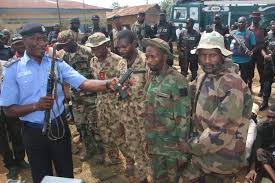
The State Commissioner of Police, CP Olugbenga Adepoju, disclosed this in Port Harcourt, recently during a press briefing at the Command Headquarters, where he said the arrests formed part of the operational achievements recorded by the Command between June and August 2026.
Adepoju said Atausi was arrested on August 10 by police operatives along Ada George, Port Harcourt, while dressed in military uniform and driving a Toyota Hilux painted in Army colours.
The Commissioner said investigation revealed that Atausi was not a member of the Armed Forces, adding that he was suspected to be a serial car snatcher, with three suspected stolen vehicles recovered from him.
He said the recovered vehicles included three Toyota Hilux vehicles without registration numbers and a Toyota Corona Premio with registration number BNY 380 ES, noting that the chassis and engine numbers of the vehicles had allegedly been tampered with.
Adepoju added that an axe and military accoutrements were also recovered from Atausi, as investigation continued into the circumstances surrounding the vehicles and other items recovered from him.
On the June 29 attack on police officers at Aluu Division, the Commissioner said three members of the gang allegedly responsible for the incident had been arrested by operatives of the Violent Crime Response Unit, VCRU-AKU.
The suspects, identified as Maduabuchi Emeka, 34, alleged gang leader; Doctor Chinedu Owhor, 42, and Kamachi Joe, 28, alleged armourer, reportedly led operatives to their hideout at Omagwa where two AK-47 rifles stolen during the attack were recovered.
Adepoju recalled that two police officers were killed during the Aluu attack, while others were wounded and one officer had his leg amputated, stressing that efforts were ongoing to apprehend the fourth suspect.
On kidnapping, the Commissioner said five members of a suspected kidnapping syndicate were arrested in Oyigbo Local Government Area, adding that they allegedly confessed to operations in Kom-Kom, Railway, Obeama and Afam communities.
He said two other suspects from the same network, Anele Ogbogu, 35, alleged to be the gang’s armourer, and Kenneth Eke, 38, were arrested on July 27, with one AK-47 rifle and one SMG rifle recovered.
The Commissioner further disclosed the arrest of suspects in connection with alleged firearm offences, armed robbery, cultism and one-chance robbery, with firearms, ammunition and other exhibits recovered during the operations.
Adepoju assured residents that the Command would sustain intelligence-led, proactive and community-oriented policing in collaboration with other security agencies, while urging members of the public to continue providing credible information that would assist the police in combating crime across Rivers State.
By; King Onunwor
-

 News3 days ago
RSG Targets Nine Million Residents in Mosquito Net Distribution Campaign
-

 Oil & Energy3 days ago
Aiyedatiwa Signs New Electricity Bill
-

 Maritime3 days ago
Marine Minister Commends President Tinubu On NPERA Bill Assent
-

 Oil & Energy3 days ago
NLNG Commissions Research And Innovation Centre In RSU
-

 News3 days ago
KenPoly Holds Eight Convocations, August 29
-

 News3 days ago
RSG Begins Another Phase of Projects Commissioning Today
-

 News3 days ago
RMAFC Completes Revenue Sharing Review, Proposes New Pay
-

 Maritime3 days ago
NAGAFF Petitions IGP Over Alleged Maritime Police Harassment