
Education
TETFUND Seeks Innovation To Fast-Track National Development

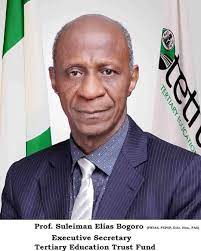
The Executive Secretary, Tertiary Education Trust Fund (TETFund), Prof. Suleiman Bogoro, says there is a need to nationalise innovation and technology to fast-track the much-needed national development.
Bogoro said this while speaking at the seventh School of Postgraduate Studies Annual lecture (2019/2020) of the University of Lagos (UNILAG) last Thursday.
According to him, the mileage attained by the most great economies today is tied to the huge investments on technology and innovations.
“We need to think and act fast in investing in our universities and other tertiary institutions toward that direction.
“If we should do things right, the frustrations that have hung over our institutions, especially the universities, will disappear.
“On our part, we shall continue to support research works and innovations in our tertiary institutions as this is what drives national development,” he said.
The executive secretary lamented that the traditional appropriation funding window for public universities in the country had failed the nation.
Bogoro noted that for universities to effectively carry out their mandate of teaching, research and community development, there must be enhanced funding.
“The dwindling revenue in the country has posed serious threat to these institutions and therefore, emphasises the need for us to do more in driving and supporting research and development.
“The out of the box innovative option of funding our public univers*ities as negotiated and secured by the Academic Staff Union of Universities, after four painful years of negotiation, is considered as the saving grace in the sustainability and improved ranking of our universities.
“Most of the interventions carried out so far on our tertiary institutions of higher learning as can be seen in universities, polytechnics and colleges of education have been carried out by the TETFund.
“Having said this too, I will say there is also the need to shore up the content components of these institutions from about 15 per cent to 33 per cent,” he said.
According to him, after the commitment of huge Tetfund intervention funds in improving basic physical infrastructure in these public universities and in consultation with relevant stakeholders, there can be a paradigm shift from physical structures to mainly content components.
He noted that areas such as research, academic staff training and development, library development and other areas could also be considered.
The TETFund boss who was the guest lecturer commended UNILAG for its research efforts, noting that it had rightfully earned its place as one of Africa’s best in that space.
”Universty of Lagos is the best performer on the National Research Fund grant. They have been very persistent and I want to say that the quality of leadership in this university has made all these possible.
“It takes a serious academic to believe in research and go ahead to win grants. We will continue to support focused leadership in universities, polytechnics and colleges of education,” Bogoro said.
Earlier in his address, the Vice Chancellor of UNILAG, Prof. Oluwatoyin Ogundipe, said the primary objective of the institution was to provide academic and research programmes.
Ogundipe noted that these programmes were geared toward meeting the high-level needs for knowledge, skills and capacity development in Nigeria and the world at large.
He said the school had since grown in leaps and bounds with more than 15,000 registered students on its various programmes for the session.
According to him, out of the figure, over 8,000 students are expected to graduate at the upcoming convocation ceremony in July.
“This is turning our institution into a postgraduate university in line with the expectation of the Federal Government first generation universities.
“No doubt, financing in Nigeria is a daunting task. It is a major factor for the recurring decimal of industrial actions and closure of our ivory towers. It has charged educational administrators to evolve strategies of generating additional funds.
“ Pursuit of qualitative education at the postgraduate level remains a financial burden that requires collective responsibility of all stakeholders. This is a pursuit that the TETFund has demonstrated.
“Permit me to remark that the TETFund has been of immense benefit to lecturers, researchers and graduate students at the University of Lagos.
“It has provided and maintained some facilities for us. A typical example is the University Scholars’ Suites, which has been very useful in accommodating visiting scholars to the university.
“This has aided our partnerships and our research and training efforts, with co-institutions in Nigeria and overseas among other benefits,” Ogundipe said.
He added that recently, TETFund signed a Memorandum of Understanding with the Forum for Agricultural Research in Africa (FARA) that would train 17 academic staff nominees from UNILAG outside the country.
“The University of Lagos was chosen as a virtual hub for the programme,” he said.
In his remark, Chairman of the occasion, Dr Ernest Ndukwe stressed the need for the private sector and education institutions to work together for mutual benefits.
“It is when the private sector practitioners recognise the importance and benefits of research that they finance research,” he said.
According to Ndukwe who is also the Chief Executive Officer, MTN Nigeria, innovation is directly related to the adequacy of its available trained manpower resources.
“This is why the government and public sector and other international fund agencies and some private organisations are traditionally funding education and research,” he added.
He, however, said there was a need for universities to be look for ways to expand on other funding opportunities for research due to dwindling resources of government in recent times
Earlier, the Dean of the School of Postgraduate Studies of the university, Prof. Alabi Soneye, said while higher education remained a paramount source of knowledge, qualitative research remained the veritable tool in the development and advancement of society.
According to him, the mirage of challenges bedevilling sustainable development may not cease in a hurry if inadequate funding continued to impede qualitative higher education and in-depth researches. (NAN)




-

 News2 days ago
RSG Targets Nine Million Residents in Mosquito Net Distribution Campaign
-

 Oil & Energy1 day ago
Aiyedatiwa Signs New Electricity Bill
-

 Maritime1 day ago
Marine Minister Commends President Tinubu On NPERA Bill Assent
-

 Oil & Energy1 day ago
NLNG Commissions Research And Innovation Centre In RSU
-

 News2 days ago
KenPoly Holds Eight Convocations, August 29
-

 News2 days ago
RMAFC Completes Revenue Sharing Review, Proposes New Pay
-

 News2 days ago
RSG Begins Another Phase of Projects Commissioning Today
-

 Maritime1 day ago
NAGAFF Petitions IGP Over Alleged Maritime Police Harassment