
Featured
Banditry Won’t End Since They’ve Politicised Security, Wike Fumes

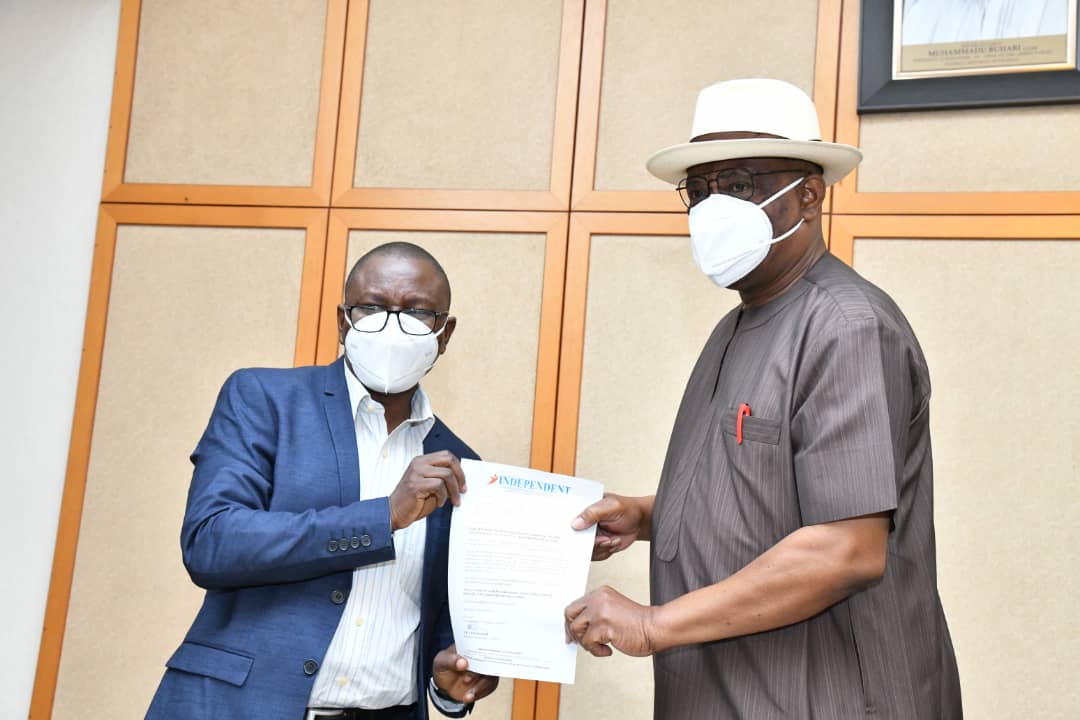
The Rivers State Governor, Chief Nyesom Wike, says, by politicising insecurity, the All Progressives Congress (APC) led Federal Government plunged the security-troubled states into an unimaginable scale of banditry that may not end soon.
The governor was speaking when he received the Board of Editors of Independent Newspapers Limited, led by the company’s Managing Director and Editor-in-chief, Steve Omanufeme, at Government House, Port Harcourt, yesterday.
Wike said that when Rivers experienced issues of insecurity in 2015, he ran to the Federal Government but rather than offering support, they dismissed it as politics out of hatred and desire to see the state remain ungovernable.
“They didn’t send Special Forces to Rivers as they’re sending to other states now. They refused to support me because they didn’t want the state to be governable.
“Crime knows no boundary. It can be you tomorrow. If they had brought out zeal to fight crime, with seriousness, and collaboration irrespective of the party you belong to, good result will be achieved.
He further added, “Banditry will never end since they’ve politicised the issue of security. I told them ‘don’t politicise issues of security’. They’re paying the price. Whatever you sow, you will reap. If you sow peace, you’ll reap peace, if you sow trouble, trouble will always be with you.”
The Rivers State governor said it was difficult to fight crime in situations when cultists are arrested, people go to Abuja to tell the Inspector General of Police (IGP) and the Chief of Army Staff that those arrested are their boys, just to secure their release and let them off the law.
Wike commented on the denials trailing the $1billion withdrawn from the Excess Crude Account, and said it was shameful that a government that was fighting corruption would condone such, allowing both the money and the weapons to go missing, unaccounted for.
“Now, the National Security Adviser says the $1billion they took from our Excess Crude Account without even paying us our 13 per cent derivation is gone. They said they’ve not seen the weapons.
“But this one the National Security Adviser is saying that they misquoted him. I tell you, nobody is misquoting anything. We are aware that there was no weapon.
“Even the Chief of Army Staff said he didn’t collect money. So, where did the money go to? This is a government fighting corruption and the Press is not talking.”
Speaking further, Wike berated the Nigerian Press for losing their strength of voice to speak truth to power with vehemence as they did during the administration of President Goodluck Jonathan.
“As regards this country, we are where we are because of you (journalists). In 2014, you were bought over to pull down the government of President Goodluck Jonathan.
“I had told the Trade Union Congress (TUC) the other day, and asked them: ‘where are you that you see things in Nigeria getting worse; insecurity, increase in price of everything, and you say nothing?’
“Now, you’ll not pull down Nigeria again because it is not a minority man that is in power. Where is the voice of the people? Where is the voice of the journalists? Have your mouth been sealed up, dumb and you can’t talk again?
“Is it because you’ve seen power greater than you? When Jonathan was in power, he respected fundamental human rights. He allowed freedom of speech.
“Nobody would be arrested but now, you can’t talk because of fear that you’ll be arrested. That’s the situation we find ourselves. So, when I see journalists these days, I just sigh. But you owe this country a lot.”
Wike said if Nigeria was truly a country, the former GOC of the 6 Division of the Nigeria Army in Port Harcourt would have been dismissed because of his political involvement during the 2019 general election.






The Rivers State Government says it has commenced the necessary processes for implementing the new wage structure for members of the Academic Staff Union of Polytechnics (ASUP), urging the union to suspend its ongoing industrial action and return to the classrooms.
The government gave the assurance during a meeting with the leadership of ASUP in Rivers State, led by the Secretary to the State Government (SSG), Dr Dagogo Wokoma, alongside the Commissioner for Education, Dr Peter Nwagor, and the Permanent Secretary of the Ministry of Education, Dr Mina Ikuru.
The meeting focused on issues surrounding the ongoing strike and the implementation of the new wage structure for academic staff in the state’s polytechnics.
At the meeting, the government reaffirmed its commitment to addressing the concerns raised by the union, disclosing that the necessary administrative and financial processes for implementing the new wage structure were already underway.
While acknowledging the grievances of the union, the government appealed to its leadership to reconsider its position and call off the strike in the interest of students, parents and the overall development of the state’s education sector.
It stressed that sustained engagement and constructive dialogue remained the most effective means of resolving outstanding issues, assuring ASUP that the government was committed to fulfilling its obligations and maintaining a harmonious working relationship with academic staff.
The SSG urged members of the union to resume academic activities while discussions and implementation processes continued to prevent further disruption to the academic calendar.
“The Rivers State Government urges ASUP members to return to the classrooms while discussions and necessary implementation processes continue, to prevent further disruption to the academic calendar,” Wokoma said.
He reaffirmed Governor Siminalayi Fubara’s commitment to workers’ welfare and the provision of a conducive environment for quality education across the state.
“Governor Siminalayi Fubara remains committed to the welfare of workers and the provision of a conducive environment for quality education across the state,” he added.
The ASUP delegation included Bariakwaadro Bere, Chairman of ASUP, Kenule Beeson Saro-Wiwa Polytechnic Bori Chapter; Destiny Obinna, Chairman of ASUP, Rivers State College of Health Science and Management; and Ezekiel Tamu-nodiepriye, Chairman of ASUP, Captain Elechi Amadi Polytechnic, Port Harcourt.
Governor of Rivers State, Sir Siminalayi Fubara, has expressed satisfaction with the level of work ongoing at the Ngo-Atlantic Oyorokoto Beach Road, beckoning on prospective investors to take advantage of the tourism potential in the project, located in Andoni Local Government Area of the state.
Governor Fubara, who inspected the project yesterday, assured that the access road to the beach will be asphalted before December and ahead of the next Tourists Beach Party.
Addressing journalists at the end of the inspection, Governor Fubara said he was on ground to see for himself the extent of work done, recalling that his administration had created the official road to the beach before the State of Emergency, after which the project witnessed some delays.
He said that since the end of the emergency rule the State Government has been meeting its own obligations to the contractors to ensure it fulfilled its promise to the people to transform the area into a tourist centre.
“We’ve been following up and meeting our own side of the obligation to ensure that one of the promises that we made to our people that day — that we want to make this place a tourist centre — comes to reality. And that is one of the main reasons we came here to see what is happening and the extent of the job that has been done,” he said.
According to Governor Fubara, the inspection tour was an opportunity to assess first-hand the progress made so far on the project.
On the beach side, the Governor said the work done was largely satisfactory, with only the asphalting of the road remaining. He gave assurance that it would be completed before December or before the next Tourists Beach Party.
He also disclosed that the other side of the road leading to the fishing ports had been inspected, with only a little culvert of about a hundred metres to the fishing centre left to be completed.
Governor Fubara said his assessment showed that the extent of work done was far better than what was previously on ground, urging investors to have no fear investing in Rivers State.

Chinese President, Xi Jinping, U.S. President, Donald Trump, and Russian President, Vladimir Putin, have made a historic commitment to strengthen global peace, reduce nuclear risks and promote strategic stability.
The world leaders made the commitment following their first-ever trilateral summit held in Shenzhen, China, yesterday.
The landmark meeting culminated in the adoption of a joint declaration, signalling renewed diplomatic engagement among three major global powers and permanent members of the United Nations Security Council.
The declaration outlined commitments to international security, United Nations reform, energy stability and dialogue on nuclear risk reduction.
Addressing the summit, Xi described the gathering as a groundbreaking diplomatic development, stressing that positive interaction among major powers was indispensable to international peace.
He recalled ?????????the historical cooperation among China, Russia and the United States during World War II, when they fought together against fascism.
“More than 80 years ago, China, Russia and the United States, the key anti-fascist forces in the world, fought shoulder to shoulder and achieved great victories, winning peace and tranquility for the world.
“History is the best textbook; we must remember history, and learn from it to shape the future,” the Chinese President said.
Xi warned that major-power rivalry could destabilise the international system, arguing that cooperation, rather than confrontation, was essential to humanity’s shared future.
He proposed four principles for managing relations among major powers: mutual respect, peaceful coexistence, win-win cooperation, and dialogue and consultation.
On mutual respect, Xi urged the three countries to respect sovereignty, territorial integrity, political systems, development choices and legitimate national interests.
He also called for greater sensitivity over contentious issues, warning against interference in domestic affairs and actions that challenge other countries’ red lines.
On peaceful coexistence, Xi maintained that the so-called Thucydides Trap was not inevitable, urging the three powers to reject confrontation and preserve international stability.
He particularly emphasised nuclear disarmament, declaring that nuclear war could never be won and must never be fought.
The joint declaration subsequently reaffirmed this principle, committing the three countries to dialogue on reducing nuclear risks and preventing nuclear proliferation.
The leaders also agreed to pursue reforms of the United Nations to strengthen its capacity to respond effectively to global challenges and advance international peace and security.
On economic cooperation, Xi advocated abandoning Cold War thinking, strengthening trade and combining the three countries’ respective advantages in resources, manufacturing and consumption.
He identified energy security as another important area for cooperation, proposing stronger coordination to maintain stable energy supplies and uninterrupted global industrial and supply chains.
The joint declaration reflected this priority, with the three countries planning to increase refined petroleum production and supply while reaffirming the importance of stable energy flows.
Another significant outcome was their common position on the authority and jurisdiction of international institutions, particularly the International Criminal Court.
The declaration stressed state consent and immunity for government officials, cautioning that the ICC and similar institutions must not abuse their jurisdiction.
On dialogue, Xi urged regular high-level engagements, open communication channels and crisis-prevention mechanisms to minimise misunderstandings and prevent disagreements from escalating.
He also called on the three countries to encourage parties involved in international conflicts to pursue negotiations and resolve disputes through political and diplomatic channels.
However, the declaration did not announce a specific agreement on ending the Russia-Ukraine war or the Iran conflict, despite their prominence in international security discussions.
Putin described the trilateral format as useful and substantive, while Xi characterised the discussions as positive, constructive and fruitful.
Trump also welcomed the opportunity, expressing optimism that cooperation among the three powers could help reduce nuclear weapons and prevent their use.
Although the summit produced no sweeping breakthrough on outstanding geopolitical disputes, its significance lies in establishing an unprecedented platform for direct engagement among three influential powers.
For the international community, the challenge now is translating the Shenzhen commitments into sustained diplomatic cooperation, practical nuclear-risk reduction and tangible progress towards global peace.
That although the historic summit offers an important diplomatic opening, its ultimate legacy will depend on Washington, Moscow and Beijing’s willingness to turn their declarations into action.
-
News2 days ago
Bayelsa Boat Mishap: Tinubu Donates N250m As Death Toll Hits 29
-
News2 days ago
Odu Pays Tribute To Late Chinwah, Describes Him As Courageous, Selfless Academic
-
 Maritime2 days ago
Nigeria, Russia Customs Sign MOU To Trade Facilitations
-

 Sports2 days ago
World marathon champion gets three-year doping ban
-
 Maritime2 days ago
South-South Governors Urges To Shake Off Collective Lethargic To Embrace Blue Economy
-
 Featured5 days ago
RSG Moves To Implement New Wage …Urges Polytechnic Lecturers to Call Off Strike
-
 Maritime2 days ago
Oyetola Woos Investors With Nigeria’s Seabed Resources, Marine Biotechnology
-

 Business2 days ago
Moniepoint MfB transaction volume hits 1trn daily — CEO